In chapter 10 of the story mode of Mortal Kombat X (NetherRealm Studios, 2015), Master Bo’ Rai Cho writhes in the courtyard of the Sky Temple under the magic of an amulet. Raiden rushes out and finds himself surrounded by his former champions, turned into undead revenants. Beside them stands Shinnok, who holds Johnny Cage prisoner. One of them, Liu Kang, asks whether they should kill the thunder god, and Shinnok smiles: not yet. He wants Raiden to watch him conquer his realm, and then to imprison him as Raiden once imprisoned him. Then he enters the Jinsei Chamber, home of Earthrealm’s life force, turns it red and addresses the ones who truly matter to him: the Elder Gods, whom he orders to tremble. Shinnok is a fallen Elder God, one of the gods who rule over the realms of the saga, who betrayed his peers to take Earthrealm for himself and was banished to the Netherrealm, Mortal Kombat’s hell, where he ended up as its ruler. He debuted as the final boss of Mortal Kombat Mythologies: Sub-Zero (1997), was the main villain of Mortal Kombat 4 (1997) and returned in Mortal Kombat X. This case file reveals how that game ends, along with the prologue of Mortal Kombat 11 (2019).
// The theoryWhat hurts is the comparison
In The American Soldier (1949), Samuel Stouffer and his team studied the morale of American troops in World War II and came across a paradox: soldiers in the branches with the most promotions were more dissatisfied with promotion than those in branches where hardly anyone was promoted. What mattered was not what each man had, but whom he compared himself with. They called it relative deprivation. Robert Merton turned it into the theory of reference groups, and W. G. Runciman formalized it in 1966: a person is relatively deprived of something when he does not have it, sees others who have it (and those others may include himself at another time), wants it and believes it feasible to have it. In Why Men Rebel (1970), Ted Robert Gurr carried it into political violence and described decremental deprivation: expectations hold steady while what one has collapses. Criminology uses it to explain why inequality weighs more than poverty: Judith and Peter Blau (1982) found that, in American cities, economic inequality predicted violent crime better than poverty did. None of them claims that comparison condemns anyone: most people who feel deprived never offend.
The grievance of one who had almost everything
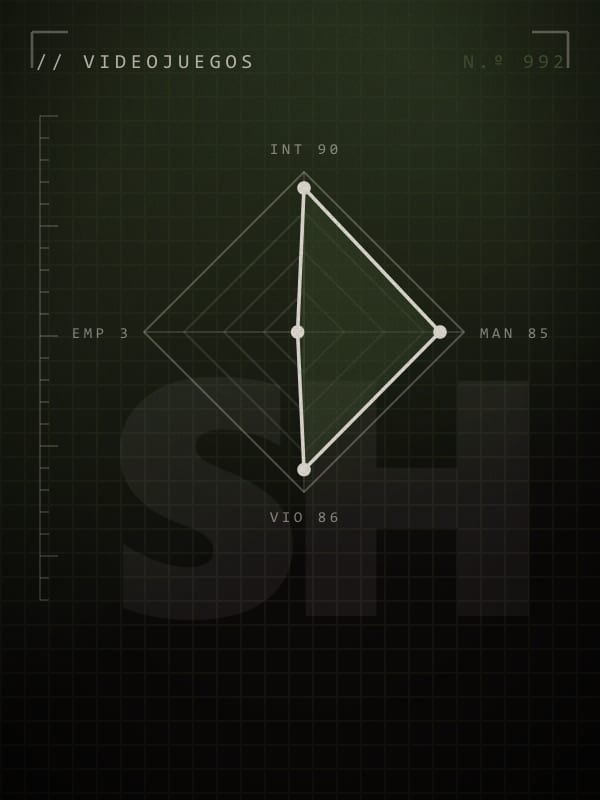
There is nothing absolute about Shinnok’s deprivation: he is a god, he rules an entire realm and he commands armies of demons. Even so, he meets all four of Runciman’s conditions. He does not have Earthrealm. He sees it in someone else’s hands, those of Raiden, its protector, and he measures himself against his former peers and against himself when he was one of them. He wants it from the very beginning. And the amulet makes it feasible: according to the saga, it is what opened Earthrealm’s door to him, and every time he gets it back, the war returns. His fall is Gurr’s decremental deprivation taken to the extreme: a god’s expectations, an exile’s position.
// The subjectThe exile who remade hell
In both of the saga’s timelines, comparison is the engine. The backstory of Mortal Kombat Mythologies: Sub-Zero (1997) presents him as an Elder God who wanted Earthrealm for himself, entered it by means of an amulet and clashed with Raiden, who took it from him and, with the help of the other gods, banished him to the Netherrealm. There, after defeating the realm’s lord with Quan Chi’s help, he found a wasteland with nothing to rule, and he remade it in an attempt to imitate the realm he wanted so badly. In Mortal Kombat 4 (1997), his biography sums it up: banished for crimes against his former fellow Elder Gods, he takes the realm of Edenia with the help of a traitor, wages war on the Elder Gods from there and waits for his chance at revenge on the god who banished him, Raiden. In chapter 1 of Mortal Kombat X, set in the second timeline, he invades Earthrealm to corrupt the Jinsei. Shinnok tells Raiden that his legacy is poisoning mortal hearts with hope, and Raiden reminds him that they stopped him once before, when he betrayed his fellow gods. He is about to trap Raiden in the amulet when Johnny Cage knocks him down from behind. “That is mine!” he shouts when Raiden spots the amulet lying on the floor. Cage beats him, and Raiden imprisons him in his own amulet.
(Spoiler warning.) Years later, in chapter 9, Quan Chi finishes freeing him just before Scorpion beheads the sorcerer. Shinnok corrupts the Jinsei and takes on a demonic form, and in chapter 12 he faces Cassie Cage, Johnny’s daughter, determined to exterminate his entire line. He loses to a Cage once again. Raiden purifies the Jinsei by absorbing the corruption, and in the final scene, darkened and wearing the amulet on his chest, he throws Shinnok’s severed, still-living head before Liu Kang and Kitana, the new rulers of the Netherrealm: an Elder God cannot die, but there are fates worse than death. The prologue of Mortal Kombat 11 shows how it came to this. As Raiden tortures him, Shinnok taunts him for wearing his amulet: at last Raiden embraces the truth the Elder Gods deny, the one Shinnok was cast out for. Raiden cuts off his head.
Shinnok
Get the map of theories for free
Subscribe to the criminal archive —one case a week, no spam— and I'll send you The map of theories: the great currents of criminology on a single sheet.
// The crackA grievance with an author
This reading has limits. Relative deprivation was developed to explain soldiers, workers and social groups who compare themselves with similar others and feel unfairly treated. Shinnok’s first betrayal, wanting Earthrealm while he was still one of the Elder Gods, is better explained by ambition than by a painful comparison. And his great loss, the exile, is not an inequality anyone imposed on him: it is the punishment for his own crime. He turns it into a grievance, and the theory explains the grievance, not the decision to corrupt a whole world. Mortal Kombat 11 opens another crack: Shinnok is the son of Kronika, the Keeper of Time, who created him to embody darkness against his sister Cetrion. If his role was written in advance, perhaps the comparison that consumes him was written too.
Explaining Shinnok is not excusing him. The theory sheds light on the story he tells himself: he is not a conqueror, but an outcast who was denied what he deserved. And the saga closes the circle with an irony: the Raiden who beheads him wears his amulet and also speaks like a man with a grievance. He asks what Earthrealm has gained from so much mercy and announces that he will no longer simply defend it. Comparison and resentment were never the exclusive trait of an evil god. They spread to anyone who spends too long staring at what has been taken from them.
Inequality is measured looking up
Relative deprivation explains why violence does not follow the map of poverty but the map of inequality: the Blaus in 1982 and, later, Richard Wilkinson and Kate Pickett in The Spirit Level (2009) found more violence in the most unequal societies than in the poorest ones. It also helps to understand a troubling profile: that of someone who has lost almost nothing in absolute terms but feels robbed of a place he believed was his. The sociologist Michael Kimmel called it aggrieved entitlement in 2013. Shinnok is its mythological version. Narrowing the gaps matters, but so does the story: who teaches someone to compare himself, with whom and by what supposed right.
Three key ideas
- Relative deprivation (Stouffer, 1949; Runciman, 1966; Gurr, 1970) holds that grievance comes from comparison with others or with what one once had, and criminology uses it to explain why inequality predicts violence better than poverty.
- Shinnok, the fallen Elder God of Mortal Kombat, betrayed his peers to seize Earthrealm and was banished by Raiden; he comes back for it in Mortal Kombat 4 (1997) and in Mortal Kombat X (2015), where he corrupts the Jinsei, loses to two Cages and ends up beheaded.
- The crack: his loss is the punishment for his own crime, and his ambition comes before the comparison; the theory explains his grievance without excusing it, and the saga shows that the same resentment can spread to the hero.
Sources · further reading
- Stouffer, S. A., Suchman, E. A., DeVinney, L. C., Star, S. A. and Williams, R. M. (1949). The American Soldier: Adjustment During Army Life (vol. 1). Princeton University Press.
- Runciman, W. G. (1966). Relative Deprivation and Social Justice. Routledge & Kegan Paul.
- Gurr, T. R. (1970). Why Men Rebel. Princeton University Press.
- Blau, J. R. and Blau, P. M. (1982). “The Cost of Inequality: Metropolitan Structure and Violent Crime.” American Sociological Review, 47(1), 114-129.
- Wilkinson, R. and Pickett, K. (2009). The Spirit Level: Why More Equal Societies Almost Always Do Better. Allen Lane.
- Kimmel, M. (2013). Angry White Men: American Masculinity at the End of an Era. Nation Books.
- Midway Games (1997). Mortal Kombat Mythologies: Sub-Zero. Midway Games.
- Midway Games (1997). Mortal Kombat 4. Midway Games.
- NetherRealm Studios (2015). Mortal Kombat X. Warner Bros. Interactive Entertainment.
- NetherRealm Studios (2019). Mortal Kombat 11. Warner Bros. Interactive Entertainment.
Case-file questionsFrequently asked questions
Who is Shinnok?
Shinnok (“El Dios Antiguo caído”) is a villain from Mortal Kombat, analysed on KRIMINIS through the lens of criminology. He was a god and ruled an entire realm.
Why does Shinnok (The fallen Elder God) become a villain?
Shinnok, the fallen Elder God of Mortal Kombat, and relative deprivation: he was a god, yet he measured himself against his peers and against Raiden. He lost heaven, remade hell and came back for Earth again and again.
Which criminological theory explains Shinnok?
Shinnok's case is analysed through Relative deprivation. Relative deprivation (Stouffer, 1949; Runciman, 1966; Gurr, 1970) holds that grievance does not come from what one lacks, but from comparing oneself with those who have more or with what one once had. Shinnok, the fallen Elder God of Mortal Kombat, takes it to the extreme: he betrayed his peers to seize Earthrealm, Raiden stripped him of his amulet and banished him to the Netherrealm, and from Mortal Kombat Mythologies: Sub-Zero and Mortal Kombat 4 (1997) to Mortal Kombat X (2015) he comes back again and again for the realm he was denied.


