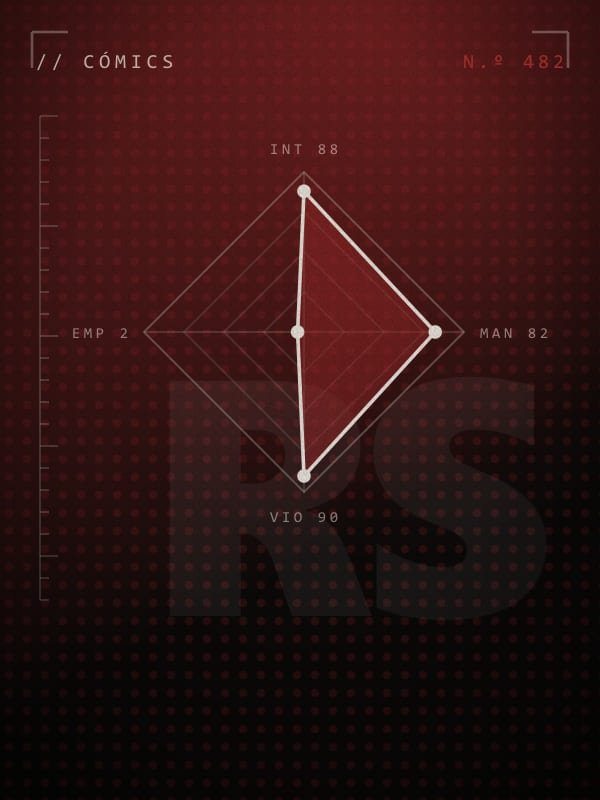
Gilgamesh, the King of Heroes of Fate/stay night, does not steal treasures: he claims them. His arsenal, the Gate of Babylon, contains the prototypes of every weapon and every riches in the world, and his logic is as simple as it is chilling —if something exists and has value, it is because it belongs to him first—. He does not fight out of ambition, like someone who covets what he lacks; he fights from a prior conviction: that the entire world was handed to him at birth and that others are nothing more than vermin to be tolerated as long as they know their place. For the criminal personality of Yochelson and Samenow, Gilgamesh is no psychiatric enigma: he is an illustrated manual of how someone who has made his own grandiosity the center of the universe thinks.
// The theoryA way of thinking, not an illness
In the mid-1970s, the psychiatrist Samuel Yochelson and the psychologist Stanton Samenow published The Criminal Personality after years of interviews with inmates of a forensic hospital in Washington. Their thesis broke with the dominant psychoanalysis: the chronic offender was not, they argued, a victim of his childhood nor a mentally ill person, but someone who had developed a distinct thinking style —a set of cognitive patterns they called "thinking errors"—. At the center of that style beats an inflated self-image: the person experiences himself as unique, special, superior, above the rules that bind everyone else. Yochelson and Samenow described the "power thrust", that permanent need to be on top, to control, to impose oneself; and its reverse, the "zero state", the unbearable void of feeling like nothing, from which one flees with a fresh stroke of power. The other, in that scheme, is not a person one lives alongside: he is a pawn, an instrument or an obstacle. Grandiosity admits no equals.
The sense of uniqueness and the "power thrust"
Yochelson and Samenow insisted that the most constant trait of the criminal personality is not cruelty, but grandiosity: the certainty of being an exception to which the world must yield. Gilgamesh carries it to its pure form. He does not believe himself a king among others: he believes himself the only true king, the first and the last, the yardstick by which everything else is measured. That uniqueness has direct consequences: if he is the standard, others are by definition inferior —"vermin", "mongrels"— and their worth depends solely on the king's usefulness or whim. The "power thrust" appears whenever someone dares to treat him as an equal: the response is not dialogue, but annihilation, because an equal is a threat to the entire edifice of his identity. When someone awakens in him something resembling interest —a rare exception—, he does not even experience it as affection: he experiences it as possession, as one more piece of his treasure he has yet to claim. This is how grandiosity works: it turns every bond into property and every difference into insolence.
Get the map of theories for free
Subscribe to the criminal archive —one case a week, no spam— and I'll send you The map of theories: the great currents of criminology on a single sheet.
// The subjectThe king who confuses existing with reigning
What makes Gilgamesh such a clear case is that his personality does not react to anything: it is a starting point. There is no founding humiliation that explains his contempt, nor a lack he is trying to fill; his grandiosity is the air he breathes. He gathers every treasure in the world not out of greed, but because for him gathering is merely acknowledging what was already his. That is, precisely, the logic of "ownership" that Yochelson and Samenow described: the chronic offender feels he has a right to whatever he desires by the mere fact of desiring it, and experiences any refusal as a theft. Gilgamesh asks no permission because on his mental map there is no authority above his own. He treats allies and enemies with the same underlying disdain —the former are tools, the latter are noise— and his "superoptimism", another of the thinking errors in the catalogue, leads him to take victory for granted even when the script says otherwise. He is brilliant, cultured, refined; none of that redeems him. Intelligence, in the criminal personality model, does not correct grandiosity: it equips it. A king who thinks this way need not be stupid to be dangerous; he needs exactly the opposite.
Gilgamesh
// The crackWhen the theory explains everything, it explains nothing
Here it is worth slowing down. The criminal personality is a theory as seductive as it is methodologically fragile, and applying it to Gilgamesh forces us to say so. Yochelson and Samenow built their catalogue —the famous "thinking errors"— from a very particular sample: inmates of a forensic psychiatric hospital, evaluated within the framework of an insanity defense, with no control group of non-offenders to compare against. Without that contrast, it is impossible to know how many of those "criminal traits" are in fact common human traits that also abound in those who never offend. The list, moreover, is so extensive and elastic that it runs the risk of over-explaining: if grandiosity gives the criminal away but so does insecurity, if optimism gives him away but so does pessimism, then the theory can no longer fail —and a theory that cannot fail also cannot be proven—. With Gilgamesh the danger soars, because he is a character designed to embody arrogance: finding "criminal personality" in him is almost a tautology. The tool elegantly describes what we already knew, but it does not predict it nor explain it from the outside.
And there is a second crack, more important. The criminal personality, in its eagerness to reject the excuses of the environment, can slide toward the opposite extreme: reducing the person to a fixed type of defective mind, a label that marks them for life and that ignores the real weight of poverty, opportunity or learning. Against that, the honest reading holds the tension without falsely resolving it. Explaining how Gilgamesh thinks —how his grandiosity turns others into subjects or into obstacles— does not excuse him of anything. Explaining is not excusing. Understanding the "power thrust" that drives a tyrant does not lessen the harm done to a single trampled subject; it only gives us the vocabulary to recognize that way of thinking before the next king convinces us that the world was his from the very beginning.
Recognizing grandiosity before kneeling
Gilgamesh matters because his mental pattern does not live only in myth. Grandiosity, the sense of uniqueness, the contempt for the other as inferior and the need to always be on top are traits that Yochelson and Samenow placed at the core of crime, but which, as later research on the Dark Triad warned, abound outside prisons too —in offices, thrones and pulpits—. The practical lesson is not to diagnose fictional villains, but to learn to name the signal: the person who treats every bond as possession and every disagreement as insolence is not asking for loyalty, they are demanding submission. A healthy community is not measured by how it topples the king once he already believes himself master of the world, but by whether it knew how to recognize grandiosity before kneeling to it —when it was still "only" arrogance—. Seeing how the king thinks is the only way not to end up as one of his vermin.
Three key ideas
- Gilgamesh, the King of Heroes of Fate/stay night, embodies the criminal personality of Yochelson and Samenow: a way of thinking —not an illness— marked by absolute grandiosity, the sense of uniqueness and contempt for the other as inferior.
- The "power thrust" —the permanent need to be on top and in control— and the logic of possession explain his conduct: he claims the world as his by right and treats others as subjects or obstacles, never as equals.
- The crack: it is a clinical framework without a control group that tends to over-explain everything and to label for life. Understanding how a tyrant thinks does not excuse him. Explaining is not excusing; memory is for his victims.
Sources · further reading
- Yochelson, S. & Samenow, S. E. (1976). The Criminal Personality, Vol. I: A Profile for Change. Jason Aronson.
- Samenow, S. E. (1984). Inside the Criminal Mind. Times Books.
- Walters, G. D. (1990). The Criminal Lifestyle: Patterns of Serious Criminal Conduct. Sage.
- Paulhus, D. L. & Williams, K. M. (2002). "The Dark Triad of Personality". Journal of Research in Personality, 36(6).
Case-file questionsFrequently asked questions
¿Quién es Gilgamesh?
Gilgamesh («El Rey de los Héroes») es un villano de Fate/stay night, analizado en KRIMINIS con la lente de la criminología. He hoards every treasure in the world because, in his view, they have belonged to him from the start.
¿Por qué Gilgamesh (El Rey de los Héroes) se convierte en villano?
Gilgamesh, the King of Heroes of Fate/stay night, and the criminal personality of Yochelson and Samenow: absolute grandiosity, the sense of uniqueness and the "power thrust" that turns others into subjects or into obstacles.
¿Qué teoría criminológica explica a Gilgamesh?
El caso de Gilgamesh se analiza desde la Personalidad criminal. The criminal personality of Samuel Yochelson and Stanton Samenow describes a way of thinking —not an illness— marked by grandiosity, a sense of uniqueness, contempt for others and a constant pursuit of power ("power thrust"). Gilgamesh, the King of Heroes of Fate/stay night, embodies that pattern taken to myth: he believes himself the only true king, considers everything that exists to be his and treats humanity as a mass of inferiors. His figure illuminates the theory and at the same time exposes its cracks: a clinical framework without a control group that runs the risk of over-explaining everything.