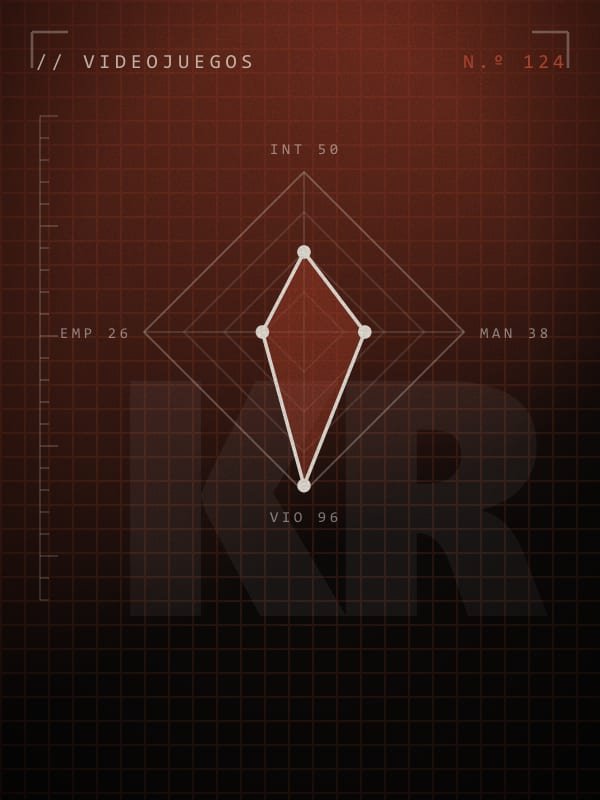
In chapter 3 of the story mode of Mortal Kombat (NetherRealm Studios, 2011), Scorpion drags Sub-Zero down to the Netherrealm, the realm where he himself was resurrected, and defeats him. He could kill him, but he does not: Raiden has promised that if he spares the Lin Kuei ninja, he will ask the Elder Gods to return the Shirai Ryu, Scorpion’s exterminated clan, to the realm of the living. Then Quan Chi appears. He asks whether this is Scorpion’s retribution and orders him to kill Sub-Zero. Scorpion refuses: the man has been beaten. “Have you forgotten?” the sorcerer presses, and shows him a vision of the Lin Kuei slaughtering the Shirai Ryu and of Sub-Zero killing his wife and child. That is not me, Sub-Zero cries out. Scorpion tears off his mask and kills him. Quan Chi is the necromancer of the Netherrealm, a sorcerer who raises dead warriors to keep them in his service, and what he has just done is his specialty: he does not kill with his own hands, he aims someone else’s rage. This case file follows the saga’s second timeline, the 2011 reboot and its sequel, Mortal Kombat X (2015), and reveals how both stories end.
// The theoryRage needs a culprit
In 1992, Robert Agnew published his general strain theory in the journal Criminology. He started from Robert Merton’s strain theory (1938), the gap between the goals a culture promises and the legitimate means to reach them, and opened it up to any negative relationship: failing to achieve what one values, losing something valued, or suffering something harmful. These strains produce negative emotions, above all anger, and anger creates pressure for corrective action that is sometimes a crime. Agnew argued that anger arises above all when people blame their adversity on someone else, a feature that, according to Hoffmann and Spence (2010), later research has largely neglected. In 2001 he specified which strains matter most: those seen as unjust, those high in magnitude, those associated with low social control, and those that create pressure or an incentive to respond with crime. And he never claimed that pain condemns anyone: most people who suffer do not offend, because they have support, resources and legitimate outlets that soften the blow.
The manager of strain
Agnew’s theory looks at the person who suffers. Quan Chi lets us read it from the other side, that of the person who manages someone else’s suffering. His method has three parts. First he causes the loss: by his own admission, he is the one who exterminated the Shirai Ryu. Then he steers the blame: he lets Scorpion’s rage point at the Lin Kuei and at Sub-Zero, and he feeds it. Finally he reopens the wound at the moment the victim finds another way out: the vision comes just as Scorpion has accepted Raiden’s deal. A loss that is unjust, enormous and comes with a culprit close at hand meets several of the conditions Agnew links to crime. Quan Chi does not wait for them to occur: he manufactures them.
// The subjectThe necromancer who gets paid in souls
Quan Chi always presents himself as a servant, and the 2011 game shows him collecting his fee in three moments. In chapter 3, Shang Tsung announces Scorpion as the specter resurrected by the sorcerer, and Scorpion demands to face Sub-Zero because he killed his family and clan. Nightwolf warns him that his aggression is misplaced, and Raiden offers him another way to find peace. At the end of chapter 11, when Shao Kahn can no longer merge the realms through the tournament, Quan Chi proposes an invasion of Earthrealm and offers to resurrect Queen Sindel, whose sacrifice protects that realm: he will return her, he promises, much more cooperative. In chapter 16, Raiden goes down to the Netherrealm and offers him the souls of the fallen warriors, even his own, in exchange for help. Quan Chi mocks him for being so generous with other men’s souls and shows him that they are already his: Shao Kahn’s payment for the Netherrealm’s allegiance. In the epilogue he congratulates his true master, the fallen Elder God Shinnok, because the plan has worked to perfection, and Shinnok sums up the move: Shao Kahn was blinded by rage.
(Spoiler warning.) In chapter 9 of Mortal Kombat X, a flashback to five years earlier takes Hanzo Hasashi, by then restored to human life and leading a new Shirai Ryu, to the Lin Kuei temple. Kuai Liang, the new Sub-Zero and the brother of the man Scorpion killed, shows him the recorded memory of the cyborg Sektor. In it, Quan Chi demands his payment: the Lin Kuei Grandmaster gave Shinnok his word, and he has exterminated the Shirai Ryu as promised. As for Scorpion, he adds, he created him from Hasashi’s soul after he died. Back in the present, Hanzo and his ninjas have already stormed the camp where Special Forces are holding the sorcerer, and he shouts the charges at him: he killed his wife and his son, got inside his head, misdirected his vengeance and cost him his one chance to have them restored. He beheads him. But D’Vorah has arrived with Shinnok’s amulet, and Quan Chi finishes the spell that frees his master an instant before he dies. He had let himself be captured on purpose.
Quan Chi
Get the map of theories for free
Subscribe to the criminal archive —one case a week, no spam— and I'll send you The map of theories: the great currents of criminology on a single sheet.
// The crackA strain with a scriptwriter
This reading has an obvious limit: general strain theory explains Scorpion, not Quan Chi. The sorcerer does not act out of anger or out of a loss of his own. He calculates, uses souls as currency and obeys a master, which brings him closer to the rational choice theory this archive uses to read his partner Shang Tsung. Fiction also simplifies. In real life, strain builds up through many channels and rarely has a single author dosing it out from the shadows. And Scorpion’s wound was not entirely invented: Sektor’s memory proves that the Lin Kuei bargained for the extermination, and Kuai Liang himself admits his clan’s complicity. Quan Chi did not conjure the culprit out of nothing. He cropped the picture, and pointed at the wrong man.
Explaining Scorpion is not excusing him, and explaining Quan Chi’s method does not make what he did any smaller. Scorpion had other ways out on the table, the peace Nightwolf proposed and Raiden’s deal, and he chose to kill a beaten man. Agnew does not deny that choice: he describes why anger makes it more likely, by pushing toward revenge and lowering inhibitions. The saga adds a final irony. When Hanzo at last turns his vengeance on the real culprit, that vengeance also serves the sorcerer’s plan. Rage, even when well aimed, was still a tool in someone else’s hands.
Rage as someone else’s resource
General strain theory does not stop at the individual. In 2010, Agnew applied it to terrorism: severe collective strains, seen as unjust and imposed by more powerful others, raise the likelihood of that violence, although they do not always cause it. In that field, the grievance is often real. What changes is who names it, how much they inflate it and whom they point at. That is why the question Quan Chi leaves behind is a practical one: whom does a person blame for their pain, and who helped them choose? Working on that attribution, and offering legitimate outlets before someone arrives to hand out culprits, is also prevention.
Three key ideas
- General strain theory (Agnew, 1992 and 2001) explains crime as a response to losses, failures or harms that produce anger, above all when they are seen as unjust, are severe and the victim blames someone else.
- Quan Chi, the necromancer of Mortal Kombat (2011) and Mortal Kombat X (2015), exterminates the Shirai Ryu under a pact with the Lin Kuei, lets Scorpion blame Sub-Zero and reopens the wound so that he kills him; years later Scorpion beheads him, but the sorcerer frees Shinnok before he dies.
- The crack: the theory explains Scorpion, not the calculating man who steers him, and the wound was not entirely false, because the Lin Kuei were complicit; explaining Scorpion’s anger does not excuse him for killing a beaten man.
Sources · further reading
- Agnew, R. (1992). “Foundation for a General Strain Theory of Crime and Delinquency.” Criminology, 30(1), 47-87.
- Agnew, R. (2001). “Building on the Foundation of General Strain Theory: Specifying the Types of Strain Most Likely to Lead to Crime and Delinquency.” Journal of Research in Crime and Delinquency, 38(4), 319-361.
- Agnew, R. (2006). Pressured into Crime: An Overview of General Strain Theory. Roxbury.
- Agnew, R. (2010). “A General Strain Theory of Terrorism.” Theoretical Criminology, 14(2), 131-153.
- Hoffmann, J. P. and Spence, K. R. (2010). “Who’s to Blame? Elaborating the Role of Attributions in General Strain Theory.” Western Criminology Review, 11(3), 1-12.
- NetherRealm Studios (2011). Mortal Kombat. Warner Bros. Interactive Entertainment.
- NetherRealm Studios (2015). Mortal Kombat X. Warner Bros. Interactive Entertainment.
Case-file questionsFrequently asked questions
Who is Quan Chi?
Quan Chi (“El nigromante del Netherrealm”) is a villain from Mortal Kombat, analysed on KRIMINIS through the lens of criminology. He does not need to kill Sub-Zero.
Why does Quan Chi (The Netherrealm necromancer) become a villain?
Quan Chi, the necromancer of Mortal Kombat, and Agnew’s general strain theory: he wiped out Scorpion’s clan, pointed him at another culprit and reopened the wound just as he was about to show mercy. Anger as someone else’s tool.
Which criminological theory explains Quan Chi?
Quan Chi's case is analysed through General strain. General strain theory (Agnew, 1992) explains crime as a response to a loss, a failure or a harm that produces anger, above all when the victim blames someone else. Quan Chi, the Netherrealm necromancer of Mortal Kombat (2011) and Mortal Kombat X (2015), works it from the other side: he exterminates the Shirai Ryu, lets Scorpion blame the Lin Kuei and reopens the wound so that he kills Sub-Zero. Years later Scorpion learns the truth, and even his revenge ends up serving the sorcerer’s plan.