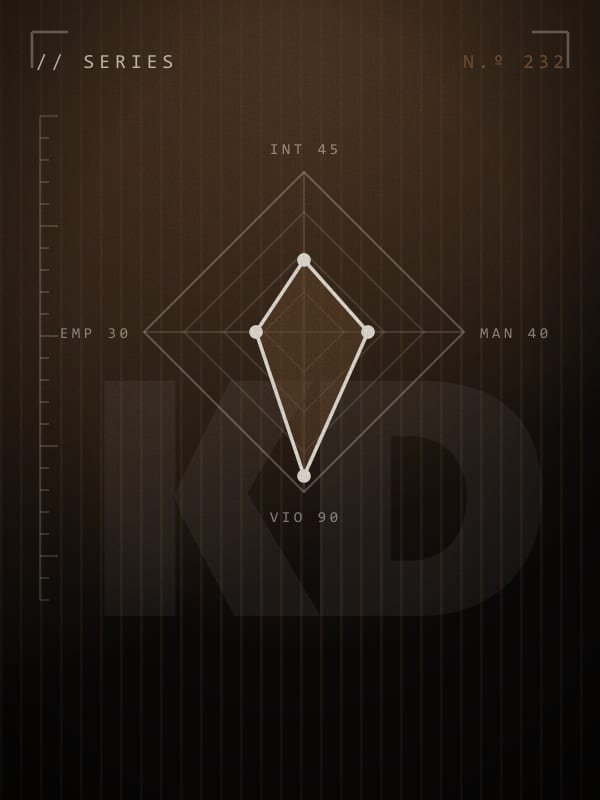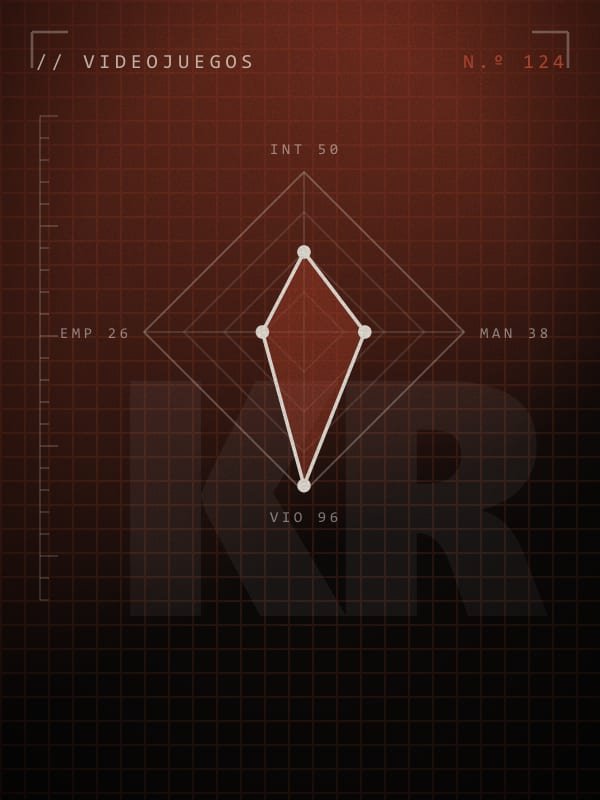
Kratos was tricked by the god Ares into killing, with his own hands, his wife and daughter. From that unbearable pain was born a fury that led him to murder gods and titans, one after another, in a spiral of vengeance that laid waste to the world. It is general strain theory in its most colossal form: absolute loss turned into boundless rage. But his story has a second part, the most valuable one—that of the warrior who, now a father again, must learn to control the monster he carries inside.
// The theoryLoss as the engine of rage
Among the sources of strain that Agnew identifies, the loss of positive stimuli—losing someone or something of value—is one of the most powerful generators of the rage that can spill over into violence. Kratos suffers the most extreme form of that loss imaginable: he not only loses his family, but is manipulated into destroying it himself, adding a devastating guilt to the loss. GST predicts that strain of that magnitude, with no coping possible, produces a proportional rage—and Kratos's is literally divine, capable of bringing down all of Olympus. His crusade of vengeance is not a cold plan: it is pain turned into a weapon, the strain seeking, against the one who caused it, the only release it knows.
The early God of War games are the portrait of that ungoverned rage: Kratos kills without restraint, betrays, devastates, and not even vengeance fulfilled brings him peace—because rage, once unleashed, is not sated by killing; it feeds on it. It is the trap Agnew describes: violence as failed coping, which relieves for an instant and worsens the problem, because it leaves the subject more alone, more guilty and more furious than before. Kratos defeats the gods and remains empty, because the real enemy—his own pain—is not on Olympus, but within. No amount of vengeance can kill what torments him.
Coping: to erupt or to govern
Here is the richest contribution Kratos makes to the theory: Agnew insists that strain does not inevitably lead to crime—it all depends on coping. Faced with the same pain, a person may erupt into violence or find ways to govern their rage: support, meaning, self-control, a reason to hold back. The young Kratos represents destructive coping; the mature Kratos of God of War (2018), the constructive kind. A father once more, with a son to raise, he can no longer afford to be only fury: he has to learn—painfully, never fully succeeding—to contain the monster, to not pass on his rage, to choose patience over the outburst. "Don't be like me," he tells his son; and that line is pure strain theory: the recognition that rage can be tamed, and that doing so is the work of a lifetime.
// The subjectThe monster who chose not to be one
What makes Kratos one of the most remarkable arcs in video games is that his redemption does not erase his rage: it manages it. The mature Kratos is still a volcano—the fury is still there, always on the verge—but he has decided not to let it govern him, for his son's sake. That constant struggle, never fully won, is far truer than a magical "healing": it reflects how coping with anger really works—not as a disappearance of the pain, but as the daily effort not to discharge it onto others. Kratos carries forever what he did (he wears the ashes of his family fused into his skin), and it is precisely that indelible wound that drives him not to create another. His greatness is not having stopped feeling rage, but having learned to set a limit to it. It is proof, in epic form, that the cycle of strain and violence can be broken—not by denying the pain, but by refusing to pass it on to the next.
Kratos
Get the map of theories for free
Subscribe to the criminal archive —one case a week, no spam— and I'll send you The map of theories: the great currents of criminology on a single sheet.
// The flawRedemption or power fantasy?
A caveat is in order: Kratos's "redemption" is, in part, a fantasy of the fiction. His mature arc is moving, but it comes after he has literally murdered an entire pantheon—a past that no "I'm a better father now" repairs for his countless victims—. GST warns against the temptation of letting later coping cancel out the prior harm: governing your own rage today does not settle the accounts of the one who unleashed it yesterday. Moreover, the saga keeps selling violence as spectacle even while it preaches self-control, a contradiction best not ignored. The honest reading takes from Kratos what is valuable—that rage can be governed and the cycle broken—without buying the idea that past brutality is washed clean by good present fatherhood. Taming the monster is admirable; it does not absolve what the monster already did.
Teaching people to govern rage
Kratos leaves the most hopeful lesson of strain theory: rage, even the most justified and colossal, can be governed—and learning to do so is prevention in its purest form. If violence is born of pain without healthy coping, then teaching people to cope—to regulate anger, to work through loss, to find meaning, to have someone for whose sake to hold back—breaks the chain. And there is one element Kratos underscores: transmission. His determination that his son not inherit his fury is what research calls cutting the intergenerational cycle of violence. Agnew's theory does not promise the pain will disappear; it promises it is not obligated to turn into harm. Kratos, the god of war who chose to be a father, is the mythological version of that truth: you can carry a volcano inside and decide, every day, not to let it lay waste.
Three key takeaways
- The general strain theory (Agnew): the loss of what we value is one of the greatest sources of rage. Kratos, tricked into killing his family, turns it into a boundless divine vengeance—which brings him no peace, because the real enemy is his own pain.
- Its great contribution is coping: strain does not inevitably lead to violence. The mature Kratos, now a father, learns to govern his rage instead of being governed by it—he does not erase it, he contains it ("don't be like me").
- The flaw: redemption does not cancel out past harm (he murdered an entire pantheon) and should not be bought as an alibi. But his lesson holds: rage can be tamed and the cycle broken—by refusing to pass it on to the next.
Sources · further reading
- Agnew, R. (1992). “Foundation for a General Strain Theory of Crime and Delinquency”. Criminology, 30(1).
- Agnew, R. (2006). Pressured into Crime: An Overview of General Strain Theory. Oxford University Press.
- Novaco, R. W. (1975). Anger Control: The Development and Evaluation of an Experimental Treatment. Lexington Books.
- Widom, C. S. (1989). “The Cycle of Violence”. Science, 244(4901).
Case-file questionsFrequently asked questions
Who is Kratos?
Kratos (“el Fantasma de Esparta”) is a villain from God of War, analysed on KRIMINIS through the lens of criminology. Kratos was tricked by the god Ares into killing, with his own hands, his wife and daughter.
Why does Kratos become a villain?
God of War and general strain: Kratos killed half of Greek mythology in a fury of vengeance born of the worst of losses—tricked into murdering his own family. And, decades later, he carries the hardest arc of all: learning to govern that rage for the sake of his son. The strain that erupts, and the strain that is tamed.
Which criminological theory explains Kratos?
Kratos's case is analysed through General strain. Agnew's general strain theory places the loss of what we value among the greatest sources of the rage that pushes toward violence. Kratos, of God of War, is its epic expression: tricked into killing his own family, he channels an immeasurable pain into a ramp of vengeance against the gods. But his modern arc supplies the other half of the theory (the more hopeful one): coping. A father once more, Kratos must learn to govern his rage instead of being governed by it. He embodies at once the strain that erupts and the strain that, with enormous effort, is tamed.