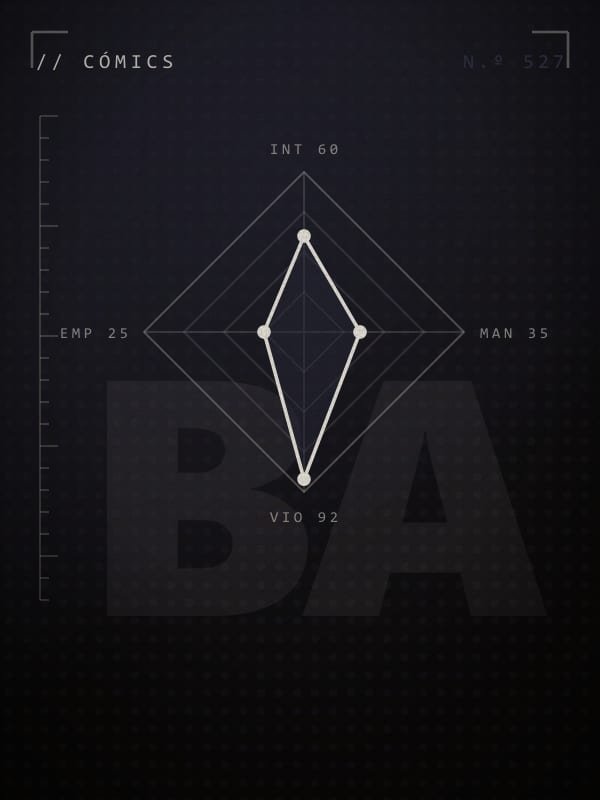
The first time we see Trevor Philips, he beats a man to death over an insult and, a minute later, he's perfectly calm. No plan, no calculation, no waiting: there's impulse. Meth, outbursts, risk for the sake of risk. GTA V lets you climb into his skin, and that's where it gets disturbing. Because most real crime doesn't look like a criminal mastermind: it looks like Trevor. And criminology has a theory that explains him almost entirely with a single word.
// The theoryIt's almost all self-control
In 1990, Michael Gottfredson and Travis Hirschi proposed a general theory of crime as ambitious as it was controversial: almost all crime is explained by low self-control. Whoever has it low is impulsive, sensation-seeking, prefers the physical to the verbal, can't stand waiting and blows up at the slightest thing. Faced with an opportunity, they offend; not because they plan it, but because they don't know how not to.
The key piece is when it forms: in childhood, according to them, through parenting, and it's all but fixed by around age eight. And it goes beyond crime: the same trait predicts addictions, accidents, jobs that don't last and relationships that fall apart. It's not a theory about criminals: it's a theory about brakes.
Neuroscience gave that "brake" a foundation. What Gottfredson and Hirschi called self-control overlaps with the executive function of the prefrontal cortex —the ability to inhibit impulse, foresee consequences and delay reward—, which matures slowly and well into one's twenties. That's why adolescence is so prone to risk, and why damaged development leaves such a long mark. Trevor's brake isn't loose out of vice: maybe it never finished installing.
Crime and its cousins
The most provocative idea from Gottfredson and Hirschi is analogous acts: low self-control produces not just crimes, but a whole way of life. Drugs, fights, gambling, reckless driving, work and relationship chaos. Look at Trevor's life and you'll see the full list. For the theory, his delinquency isn't a separate chapter: it's the same loose screw poking out of everything he touches.
Get the map of theories for free
Subscribe to the criminal archive —one case a week, no spam— and I'll send you The map of theories: the great currents of criminology on a single sheet.
// The subjectPure impulse
Trevor is the traits of low self-control made character: he acts before thinking, chases the high, defers nothing and responds to any friction with disproportionate violence. The contrast with Dexter is revealing: Dexter is high self-control —he plans, waits, restrains himself— and yet he kills; Trevor is low self-control and, curiously, keeps flashes of loyalty. Same theory, opposite poles. And a lesson that unsettles: self-control isn't the same as morality. You can be master of yourself and be a monster, and you can be a brakeless disaster and still have a code.
The psychologist Terrie Moffitt refined that portrait with a distinction that fits Trevor like a glove. Most of those who offend do so only as adolescents and quit as they mature —they're adolescence-limited offenders—; a minority, on the other hand, carry the pattern from early childhood into old age: the life-course-persistent. These latter usually combine early neurocognitive deficits —of attention, of executive function, of impulse control— with environments that, instead of correcting them, amplify them. Trevor is the archetype of the second group: not a rebel of one phase, but a loose screw for life.
Trevor Philips
// The crackA single screw for the whole machine
Does all crime really fit into one variable? That's where the theory falters. First, it verges on tautology: if we deduce "low self-control" from the very crime it claims to explain, the argument bites its own tail. Second, it leaves out the structural: poverty, opportunity, the neighborhood —everything other theories in the archive do see—.
And there's a third flank. Gottfredson and Hirschi hold that self-control is fixed in childhood, but Robert Sampson and John Laub proved the opposite: people change. A stable job, a partner, military service… can redirect a life well into adulthood. Trevor, so cartoonish, is precisely the theory's blind spot: real offenders are more than a brake that was missing.
Prevention starts in the cradle
If self-control is forged early, the most cost-effective prevention is early: parenting support, quality early childhood education, programs for vulnerable families. Preschool intervention studies show less delinquency decades later. Translated: you prevent more crime by investing in the first years than by building the last cell.
That's why Trevor is fun in a video game and would be a catastrophe in real life: he's the impulse we all feel and almost all of us learned to hold back. The theory's uncomfortable suggestion is that the line separating us from him was drawn before we could remember it —in whether someone taught us, as children, to wait.
Three key takeaways
- The general theory of crime reduces almost all crime to one variable: low self-control (impulsivity, risk, inability to wait), formed in childhood.
- It explains not just crimes but "analogous acts" —drugs, accidents, life chaos—: Trevor's entire life is its list of symptoms.
- Its limits: it verges on tautology, ignores the structural, and people do change as adults (Sampson and Laub). The most effective prevention is early: parenting and early childhood education.
Sources · further reading
- Gottfredson, M. R. & Hirschi, T. (1990). A General Theory of Crime. Stanford University Press.
- Pratt, T. C. & Cullen, F. T. (2000). «The Empirical Status of Gottfredson and Hirschi’s General Theory of Crime: A Meta-Analysis». Criminology, 38(3).
- Sampson, R. J. & Laub, J. H. (1993). Crime in the Making: Pathways and Turning Points through Life. Harvard University Press.
- Moffitt, T. E. (1993). «Adolescence-Limited and Life-Course-Persistent Antisocial Behavior: A Developmental Taxonomy». Psychological Review, 100(4).
Case-file questionsFrequently asked questions
¿Quién es Trevor Philips?
Trevor Philips («Trevor») es un villano de GTA V, analizado en KRIMINIS con la lente de la criminología. If most people don't offend because they know how to check the impulse, what happens when that brake was never installed?
¿Por qué Trevor Philips se convierte en villano?
GTA V and self-control theory: if most people don't offend because they know how to check the impulse, Trevor Philips is what happens when that brake was never installed.
¿Qué teoría criminológica explica a Trevor Philips?
El caso de Trevor Philips se analiza desde la Control social. Gottfredson and Hirschi's general theory of crime reduces almost everything to one variable: self-control. Whoever didn't learn as a child to check the impulse and wait for the reward tends, all their life, toward violence, risk and crime. Trevor Philips is that profile with no filter.