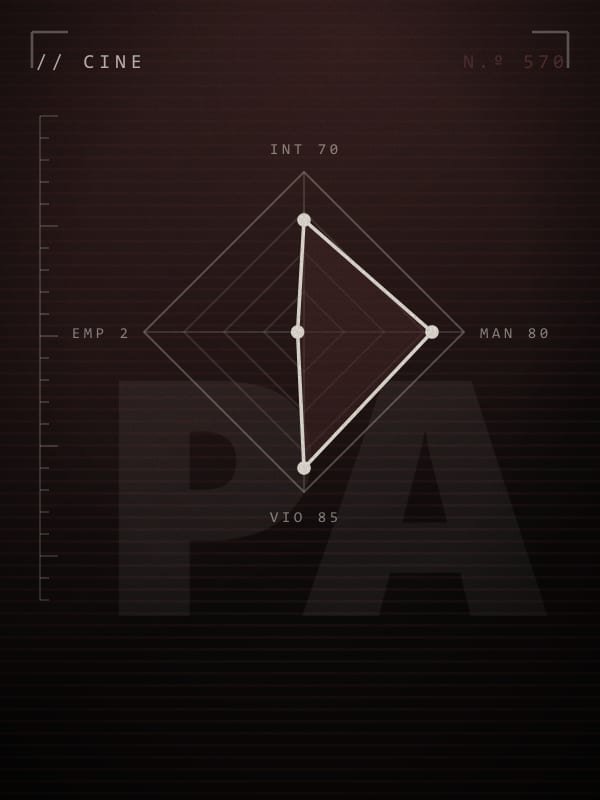
Let's start with the honest part: Valak, the nun-shaped demon of The Conjuring 2 and its own The Nun saga, has no criminal psyche to profile. There is no broken childhood, no trauma to reconstruct, no cost-benefit calculation, no chain of decisions to audit. It is a demon: pure otherness, evil with no biography. Any attempt to «understand her mind» would collide with the fact that there is no mind, only design. And that is precisely what is criminologically interesting. The useful question is not what is wrong with Valak, but what is wrong with us when we buy a ticket for the scare. For that there is a theory made to measure: cultural criminology, which does not look at crime from the outside —poverty, strain— but from inside the moment, and which knows how to read terror for what it is here: a cultural product that is manufactured, packaged and consumed.
// The theoryFear as merchandise: the terror industry
Cultural criminology was born in the nineties at the hands of Jeff Ferrell, Keith Hayward and Jock Young, on the foundation that Jack Katz had laid in Seductions of Crime (1988): against the «background» of social causes, he championed the foreground, the lived experience of the act —what it feels like—. Its sharpest tool for a case like this is the media loop: the idea that the representation of crime and of evil does not reflect it but shapes it, until the crime and its image feed back on each other and become spectacle. Valak is that loop made flesh —or made latex and postproduction—. It is not a demon that existed and was then filmed: it is a demon manufactured to be filmed. The name Valak comes from a real grimoire, the Ars Goetia, where it appears as a spirit in the shape of a child, not a nun. The nun is a script invention, an icon deliberately designed —the habit that should mean comfort turned into a threat, the pale face calculated for the scare—. Terror here is merchandise of the fear industry: what frightens is studied, the jump scare is optimized, the experience is sold. What we consume is not a supernatural being; it is an intense emotion, bottled.
The monster as a mirror of our anxieties
Cultural criminology insists that the figures of evil an era chooses are not neutral: they are a symptom. Every society manufactures the villain it needs to give a face to what it fears. That the fashionable demon takes the form of a nun —the religious institution turned against itself, the sacred profaned— says more about our contemporary anxieties toward faith, authority and guilt than about any theology. Valak works because it touches a precise cultural nerve: the fear that whatever was meant to protect us may conceal something monstrous. That is why the same icon would not have worked a century ago, nor will it work the same a century from now. The monster is a mirror: it does not tell us about a beyond, but about ourselves —about what, at each moment, we find unbearable and need to project outward in order to look at it—. To analyze Valak, then, is not psychology of evil; it is a cultural reading of fear.
Get the map of theories for free
Subscribe to the criminal archive —one case a week, no spam— and I'll send you The map of theories: the great currents of criminology on a single sheet.
// The subjectAn icon with no biography, all surface
Unlike a fictional killer with motivations —for whom criminology can at least attempt a profile—, Valak is pure surface: no arc, no comprehensible desire, no inner contradiction. And that emptiness is not a writing flaw, it is the function. A demon that let itself be understood would stop frightening; terror needs evil to be opaque, bottomless, impossible to negotiate with. That is why the «character» is built entirely from style and aesthetics —another central concept of the current—: the lighting, the silence broken by the scare, the design of the face, the staging of the jolt. Valak does not do much in narrative terms; it appears, and that appearance is the product. Cultural criminology would say it bluntly: here there is no criminal to study, there is an artifact of emotional consumption —a machine for generating the jolt of the scare— that also drags along merchandising, a franchise and a loyal audience that returns to the theater precisely to be frightened. The monster is the packaging; the emotion is what is sold.
Valak
// The crackWhen the panic jumps from the screen to the stake
Here the crack changes shape compared to other case files. There is no risk of «excusing» Valak, because there is no moral agent to forgive: it is fiction. The risk is the opposite —and graver—. The moral panic, a concept cultural criminology inherited from Stanley Cohen (Folk Devils and Moral Panics, 1972), describes how a society, spurred by its images, singles out a «folk devil» and reacts disproportionately. And the panic over the demonic has not always stayed in the movie theater. That same fear —supernatural evil infiltrating the everyday— was the engine of the witch hunts of early modern Europe, which brought tens of thousands of people, the vast majority women, to torture and death, accused of pacts with demons. It was the engine, by the nineteen-eighties, of the «Satanic panic»: a wave of accusations of Satanic ritual abuse that ruined families and jailed innocent people on nonexistent evidence. The demon on the screen is harmless; the panic its logic feeds, off the screen, never has been.
That is why an honest reading must separate two planes that are easily confused. One is packaged fear: the voluntary scare, consumed with a round-trip ticket, that harms no one and that cultural criminology explains well as the search for an intense emotion in an orderly life. The other is real harm: what happens when belief in demonic evil stops being entertainment and becomes accusation, suspicion, a license to persecute. «To explain is not to excuse» means something particular here: understanding the cultural fascination with terror does not authorize us to forget the victims of the real panics that same fascination, unleashed, has produced. The theory's crack is its well-known temptation to aestheticize —to linger on the spectacle of the scare and not look at the cost—; against that, the memory that matters is not that of the fictional monster, but that of the women who burned for a fear that someone, one day, decided to take seriously.
Telling the scare you pay for from the fear that kills
Valak matters because it forces a distinction that public life handles terribly: the one that separates the fear that is consumed from the fear that is instrumentalized. The first is a product —legitimate, even healthy as a release valve—: we pay to skirt the vertigo from our seat, and the terror industry does nothing but industrialize an old human need to peer into the darkness and come back unharmed. The second is a weapon. Every time a society turns its diffuse fear into a concrete «folk devil» —the heretic, the witch, the cult, the different neighbor— and reacts with the disproportion Cohen described, the scaffolding of a persecution is being built. Cultural criminology teaches us to read that mechanism before it catches fire: to ask who manufactures the panic, who sells it, and at whose expense. The lesson is not to stop enjoying the scare, but never to confuse it with a cause. The monster on the screen is a mirror; the problem begins when someone tries to find the reflection in their neighbor's face.
Three key takeaways
- Valak is not a criminal with a psyche to profile, but a designed icon of terror. Cultural criminology (Katz; Ferrell, Hayward, Young) lets us read it for what it is: a product of the fear industry, manufactured, packaged and consumed.
- The monster is a mirror: the form we choose for evil —a nun, the sacred profaned— reveals our anxieties, not a theology. And the media loop does not reflect terror, it shapes it and sells it as spectacle.
- To explain is not to excuse: there is no one to forgive, but there is someone to remember. The moral panic over the demonic (Cohen) fueled witch hunts and the «Satanic panic», with very real victims. We must separate the scare you pay for from the fear that kills.
Sources · further reading
- Cohen, S. (1972). Folk Devils and Moral Panics: The Creation of the Mods and Rockers. MacGibbon & Kee.
- Ferrell, J., Hayward, K. & Young, J. (2008). Cultural Criminology: An Invitation. Sage.
- Goode, E. & Ben-Yehuda, N. (1994). Moral Panics: The Social Construction of Deviance. Blackwell.
- Levack, B. P. (2006). The Witch-Hunt in Early Modern Europe (3rd ed.). Pearson Longman.
Case-file questionsFrequently asked questions
¿Quién es Valak?
Valak («La Monja») es un villano de El Conjuro, analizado en KRIMINIS con la lente de la criminología. There is no broken childhood to reconstruct, no motive to decode: Valak is a demon, an icon deliberately designed to terrify.
¿Por qué Valak (La Monja) se convierte en villano?
Valak, the Nun from The Conjuring, has no criminal psyche to profile. The criminological angle is not the monster: it is how culture designs, packages and consumes terror —and how the panic over the demonic has justified very real persecutions—.
¿Qué teoría criminológica explica a Valak?
El caso de Valak se analiza desde la Criminología cultural. Cultural criminology (Katz; Ferrell, Hayward and Young) shifts the focus from the social «why» of crime to the way culture lives it, aestheticizes it and turns it into spectacle. Valak, the nun-shaped demon of The Conjuring 2 and The Nun, is a limit case: not a criminal with a psyche to profile, but an icon of terror designed to be consumed. An honest analysis does not seek to profile a monster, but to dismantle the fear industry —the media loop, Stanley Cohen's moral panic— and to remember that the panic over the demonic has fueled real persecutions, from the witch hunts to the «Satanic panic». The monster as a mirror of our anxieties.