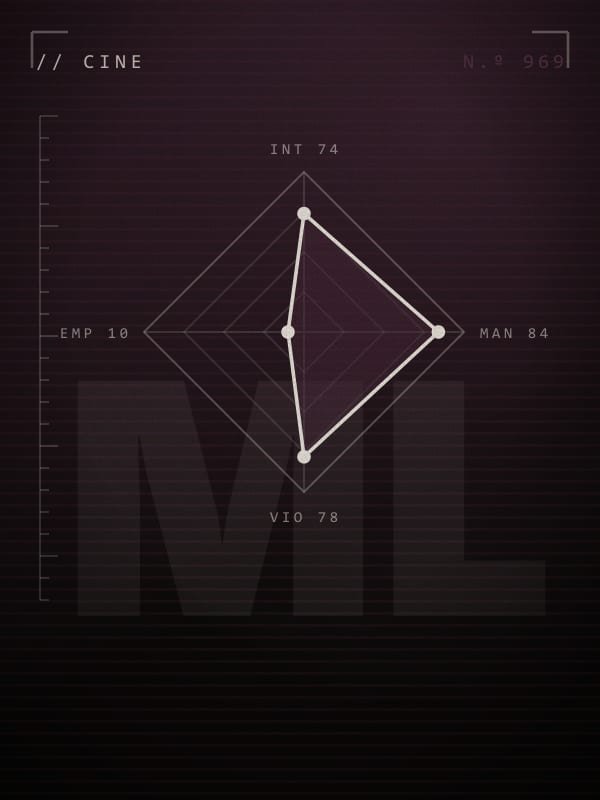
John Kreese is the sensei of Cobra Kai, and his doctrine fits in three sentences: “strike first, strike hard, no mercy”. He is neither the strongest in his dojos nor the one who fights most: his power is another kind. Kreese decides which behavior gets rewarded—who receives the belt, the attention, the fatherly approval his students desperately crave—and which behavior gets ridiculed. With that single lever he manufactures, class after class, violent teenagers. For differential reinforcement theory, Kreese occupies the most interesting side of the mechanism: that of the reinforcer.
// The theoryWhoever controls the reward controls the behavior
Ronald Akers's differential reinforcement theory holds that behavior is sustained by its balance of social rewards and punishments. We almost always study the one who receives those reinforcements; Kreese makes us look at the one who administers them. He doesn't need to be violent in person: it's enough to control his dojo's economy of rewards. He establishes “definitions” favorable to aggression (“mercy is for the weak”), models the behavior with his own example, and systematically reinforces cruelty with what his students most need—belonging, rank, the approving gaze of a father figure. It is the industrial production of violent behavior through contingencies.
Recruiting the lack
Kreese's dark talent lies in whom he recruits: kids who are alone, humiliated, without father figures, with an enormous need to belong and to feel strong. Akers stressed that the power of a reinforcement depends on how much its recipient needs it: the same pat on the back is worth little to a boy who is loved at home and enormously to one who receives it nowhere. Kreese exploits exactly that. His dojo is strong not because it teaches good karate, but because it offers—in exchange for cruelty—precisely what his students lack. It is the pattern of every dangerous recruitment, from the one gangs run to the one of extremist groups: seek out the lack and pay for it in belonging.
// The subjectThe reinforced one who became a reinforcer
The series hints at his origin: Kreese was a good young man whom the Vietnam War taught, through brutality, that mercy kills and only the ruthless survive. That is: he was himself reinforced by a monstrous system, and then reproduced that system with his students. Differential reinforcement thus describes chains of transmission: the reinforced become reinforcers. That explains where his doctrine comes from; it does not exonerate him in the slightest. Kreese is an adult who chooses, with full awareness, to apply to children the same conditioning that destroyed him—and who sees the destructive results without changing course.
It's worth specifying how Kreese reinforces, because he doesn't reward cruelty with every blow. Akers distinguished continuous reinforcement from intermittent reinforcement, and behavior that is rewarded unpredictably—sometimes yes, sometimes no—is precisely the most resistant to extinction. Kreese doles out his approval drop by drop: one day he crowns a student, the next he humiliates him in front of the dojo. That unpredictable trickle hooks harder than any constant praise, because it forces the kid to keep trying in order to win back the sensei's gaze. And, at the same time, it raises the cost of the opposite behavior: compassion not only stops being rewarded, it is punished with contempt. Reinforcement is never just about what gets rewarded, but about what cost is placed on the alternative.
Punishing the alternative
A reinforcement system is defined not only by what it rewards, but by what it makes costly. Akers framed it as a balance: behavior is sustained when its net reward exceeds that of rival behaviors. Kreese manipulates both sides. He raises the price of compassion—whoever hesitates is “soft” and gets left out of the group— and cheapens cruelty, which is paid in status on the spot. That is why his students don't choose between being cruel or kind in the abstract: they choose within a rigged market where kindness costs belonging. And whoever sets the prices in that market is responsible for them.
John Kreese
Get the map of theories for free
Subscribe to the criminal archive —one case a week, no spam— and I'll send you The map of theories: the great currents of criminology on a single sheet.
// The flawNeither "he's just a tough coach" nor "Vietnam made him"
The flaw with Kreese is the one he himself sells: “I only teach my kids to defend themselves in a hard world”. The theory dismantles the euphemism: he doesn't teach defense, he reinforces cruelty—he systematically rewards doing harm, even when there is no threat at all. The opposite flaw is the biographical alibi: “Vietnam turned him into this”. His story explains the origin of his “definitions”, but it doesn't take away a single gram of his responsibility: he is an adult with power over minors who chooses, year after year, what to reward. And there lies his specific guilt—not in the blows he throws, but in the ones he teaches others to throw. The reinforcer is as responsible as the reinforced, or more: he designs the machine.
That the series pits two dojos with opposite doctrines against each other—one that rewards balance and another that rewards cruelty—turns the story into an experiment on reinforcements: the same teenagers, opposite outcomes, depending on what gets applauded. It is Akers's thesis staged.
One last nuance remains that, far from exonerating him, incriminates him further. Differential reinforcement is probabilistic, not deterministic: not all of Cobra Kai's students end up equally broken—some leave, some rebel—and that shows the system doesn't manufacture automatons, but tips the scales. Kreese could use those margins to steer the one who falters back on course; instead he uses them to purge him. That the conditioning isn't total doesn't give freedom back to the pressured minor: it confirms it for the adult who, seeing that some escape, redoubles the pressure on those who don't. Explaining the mechanism is never exonerating the one who operates it: understanding the machine is, precisely, what points to the one who keeps it running.
Watching those who hand out status
Kreese matters because he shifts the preventive gaze from the offender to the architect of contingencies. In any environment where there are young people, someone is deciding which behavior grants status: a coach, a gang leader, an influencer, a forum ringleader. That person has more power over the group's behavior than any written rule or criminal threat, because they administer the immediate reward that really matters. The practical lesson: to prevent youth violence you have to watch and, above all, contest those posts—put mentors who reward other things where there used to be a Kreese. A group's behavior is written by whoever hands out the applause.
Three key takeaways
- John Kreese is the other side of differential reinforcement: the reinforcer. He doesn't need to throw a punch—he controls which behavior gets rewarded—and with that single lever he manufactures generations of violent students.
- His dark talent is recruiting the lack: he picks kids who are alone and without father figures, for whom the belonging he offers is worth enormously. The pattern of every dangerous recruitment: seek out the lack and pay for it in belonging.
- Neither "he's just a tough coach" (he reinforces cruelty, not defense) nor "Vietnam made him" (he was reinforced and chose to reproduce it with minors). The reinforcer is as responsible as the reinforced: he designs the machine.
Sources · further reading
- Akers, R. L. (1998). Social Learning and Social Structure. Northeastern University Press.
- Burgess, R. L. & Akers, R. L. (1966). “A Differential Association-Reinforcement Theory of Criminal Behavior”. Social Problems, 14(2).
- Bandura, A. (1977). Social Learning Theory. Prentice Hall.
Case-file questionsFrequently asked questions
Who is John Kreese?
John Kreese (“Kreese”) is a villain from Cobra Kai, analysed on KRIMINIS through the lens of criminology. He doesn't need to throw a punch: it's enough to decide who gets applauded.
Why does John Kreese become a villain?
John Kreese and differential reinforcement: the other side of the mechanism. Not the one who learns to be violent, but the one who designs the system that teaches it.
Which criminological theory explains John Kreese?
John Kreese's case is analysed through Differential reinforcement. Differential reinforcement theory (Akers) explains that behavior persists depending on who rewards it. John Kreese, from Cobra Kai, occupies the other side of the mechanism: he is the reinforcer. He designs a system where cruelty buys belonging and compassion is punished with contempt, and thereby manufactures generations of violent students without landing a single blow.