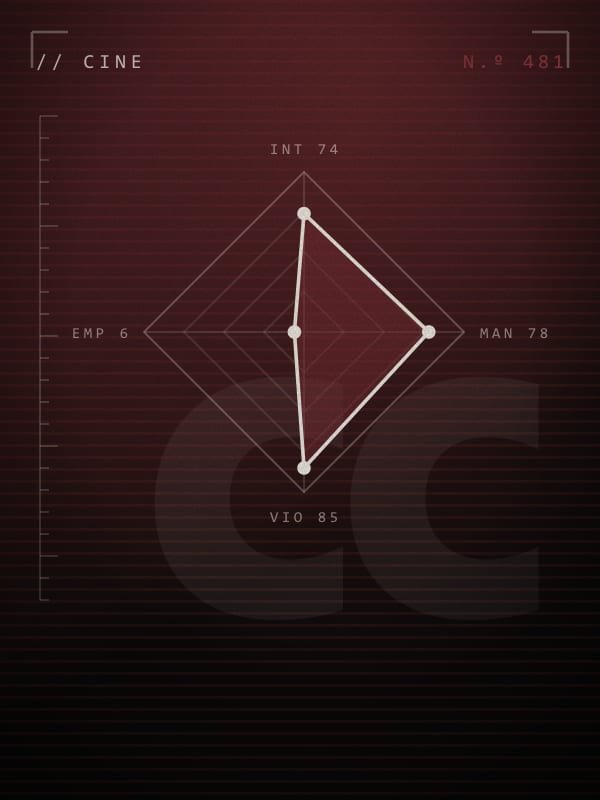
Envy, one of the seven homunculi of Fullmetal Alchemist, is envy made flesh —or rather, made formless matter, because his true form is a grotesque mass that does not even resemble a body—. For almost the entire story we see him as a cruel, mocking shapeshifter: he takes on any face, infiltrates, manipulates and, above all, sows hatred. It is Envy who ignites a civil war by disguising himself to murder a key figure, who delights in setting people against one another until the blood flows on its own. But the core of his character is not that cruelty: it is what feeds it. For the theory of relative deprivation, Envy is a textbook case —a being with almost unlimited power who, even so, lives corroded by what he sees in creatures infinitely weaker than himself—.
// The theoryIt is not the lack: it is the comparison
Relative deprivation was born in an unexpected place: the army. In The American Soldier (1949), the sociologist Samuel Stouffer uncovered a paradox —soldiers in the corps with the most promotions felt more frustrated, because they compared their lot with that of so many promoted comrades—. Satisfaction did not depend on objective reality, but on the reference group. The Briton W. G. Runciman (1966) formalized the idea, and Ted Robert Gurr, in Why Men Rebel (1970), carried it into violence: what pushes people toward conflict is not misery, but the gap between what one expects and what one gets when looking at others. The twist is devastating for intuition: it is not poverty that lights the fuse, but hunger surrounded by abundance. And Envy, who lacks nothing material —he is practically immortal, powerful, able to absorb lethal wounds again and again—, suffers exactly that kind of grievance: the one born of comparing what one is with what others have.
The reference group is humans
The crux of relative deprivation is whom one compares oneself with. Envy chooses the worst possible reference group for a being like him: humans. And there lies the trap. Seen from outside, the homunculi should despise humans —they surpass them in strength, in longevity, in almost everything—. But Envy does not look at what he has in excess; he looks at what he lacks. He sees that those fleeting beings, who die in a breath, have something he will never have: they lean on one another, weave bonds, find reasons to carry on even when broken. That is the revelation of his arc —beneath the mask of the all-powerful monster beats the most miserable creature of all, because his strength cannot win him the one thing he longs for—. Gurr's gap, in his case, is abyssal and irreparable: however much power he accumulates, he will never close the distance between what he is and what he envies. His cruelty is the outlet for that permanent grievance: if he cannot have what humans have, at least he can destroy it.
Get the map of theories for free
Subscribe to the criminal archive —one case a week, no spam— and I'll send you The map of theories: the great currents of criminology on a single sheet.
// The subjectThe shapeshifter who hated what he could not be
That Envy is a shapeshifter is no minor detail: it is the perfect metaphor for envy. He can put on any face, imitate anyone, take anyone's place —and yet he is no one—. The ability to become another is the envious person's dream and curse: he touches the surface of what belongs to others without ever being able to possess their interior. Envy takes on the face of a father, of a soldier, of a friend, and with them he manipulates and kills; but the intimacy, the affection, the belonging that those faces represent are forever forbidden to him. That is why his favorite method is sowing hatred: unable to share in human bonds, he devotes himself to poisoning them —he sets peoples against each other, provokes massacres, delights in watching those who can love one another tear each other apart—. Social comparison, in him, produces not constructive ambition but pure resentment. He does not want to deserve what he envies; he wants no one to have it. It is relative deprivation degraded to its most destructive form: the grievance that no longer seeks justice, only company in misery.
Envy
// The crackEnvy explains the engine, it does not excuse the crime
The crack with Envy is the temptation to turn explanation into absolution. His ending —when his envy is laid bare and he, humiliated at having been understood, chooses to vanish rather than endure pity— is so tragically human that it invites us to pity him. And compassion is not a mistake; but confusing it with exculpation is. Relative deprivation illuminates the engine of Envy —where his resentment comes from, why he compares, what wound feeds him— but it does not erase a single one of the wars he ignited, nor a single one of the lives he cut down for fun. The theory is explicit on this point: understanding the grievance does not make it a right. Most of those who suffer comparative deprivation do not sow massacres; it takes something more —the sustained, repeated choice to unload one's own pain onto others—. Envy made that decision a thousand times.
The other crack is the opposite: reducing him to "just a monster," denying that there is anything to understand. That reading also lies, because it leaves us defenseless before the real mechanics of his harm. The envy Envy embodies is not a fantasy trait: it is an everyday emotion, the one that arises each time someone measures their life against another's and finds it wanting. Seeing it operate in its extreme form —in a being who literally cannot have what he sees— helps us recognize it in smaller, more familiar versions. To explain is not to exculpate: it is to learn to name the wound before it becomes a knife.
The comparison that corrodes from within
Envy matters because he pushes an uncomfortable idea to its limit: that the suffering that poisons most is not always that of real lack, but that of comparison. A being who has almost everything —power, time, invulnerability— can be the most wretched of all if he measures his existence against that of the one who possesses the single thing he lacks. In an age that has industrialized comparison —where every screen offers an edited, enviable version of other people's lives—, the lesson is sharper than ever: the "shop-window effect" artificially widens what we believe we deserve, and that inflated gap is fuel for resentment. Comparative criminology confirms that it is not poverty but inequality —the visible distance between those who have and those who do not— that best predicts violence. Envy is that truth turned into a monster: proof that a grievance without an outlet, fed by constant comparison, can corrode anyone from within —even one who seemed to need nothing—.
Three key takeaways
- Envy, the homunculus of envy in Fullmetal Alchemist, embodies relative deprivation (Stouffer, Runciman, Gurr): his grievance is born not from what he lacks in absolute terms —he is powerful and near-immortal— but from comparing himself with humans, who have what he longs for (bonds, hope).
- His reference group is the creatures weaker than himself, and that is the trap: he does not look at what he has in excess, but at what he lacks. A shapeshifter who can be anyone without being anyone, he channels the grievance not into ambition but into cruelty —sowing hatred so that no one has what he cannot have—.
- To explain is not to exculpate. Relative deprivation illuminates the engine of his resentment, but it does not erase the wars he ignited: understanding the grievance does not make it a right, and most of the deprived do not sow massacres. Envy chose to.
Sources · further reading
- Stouffer, S. A. y cols. (1949). The American Soldier. Princeton University Press.
- Runciman, W. G. (1966). Relative Deprivation and Social Justice. Routledge & Kegan Paul.
- Gurr, T. R. (1970). Why Men Rebel. Princeton University Press.
- Wilkinson, R. & Pickett, K. (2009). The Spirit Level. Allen Lane.
Case-file questionsFrequently asked questions
¿Quién es Envy?
Envy («la Envidia») es un villano de Fullmetal Alchemist, analizado en KRIMINIS con la lente de la criminología. He can change his face, shrug off a thousand wounds and live for centuries.
¿Por qué Envy (la Envidia) se convierte en villano?
Envy, the homunculus of envy, and the theory of relative deprivation: how grievance is born not from what is lacking in absolute terms, but from comparing oneself with those who have what one longs for. A near-immortal being corroded by what he sees in humans.
¿Qué teoría criminológica explica a Envy?
El caso de Envy se analiza desde la Privación relativa. Relative deprivation (Stouffer, Runciman, Gurr) holds that grievance is not ignited by absolute lack, but by comparison with a reference group that has what one believes it deserves. Envy, the homunculus of envy in Fullmetal Alchemist, embodies that wound in its purest form: a near-immortal shapeshifter who sows wars and hatred, and who deep down —the key revelation of his arc— profoundly envies humans, those fragile beings who nonetheless possess what he lacks. His cruelty does not spring from an abundance of power, but from the distance between what he is and what he sees in others.