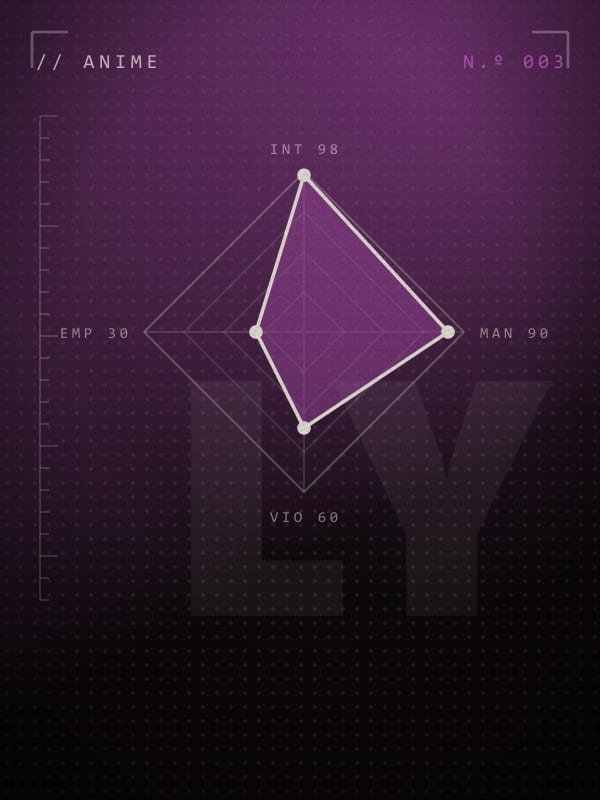
By the time we meet Kaigaku as the Upper Moon Six—a demon strong enough to wear one of the twelve highest ranks in Muzan's army, wielding a corrupted Thunder Breathing as lightning made cruelty—nothing on the surface recalls the boy he was. But the demon is the boy, magnified. Kaigaku was Zenitsu's senior fellow disciple, trained by the same old master, Jigoro Kuwajima, in the same swordsmanship, out of the same poverty. He was gifted; by most measures he was the better swordsman of the two. And he was, always and unbearably, second—not in skill but in something he could not name and could not forgive: the sense that the world had looked at the two of them and chosen the other boy. He was poor, and he was terrified, above everything, of dying with nothing to show for a life that had given him nothing. When a demon named Kokushibo finally cornered him with that exact choice—die now, as a human with empty hands, or live on as a monster—Kaigaku did not hesitate for the reason a coward hesitates. He had been rehearsing the answer his whole life. He took the gap he felt between himself and everyone luckier, and he made it into a reason.
// The theoryThe grievance that is not about what you have, but about the gap
In 1949, studying the morale of American soldiers, the sociologist Samuel Stouffer and his colleagues found something that did not fit common sense: soldiers in units with better promotion odds were often more frustrated about promotion, not less. What galled a man was not his absolute position but the comparison—how he stood against the others around him whom he took as his measure. The concept was named relative deprivation, and in 1966 the sociologist W. G. Runciman gave it its rigorous form in Relative Deprivation and Social Justice: a person feels deprived not when he lacks something in the abstract, but when he wants something, sees that others like him have it, believes he could have it too, and yet does not. Grievance is a subtraction—what I believe I deserve, minus what I actually hold—and the term that decides its size is not my possessions but my reference group. Choose a higher group to measure yourself against, and the same life can feel like a robbery.
Kaigaku is that subtraction walking. His reference group is a single person: Zenitsu. Not a distant celebrity or an abstract rich man—the boy beside him, trained by the same master, raised in the same scarcity, holding the same sword. That is precisely what makes the comparison unbearable: every excuse for the gap is stripped away. They started level; if the other boy is favored anyway, then the injustice is personal, aimed, deserved-in-reverse. Kaigaku measures himself against Zenitsu and reads the result as a verdict on the fairness of the world—and finds the world guilty. His envy is not greed for objects; it is the specific, corrosive resentment Runciman described, the conviction of a man who has decided that the distance between himself and his chosen rival is not something he failed to close but something that was done to him. From there, every grievance compounds. The poverty is not misfortune but proof. The master's faith in Zenitsu is not love but insult. And the offer to become a demon is not a temptation but, at last, a way to win.
The rival is chosen, and so is the reading
The engine of relative deprivation has two settings a person controls, and Kaigaku turns both toward ruin. The first is the choice of reference group: he could have measured himself against the demon he might one day slay, against the swordsman he was last year, against the master who took in two penniless boys and asked nothing—but he measured himself against Zenitsu, and only Zenitsu, so that the other's every step forward registered as his own loss. The second is the interpretation of the gap. A gap can be read as a task (I am behind; I can close it) or as a verdict (I am behind; the world is unjust and owes me). Runciman's insight is that grievance lives entirely in the second reading, and the second reading is not forced by the facts—it is chosen. Kaigaku, cornered by Kokushibo (see his file), the very demon whose comparisons destroyed his own brother, takes the verdict reading to its end: if the world will not give him the standing he is owed, he will seize it by ceasing to be human. Relative deprivation explains why the gap hurt him so much. It does not decide what he did with the hurt.
// The subjectThe boy who feared dying with nothing—and paid any price to avoid it
Underneath the envy is a fear, and the fear is the truer key. Kaigaku is defined less by wanting to surpass Zenitsu than by dreading the alternative: to die as he had lived, poor and unremarked, a life that added up to nothing. To a boy who has been given nothing, the promise of survival at any price is not a bargain—it is the only thing that has ever been offered without a catch he could see. So when Kokushibo presents the choice, Kaigaku's whole biography answers for him. Becoming a demon is not, in his mind, a fall; it is a refusal to be robbed one final time, by death, of the standing he never got in life. And here the betrayal is total, because it is not only Muzan's cause he joins—it is everything behind him he sells. His turning drove Jigoro Kuwajima, the master who had believed in both his pupils, to seppuku: the old man could not bear the shame of having trained a demon, and took his own life for it. That is the measure of what Kaigaku's fear cost. He chose to live as a monster, and the choice killed the one man who had refused to see him as second—who had, in taking him in, treated him as worth saving. The gap he could not forgive was answered, all along, by a master's faith he could not feel. He repaid it with a blade turned inward on the man who gave it.
Kaigaku
Get the map of theories for free
Subscribe to the criminal archive —one case a week, no spam— and I'll send you The map of theories: the great currents of criminology on a single sheet.
// The flawThe same start, the opposite choice—deprivation is a pressure, not a verdict
Here is the crack, and it is standing right beside him. Relative deprivation explains, with real force, why the gap between himself and Zenitsu burned in Kaigaku as it did—but the theory names a pressure, not a destiny, and the proof is Zenitsu. The same poverty. The same master. The same Thunder Breathing, the same scarcity, the same open door to resentment. Zenitsu is, if anything, the more openly frightened of the two, the one who wails that he is worthless and cannot go on. And out of that identical raw material he chose the opposite path: loyalty over betrayal, the closing of the gap over the blaming of the world, a single mastered form practiced until it was his own rather than a demon's shortcut. Two boys stood in the same deprivation and one became Upper Moon Six while the other became a Demon Slayer—which means the deprivation did not decide it. What decided it was the reading each gave the gap, and the reading was a choice. Kaigaku chose to hear the distance between himself and Zenitsu as a debt the world owed him, and to collect it by any means; chose survival-at-any-price over the master who saved him; chose the blade over the shame of staying second and staying human. Explaining the envy is not excusing the betrayal. The felt gap was real. What he did with it was his.
Explaining the resentment is not endorsing it
Kaigaku matters because relative deprivation is among the most humanly familiar of all the engines in this gallery—almost everyone has, at some point, measured themselves against someone close and felt the sting of an unfair-seeming gap. That familiarity is exactly why the theory has to be held with care. To understand that Kaigaku's grievance grew from comparison rather than from any absolute lack is to gain something genuinely useful: it explains resentment we can all feel, and it warns how a chosen rival and a chosen reading can turn ordinary envy into ruin. It is not to grant him the verdict his resentment was reaching for. The whole value of naming relative deprivation is that, once named, its two levers become visible—the reference group you pick, the meaning you assign the gap—and both can be turned another way, exactly as Zenitsu turned them. A person who learns to hear "the world owed me and I only took what was mine" as an alibi rather than an account has learned the one thing Kaigaku most needed to not know—that the gap is a pressure and the response is a choice, and that a master died believing the boy he saved could have chosen otherwise. That is how the excuse is refused.
Three key takeaways
- Kaigaku, the Upper Moon Six demon of Demon Slayer, embodies relative deprivation (Stouffer, 1949; Runciman, 1966): grievance born not from absolute poverty but from the felt gap between himself and his reference group—Zenitsu, his senior fellow disciple under the same master and in the same scarcity, against whom he measured himself and found the world unjust.
- His engine is envy and a deeper fear: of dying poor and unremarked, with nothing. When Kokushibo cornered him, he chose to become a demon to survive—a betrayal so total it drove their shared master, Jigoro Kuwajima, to seppuku out of the shame of having trained a demon.
- The flaw: deprivation is a pressure, not a verdict. The same poverty and the same master produced Zenitsu, who chose the opposite path—loyalty, and closing the gap rather than blaming the world. Kaigaku chose to read the gap as a debt owed him and survival as worth any price. The envy accounts for the impulse; the betrayal was still his choice.
Sources · further reading
- Stouffer, S. A., Suchman, E. A., DeVinney, L. C., Star, S. A. & Williams, R. M. (1949). The American Soldier: Adjustment During Army Life (Vol. 1). Princeton University Press.
- Runciman, W. G. (1966). Relative Deprivation and Social Justice: A Study of Attitudes to Social Inequality in Twentieth-Century England. Routledge & Kegan Paul.
- Webber, C. (2007). “Background, foreground, foresight: The third dimension of cultural criminology?”. Crime, Media, Culture, 3(2), 139–157.
- Smith, H. J., Pettigrew, T. F., Pippin, G. M. & Bialosiewicz, S. (2012). “Relative Deprivation: A Theoretical and Meta-Analytic Review”. Personality and Social Psychology Review, 16(3), 203–232.
Case-file questionsFrequently asked questions
Who is Zenitsu's brother?
Kaigaku is Zenitsu Agatsuma's adoptive older brother: the same master, Jigoro Kuwajima, raised them both in the same Thunder Breathing school. Kaigaku accepted Muzan's blood and became Upper Rank Six, and their master took his own life over it. They are not blood brothers, and that relationship is exactly what this file analyses.
Who is Kaigaku?
Kaigaku (“Luna Superior Seis”) is a villain from Demon Slayer, analysed on KRIMINIS through the lens of criminology. He had talent, but he was always second.
Why does Kaigaku (Luna Superior Seis) become a villain?
Kaigaku, the Upper Moon Six of Demon Slayer, and relative deprivation (Stouffer, Runciman): how the envy of the boy who measured himself against Zenitsu became betrayal. The one who feels cheated by the gap is not born a monster—he decides the world owes him, and chooses survival over loyalty.
Which criminological theory explains Kaigaku?
Kaigaku's case is analysed through Relative deprivation. Relative deprivation (Samuel Stouffer, 1949; W. G. Runciman, 1966) holds that grievance and crime arise not from absolute poverty but from the felt gap between oneself and a reference group—the resentment of the person who measures himself against others and finds the world unjust. Kaigaku, Zenitsu's senior fellow disciple under Jigoro Kuwajima and later the Upper Moon Six demon of Demon Slayer, is that resentment given a body. His whole psychology is comparison: talented but poor, always overshadowed by Zenitsu, terrified above all of dying with nothing, he concluded he deserved more than the world gave him. When Kokushibo cornered him, he chose to become a demon to survive—and the betrayal drove their shared master to seppuku out of shame. And the flaw is decisive: the same scarcity and the same master produced Zenitsu, who chose the opposite path—deprivation is a pressure, not a verdict; Kaigaku chose to blame the world for a gap he could have closed differently.