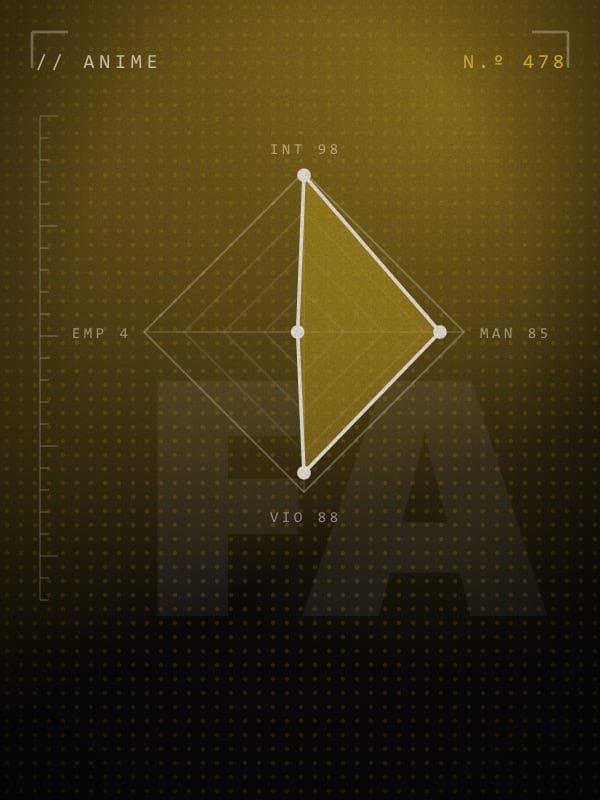
It began as a tiny, nameless thing sealed inside a flask —the «Homunculus»—, a shadow with a voice that learned about the world through the glass. It ended as Father, the central villain of Fullmetal Alchemist: Brotherhood: a being who spawns homunculi, rules a country from the shadows and plans to use millions of people as fuel to become God. Between the flask and the altar there is a single straight line, and it is not the line of an incomprehensible monster: it is that of a way of thinking. The criminal personality that Samuel Yochelson and Stanton Samenow described speaks not of impulses or traumas, but of how the unrestrained offender reasons: with grandiosity, with the certainty of being unique, with a hunger for power that turns everything into a pawn. Father is no exception to that mental grammar. He is its purest statement.
// The theoryThinking like a criminal: grandiosity and the craving for power
In The Criminal Personality (1976), Samuel Yochelson and Stanton Samenow proposed an uncomfortable turn for their time. After years interviewing inmates at a forensic psychiatric hospital in Washington, they argued that the chronic offender is not, deep down, a sick person or a victim of his environment, but someone who thinks differently: he possesses a stable set of cognitive patterns —they called them "thinking errors", more than half a hundred of them— that sustain and justify his conduct. Among them, some form the hard core: grandiosity (an inflated self-image, the sense of being above the rules), the sense of uniqueness (I am not like the others, the norms of ordinary people do not apply to me), the objectification of the other (people are pawns, means, obstacles) and above all the "power thrust": a compulsive craving for power and absolute control, the need to impose oneself and triumph over everything and everyone. Crowning the edifice is the search for a perfect self: the fantasy of a version of oneself that is untouchable, superior, without cracks. Yochelson and Samenow summed it up with a brutal phrase: the criminal is not different because of what happened to him, but because of what he chooses to think each morning.
The "power thrust" and the perfect self
The heart of Yochelson and Samenow's criminal personality is not violence, but a relationship with power. The "power thrust" describes someone for whom the whole of life is a struggle for control: winning is not enough, he needs to dominate; being above is not enough, he needs the other to be below. And that craving rests on a fantasy —the perfect self—, the image of a version of oneself with no limits, no debts, no human ties. Father takes it to its most literal imaginable expression. He does not want to reign from a throne: he wants to stop being the sealed-in homunculus and become a complete, absolute, divine being. His crime does not spring from lack but from the naked ambition for perfection. And there lies the key the theory underscores again and again: for someone who thinks this way, others are not people to live alongside, but ingredients of his own ascent.
Get the map of theories for free
Subscribe to the criminal archive —one case a week, no spam— and I'll send you The map of theories: the great currents of criminology on a single sheet.
// The subjectThe one who amputated his own humanity
There is a gesture in Father's story that makes him an almost perfect case study. To "purify" himself and draw closer to divinity, he amputated his seven sins: he separated from himself greed, wrath, envy, lust, sloth, gluttony and pride, and gave them bodies —the seven homunculi that are, literally, his exiled emotions—. The criminological reading is chilling: Father tried to manufacture Yochelson and Samenow's perfect self by deliberately emptying himself of humanity. He believed perfection consisted in not feeling, in owing nothing to anyone, in being uncontaminated by the affections that bind the rest of mortals. He was left, he said, serene and superior; in reality he was left hollow. That is the dark reverse of grandiosity: the self-image inflates so much that no other fits inside it. The inhabitants of Amestris are not, to him, a people: they are a living transmutation circle, a reserve of souls he plans to consume all at once to complete his transformation. His empathy does not fail by accident. He excised it himself, convinced it was getting in the way of his project of divinity.
Father
// The crackThe theory that over-explains (and why it matters)
Applying Yochelson and Samenow's framework to Father is tempting because it fits too well —and that is where the crack begins—. The criminal personality theory has been harshly criticized by serious criminology, and it is worth saying so in full. First, its empirical basis is weak: they worked with a clinical sample of inmates already selected for their dangerousness, with no control group, so they could never prove that those "thinking errors" distinguish the offender from everyone else —many of us have them without ever committing a crime—. Second, its catalog of more than fifty patterns over-explains: when a theory has a slot for every possible behavior, it stops predicting anything and becomes unfalsifiable, a mirror that confirms what we already believed. And third, its almost absolute emphasis on free will —"the criminal chooses"— tends to erase the social context, poverty, abuse, the structures that do weigh on real trajectories. With a fictional character like Father the problem is disguised, because he is pure deliberate choice; but transferring that moral optimism to flesh-and-blood human beings has, historically, served to justify punishment and neglect prevention.
And yet, the crack does not cancel the lesson. That the theory explains too much does not mean it illuminates nothing. Its central intuition —that certain crimes are born from a way of thinking about the world, and not only from an impulse or a wound— remains valuable when looking at someone like Father, whose evil is not visceral but architectural, planned over centuries with the coldness of one solving an equation. The non-negotiable warning is the usual one: explaining is not excusing. Reconstructing Father's inner logic —his grandiosity, his craving for power, his perfect self— does not humanize or excuse him; on the contrary, it lays bare that his emptying of empathy was a decision, not a misfortune. Understanding the pattern of thought is the best way not to be seduced by it.
When grandiosity disguises itself as perfection
Father matters because he dismantles a comforting idea: that great evil is always a loss of control, an outburst, a madness. Sometimes the most devastating evil is serene —it reasons, calculates, believes itself perfect—. Yochelson and Samenow's criminal personality, with all its methodological flaws, is right to point out that grandiosity and the craving for power are not ornaments of crime, but sometimes its engine. And it is right about something even deeper: the villain who believes himself above the rules usually begins by convincing himself that others are worth less, that they are ingredients of his ascent. Recognizing that pattern —contempt disguised as superiority, cruelty disguised as purification— is an antidote. Not to diagnose homunculi, but to distrust every human project that promises perfection at the price of empathy. Father amputated his sins believing he was rising. The remembrance, here, is for the souls he meant to consume along the way.
Three key ideas
- Father, the «Homunculus» of Fullmetal Alchemist: Brotherhood, embodies Yochelson and Samenow's criminal personality: grandiosity, a sense of uniqueness, the craving for absolute power (the "power thrust") and the pursuit of a perfect self that reduces others to pawns and ingredients.
- His defining gesture —amputating his seven sins to "purify" himself of all humanity— is the perfect self emptied of empathy taken to the literal: a god without affections who sees an entire nation as fuel for his transcendence.
- The theory is heavily criticized (a clinical sample with no control group, a catalog that over-explains, an excess of free will that ignores the social context). But its intuition is useful, and its ethical limit is clear: explaining Father's pattern is not excusing it. The remembrance is for his victims.
Sources · further reading
- Yochelson, S. & Samenow, S. E. (1976). The Criminal Personality, Vol. I: A Profile for Change. Jason Aronson.
- Samenow, S. E. (1984). Inside the Criminal Mind. Times Books.
- Walters, G. D. (1990). The Criminal Lifestyle: Patterns of Serious Criminal Conduct. Sage.
- Maruna, S. (2001). Making Good: How Ex-Convicts Reform and Rebuild Their Lives. American Psychological Association.
Case-file questionsFrequently asked questions
¿Quién es Father?
Father («El Enano del Frasco») es un villano de Fullmetal Alchemist, analizado en KRIMINIS con la lente de la criminología. He was born as a shadow in a flask and wanted to be God.
¿Por qué Father (El Enano del Frasco) se convierte en villano?
Father, from Fullmetal Alchemist, and the criminal personality of Yochelson and Samenow: grandiosity, the craving for absolute power and the perfect self emptied of empathy. A being who cut away his emotions to stop being human… and to see an entire country as an ingredient.
¿Qué teoría criminológica explica a Father?
El caso de Father se analiza desde la Personalidad criminal. The criminal personality theory of Yochelson and Samenow describes a constellation of thought patterns —grandiosity, a sense of uniqueness, the craving for absolute power (the "power thrust") and the pursuit of a perfect self— that reduces others to pawns. Father, the «Homunculus» of Fullmetal Alchemist: Brotherhood, embodies that profile in its most literal version: he amputated his seven sins to "purify" himself of all humanity and become a god without empathy, willing to sacrifice an entire country as a mere ingredient of his transcendence. A study of the grandiose self taken to absolute moral emptiness.