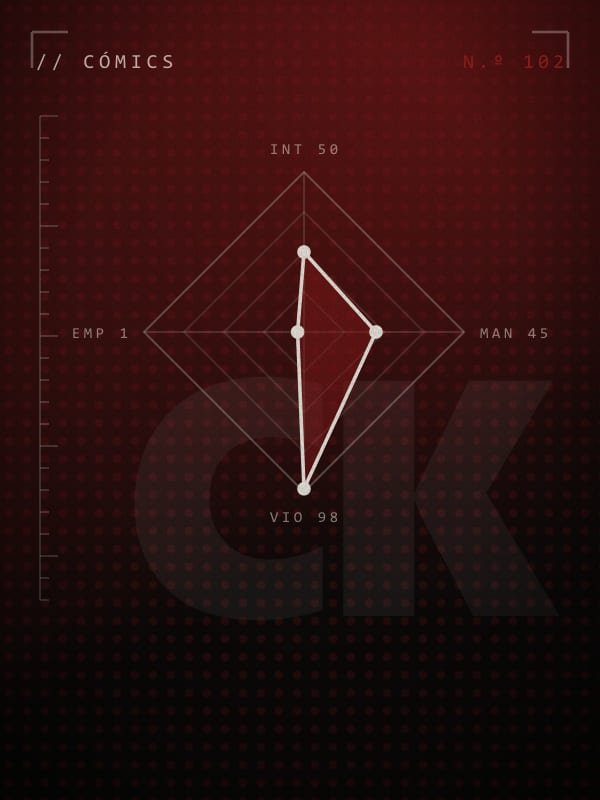
Art the Clown, the clown of the Terrifier saga, is a problem for any classical criminology —and that is precisely why he is a gift for cultural criminology—. He does not speak. He has no past that explains anything, no founding trauma, no manifesto, not even a goal beyond inflicting pain with a smile. He is a killer without motive and without psychology: a clown-shaped void. The theories that seek the cause of crime —strain, learning, calculation, personality— crash against that emptiness, because there is no subject to analyze. And yet, in 2024, Terrifier 3 —an independent, brutal film, with no big stars— dethroned studio productions at the US box office on its opening. The phenomenon is undeniable. The question, then, cannot be "what is wrong with Art?", because nothing is wrong with Art: he is a mask. The question is the one cultural criminology puts at the center: what is going on with us, the ones who queue up to watch him?
// The theoryCrime as culture, experience and spectacle
Cultural criminology —founded in the nineties by Jeff Ferrell, Keith Hayward and Jock Young, building on Jack Katz's Seductions of Crime (1988)— made a decisive turn: it stopped looking at crime only "from the outside", as a social datum, and stepped inside its emotional experience and, above all, its cultural representation. Crime is not merely an act: it is an image, a narrative, a product that circulates. For this current, crime and culture feed back into each other in a media loop —representation does not reflect crime, it shapes it—, and much transgression is sought for what it feels like: the adrenaline, the vertigo, the forbidden pleasure of leaning over the edge. Applied to Art the Clown, the theory does something no other can: since the "criminal" is empty, it shifts the whole analysis to the phenomenon. It stops asking about the killer's mind —which does not exist— and asks about the spectator's experience, about the industry that manufactures it and the culture that celebrates it. You can read the full theory in cultural criminology.
The carnival of transgression
Mike Presdee, in Cultural Criminology and the Carnival of Crime (2000), revived an old idea —the carnival— to explain something very current. The carnival was the ritual moment when the world was turned upside down: for a bounded and safe time, what was forbidden the rest of the year was permitted —excess, the grotesque, the mockery of death, the transgression of every limit—. Presdee argues that modernity, which represses that transgressive energy in orderly and productive life, lets it escape through other valves: and one of them is the consumption of horror. Watching Art dismember on screen is a carnival in miniature: the spectator crosses the taboo without crossing it, experiences total transgression from the safety of a seat. The extreme gore of Terrifier is not a lapse of taste: it is exactly the product that promises the carnival high —death turned into an attraction, disgust and laughter at once, the fascination with what in real life would horrify us—. Art needs no motive because he is not the subject of the carnival: he is its attraction.
Get the map of theories for free
Subscribe to the criminal archive —one case a week, no spam— and I'll send you The map of theories: the great currents of criminology on a single sheet.
// The subjectThe blank canvas onto which the audience projects
That Art is mute and empty is not a shortcoming of the character: it is his design, and it is the key to his cultural power. A villain with a motive —one who kills for revenge, for ideology, for trauma— closes off meaning: we know what he is and what he wants, and that contains him. Art, by explaining nothing, becomes a blank canvas onto which the spectator projects whatever they want —pure fear, the childhood nightmare of the clown, evil without a why, the vertigo of meaninglessness—. Cultural criminology reads this as ritualized transgression: Art works as the "folk devil" of a controlled panic, a figure onto which culture discharges and at the same time domesticates its fascination with violence. His expressiveness is purely bodily and aesthetic —the smile, the gesture, the grotesque pantomime—, and that muteness makes him more iconic, not less: he is memed, worn as a Halloween costume, printed on T-shirts. The character separates from his own films and becomes a brand. That is where the commodification of fear operates: the record box office, the merchandising, the cycle of memes and viral reactions that turn a fictional killer into a pop icon. Ferrell's media loop in its purest form —the image of crime does not describe a real offense, it is produced and sold as experience—.
Art the Clown
// The crackIlluminating the phenomenon, aestheticizing violence
The crack in cultural criminology applied to Art is honest and double. The first: the theory brilliantly illuminates the phenomenon —why we are fascinated, why we queue up, how fear is manufactured and sold— but says almost nothing about the "criminal", because here the criminal literally does not exist as a psyche. That is at once its great achievement and its limit: it is the only lens that pays off with an empty villain, but only because it gives up explaining an offense that is not one. Art harms no real person; he is an image. And that is exactly the risk of the second crack: in analyzing the consumption of violence, the current brushes against the danger of aestheticizing it —of treating gore as pure cultural play and forgetting that the fascination with suffering, when it leaps from fiction to reality, has flesh-and-blood victims—. Cultural criminology itself has earned the criticism of romanticizing transgression and losing sight of the wounded behind the spectacle.
That is why the non-negotiable principle —to explain is not to excuse— translates here in a particular way. There is no killer to excuse: Art is fiction and no one needs to be defended from him. What the formula forces us to remember is the other thing: that understanding why a culture consumes transgression as carnival is not the same as blessing that transgression when it stops being fiction. Enjoying horror from a seat is an old and probably harmless rite; the problem begins when the media loop also aestheticizes real violence —crime turned into content, the real victim reduced to spectacle—. Cultural criminology is valuable precisely because it lets us see that line: it distinguishes the safe carnival of the fictional clown from the obscene consumption of authentic pain. And it reminds us that memory, even when the villain is a voiceless mask, is always owed to the real victims that no aesthetic should turn into entertainment.
When the villain looks back at us
Art the Clown matters because he inverts the criminological question. Almost every case seeks to understand the criminal: his mind, his causes, his responsibility. Art has none of that, and that emptiness is a mirror. By giving us no monster to study, the Terrifier saga leaves us alone with our own fascination —with the urge to watch, with the pleasure of disgust, with the queue at the box office for gore with no artistic alibi—. Cultural criminology names that impulse without condemning or celebrating it: it understands it as carnival, as the need for vertigo and transgression that an orderly life represses and that the cinema of excess channels. But the same lens that explains why fear sells also forces us to watch its edges: the always-fragile distance between enjoying invented horror and consuming real horror. A mute clown who dominates the box office says nothing about himself. He says a great deal about us.
Three key takeaways
- Art the Clown is a deliberately empty villain —mute, motiveless, without a psyche—, and that is why cultural criminology (Ferrell, Hayward, Young; Katz; Presdee) is the only lens that pays off: it shifts the focus from the nonexistent criminal to the cultural phenomenon and the audience's experience.
- The slasher works as a carnival of transgression (Presdee): the spectator crosses the taboo without crossing it, and the mute villain is a blank canvas onto which they project their fear. The media loop commodifies that fear —record box office, memes, merchandising— and turns a fictional killer into a pop icon.
- The theory illuminates the phenomenon far better than the "criminal", who does not exist here. Its risk is aestheticizing violence; to explain is not to excuse means here distinguishing fictional horror from real horror and not turning real victims into spectacle.
Sources · further reading
- Ferrell, J., Hayward, K. & Young, J. (2008). Cultural Criminology: An Invitation. Sage.
- Katz, J. (1988). Seductions of Crime: Moral and Sensual Attractions in Doing Evil. Basic Books.
- Presdee, M. (2000). Cultural Criminology and the Carnival of Crime. Routledge.
- Cohen, S. (1972). Folk Devils and Moral Panics. MacGibbon & Kee.
Case-file questionsFrequently asked questions
¿Quién es Art the Clown?
Art the Clown es un villano de Terrifier, analizado en KRIMINIS con la lente de la criminología. He does not speak, does not explain, has no past and no plan.
¿Por qué Art the Clown se convierte en villano?
Art the Clown and cultural criminology: a killer with no voice, no motive and no psychology who dominates the box office. When the criminal does not exist as a mind, the theory stops looking at the monster and starts looking at us —the audience that queues up for the horror—.
¿Qué teoría criminológica explica a Art the Clown?
El caso de Art the Clown se analiza desde la Criminología cultural. Cultural criminology (Ferrell, Hayward, Young; with Katz and Presdee) studies crime as a cultural construction and an emotional experience: not only why it is committed, but how it is lived, represented and consumed. Art the Clown, from the Terrifier saga —a box-office phenomenon with Terrifier 3 (2024)—, is the perfect case because he is a deliberately empty villain: mute, motiveless, without a psyche. There the theory turns the focus from the nonexistent criminal to the real audience: the aesthetics of gore, the adrenaline of the taboo, the carnival of transgression (Presdee) and the commodification of fear that turns a fictional killer into a pop icon of memes and merchandising.