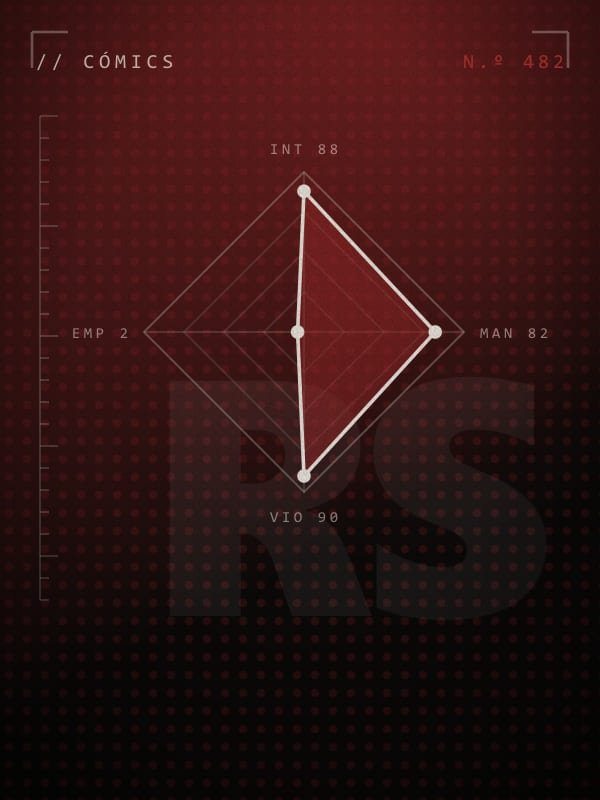
Muzan Kibutsuji, the first demon and "demon king" of Demon Slayer (Kimetsu no Yaiba), is the most powerful being in his world and, at the same time, the most terrified. His entire existence revolves around one obsession: not dying. He pursues "perfection" —a body able to survive the sun— sacrificing as many as necessary, and he eliminates his own subordinates at the slightest failure, without rage and without guilt, like someone discarding a faulty tool. For clinical psychology, Muzan is an almost textbook illustration of antisocial personality disorder (ASPD): a persistent pattern of disregard for the rights of others, deceit, aggressiveness, irresponsibility and, above all, an absence of remorse. In him, the panic of death neither explains nor excuses anything: it only reveals how far an absolute self can go in treating every other life as disposable material.
// The theoryA pattern, not an outburst
Antisocial personality disorder appears in the DSM-5 of the American Psychiatric Association as a general pattern of disregard for and violation of the rights of others, present since adolescence. Its criteria include: failure to conform to social and legal norms, repeated deceit (lying, manipulating for personal gain), impulsivity, irritability and aggressiveness, reckless disregard for the safety of oneself and others, persistent irresponsibility and —the core trait— an absence of remorse: indifference to or rationalization of the harm caused. It is not a diagnosis of "evil" nor a one-off outburst: it is a stable pattern of functioning, a way of being in the world in which the other does not count as a subject with rights, but as an obstacle or an instrument. An important nuance is in order: ASPD and psychopathy are related but distinct constructs. The DSM-5's ASPD is defined above all by observable behaviors (crimes, deceptions, assaults); psychopathy —assessed with instruments such as the Hare scale— adds an affective and interpersonal core: superficial charm, grandiosity, emotional coldness, an absence of empathy. Not every antisocial person is a psychopath, nor the reverse. Muzan is interesting because he combines both registers: flagrant antisocial conduct and the affective void of the predator.
The absence of remorse
The heart of ASPD —and what most disturbs us about Muzan— is not the violence, but the absence of remorse. Muzan does not hate those he kills; he simply does not register them as losses. When he annihilates a subordinate who failed, or inconvenient witnesses, there is no reckoning of guilt because there is no guilt: the harm done to others produces no emotional resonance in him. Psychology distinguishes two layers here. One is cognitive: he can perfectly well understand that he causes pain —in fact he instrumentalizes it, using it to intimidate and control—. The other is affective: that pain does not matter to him, he feels it as neither his nor anyone else's. It is the dissociation between knowing that something wounds and having that wounding move something inside. In ASPD that second layer is atrophied or absent, and so remorse —the brake that in most people limits harm— simply does not operate. Muzan is not cruel despite knowing what he does: he is cruel because knowing it costs him absolutely nothing.
Get the map of theories for free
Subscribe to the criminal archive —one case a week, no spam— and I'll send you The map of theories: the great currents of criminology on a single sheet.
// The subjectThe tyrant who fears his own shadow
Muzan gathers the traits of ASPD with unsettling clarity. Deceit and manipulation: for centuries he lives camouflaged among humans, adopts identities, feigns affection, weaves webs of fear and promises to control his demons. Aggressiveness and impulsivity: he executes his "Moons" —his generals— the moment they disappoint him, sometimes over a single misspoken syllable, in fits of cold violence. Irresponsibility and disregard for the rights of others: he turns people into demons without their consent, uses them and discards them, and acknowledges no duty toward anyone. And above all, the absence of guilt: not one of the countless deaths he causes wrings a single moral hesitation from him. What is singular about Muzan is the engine beneath it all: a pathological terror of death. His egocentrism is so absolute that his own survival becomes the sole value in the universe; compared with it, any other life is expendable. His tyranny over his subordinates is not gratuitous sadism, but the icy logic of one who sees others as pieces in a plan whose only end is himself. Power does not calm him: the more powerful he grows, the more terrified, because the more he has to lose. He is the supreme predator who flees, without rest, from his own shadow.
Muzan Kibutsuji
// The crackExplaining the mechanism does not dissolve responsibility
The crack with Muzan has two edges. The first is turning the diagnosis into an alibi: assuming that if he "feels no remorse," then he "can't help it" and is therefore not responsible. This is a clinical and ethical error. ASPD describes a difficulty —sometimes severe— in having harm to others generate an emotional brake; not an inability to understand the norms nor to decide. Muzan knows what he does, he calculates, he plans, he chooses. Responsibility does not live in feeling alone, but in deliberate action, and there Muzan is fully an agent. Explaining the psychological mechanism —how a terrified self with no affective resonance comes to treat every life as waste— does not dissolve a gram of his guilt; it only lets us see it with precision instead of with horror.
The second edge is the opposite: using the label "antisocial" or "psychopath" to dehumanize, to place whoever bears it outside the species and spare ourselves the work of thinking. It is worth remembering that the vast majority of people with antisocial traits are neither demon kings nor serial killers, and that the real diagnosis is a clinical tool, not an insult nor a sentence. Muzan is fiction taken to the extreme; his value is not to teach us to "detect monsters," but to recognize the mechanism —the instrumentalization of the other when one's own survival becomes an absolute value— that, in smaller doses and without fangs, also operates in ordinary human cruelty. To explain is not to exonerate: it is to refuse to let horror remain an impenetrable mystery, precisely so that we can respond to it.
When the other stops counting
Muzan matters because he takes to the extreme a very real question in criminology and the clinic: what happens when someone stops registering the other as a subject with rights?. ASPD is not a fictional eccentricity; it is one of the profiles most associated with persistent criminal conduct, and understanding it well —without falling into the alibi or into dehumanization— is central to prevention, risk assessment and treatment. The lesson of Muzan is that the most efficient cruelty usually springs not from hot hatred, but from cold indifference: from the calculus of one who, terrified of himself or given over to an aim of his own, has stopped feeling that other lives count. Recognizing that mechanism —the absence of remorse as the absence of a brake, and absolute egocentrism as its fuel— is what lets us name it, judge it and, where possible, intervene before it produces corpses. Not to excuse whoever harms, but to keep ourselves from being defenseless before him.
Three key ideas
- Muzan Kibutsuji embodies antisocial personality disorder (DSM-5) in its purest form: deceit, manipulation, impulsive aggressiveness, irresponsibility, disregard for the rights of others and, above all, an absence of remorse. He sacrifices anyone —his subordinates included— for his own survival.
- ASPD and psychopathy are related but distinct constructs: ASPD is defined by observable behaviors; psychopathy adds an affective core (coldness, absence of empathy, grandiosity). Muzan combines both, but they should not be confused.
- The ethical crack: neither turning the diagnosis into an alibi (Muzan understands, calculates and chooses: he is fully responsible), nor using the label to dehumanize. Explaining the mechanism —the other stops counting when one's own survival is an absolute value— is not exonerating.
Sources · further reading
- American Psychiatric Association (2013). Diagnostic and Statistical Manual of Mental Disorders (DSM-5). American Psychiatric Publishing.
- Hare, R. D. (1999). Without Conscience: The Disturbing World of the Psychopaths Among Us. Guilford Press.
- Cleckley, H. (1941). The Mask of Sanity. Mosby.
Case-file questionsFrequently asked questions
¿Quién es Muzan Kibutsuji?
Muzan Kibutsuji («el Rey Demonio») es un villano de Demon Slayer, analizado en KRIMINIS con la lente de la criminología. He is the most powerful being and the most terrified: Muzan kills his own subordinates at the slightest failure, not out of rage but out of calculation.
¿Por qué Muzan Kibutsuji (el Rey Demonio) se convierte en villano?
Muzan Kibutsuji and antisocial personality disorder: the first demon who sacrifices anyone to survive one more day. The panic of death as the engine of a cruelty without remorse.
¿Qué teoría criminológica explica a Muzan Kibutsuji?
El caso de Muzan Kibutsuji se analiza desde la Trastorno antisocial de la personalidad. Antisocial personality disorder (ASPD) is a stable pattern of disregard for and violation of the rights of others: deceit, aggressiveness, irresponsibility and an absence of remorse. Muzan Kibutsuji, the demon king of Demon Slayer, embodies it in its purest form: manipulative, tyrannical, incapable of guilt, willing to sacrifice anyone —his own included— to prolong his own survival. His obsession with "perfection" is not vanity: it is a pathological terror of death turned into a machine for annihilating everything else.