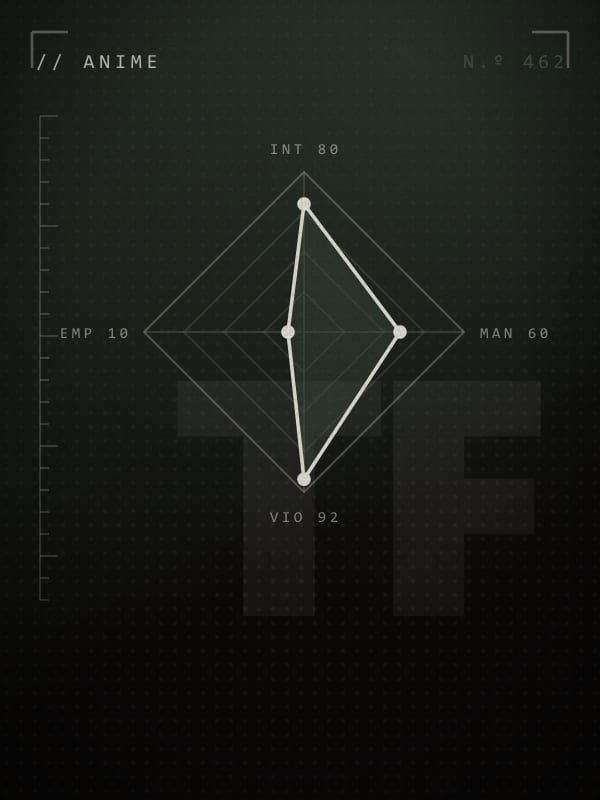
Kenjaku, the millennia-old sorcerer of Jujutsu Kaisen, is an anomaly even in a world of curses: he does not inhabit a body, he leaps from one to another, discarding each body like someone changing coats, to prolong his existence across more than a thousand years. In that time he has done nothing but manipulate human history —arranging marriages, seeding bloodlines, provoking disasters— like someone setting up a laboratory experiment to "evolve" cursed energy. People, families, entire generations are, to him, disposable variables. What appalls is not his power, but the total absence of moral friction: a thousand years operating without a single drop of guilt. For psychology, Kenjaku is antisocial personality disorder taken to its most extreme form.
// The theoryThe pattern of contempt for the other
Antisocial personality disorder (ASPD), as defined by the DSM-5, is not "being bad": it is a stable pattern of disregard for and violation of the rights of others, present since adolescence and sustained over time. Its core traits are recognizable: repeated deceit and manipulation for one's own profit or pleasure; absence of remorse, with rationalization of or indifference to the harm caused; impulsivity and an inability to plan according to rules; persistent irresponsibility; and, beneath it all, an incapacity for attachment —others are not subjects one bonds with, but objects that get used—. Kenjaku does not fit the impulsive part of the picture (he is, on the contrary, a millennia-long planner), but he displays with utter clarity the marrow of the disorder: the reduction of the other to an instrument. His relationship with any living being is purely functional: it serves the plan or it does not, and in the latter case it is discarded. That instrumental gaze, sustained without exception or crack for centuries, is the heart of ASPD.
ASPD is not exactly psychopathy
It is worth not confusing two labels that overlap but are not identical. Antisocial personality disorder is a clinical diagnosis in the DSM-5 centered above all on observable behavior: lying, breaking rules, harming, not answering for it. Psychopathy —measured with instruments like the Hare scale— adds an affective and interpersonal dimension: emotional coldness, superficial charm, grandiosity, absence of empathy and of fear. Almost all psychopaths meet ASPD criteria, but not everyone diagnosed with ASPD is a psychopath; many offend out of impulsivity or circumstance, without that deep affective iciness. Kenjaku is interesting because he falls squarely into the intersection: he has the antisocial behavior of ASPD and the psychopathic core —cold calculation, grandiosity ("I am going to redesign the world"), absence of empathy and of attachment—. He is the version where both circles overlap completely, and precisely for that reason he works as a limit case for understanding what we mean when we talk about one thing and the other.
Get the map of theories for free
Subscribe to the criminal archive —one case a week, no spam— and I'll send you The map of theories: the great currents of criminology on a single sheet.
// The subjectThe experimenter who hates no one
What is disturbing about Kenjaku is not that he is cruel out of rage, but that he hates no one. A vengeful tyrant at least feels something for his victims; Kenjaku does not. He treats humanity with the same affective neutrality with which a researcher treats a culture plate: he neither hates it nor loves it, he uses it. His motor is not revenge nor the pleasure of harm, but curiosity —he wants to see how far he can take the evolution of cursed energy, and to find out he is willing to sacrifice anything—. This experimental coldness is the purest form of the antisocial trait: where a bonded person would see subjects, he sees variables. And he sustains that gaze for a thousand years, stealing body after body, without any of the bonds those bodies had —families, children, loves— ever coming to touch him. Longevity, in his case, does not humanize: a thousand years of life have not taught him a single gram of empathy, because the very apparatus of attachment was never there. He is a being who has watched entire civilizations pass by and has loved none of them.
Kenjaku
// The crackA diagnosis explains; it does not exempt
Here is the crack, and it is delicate. Saying that Kenjaku "has antisocial personality disorder" can be read in two opposite ways, and only one is honest. The dishonest reading turns the diagnosis into an alibi: "he is ill, he can't help it, he is not responsible." That is false. ASPD describes a pattern of behavior and a way of relating to the world; it does not annul the capacity to understand what one is doing or to choose to do it. Kenjaku plans over centuries, calibrates every move, understands perfectly the harm he causes and decides to cause it anyway: that is the opposite of involuntary irresponsibility. A diagnosis explains a pattern —why the other never counts for him, why guilt never appears— but it does not erase the authorship of a single act. Explaining is not excusing.
The opposite crack is just as dangerous: using the label as a totalizing insult that dehumanizes anyone who is diagnosed. In real life, the vast majority of people with antisocial traits are not millennia-old villains; many carry histories of trauma, neglect and early adversity, and not all of them harm anyone. Kenjaku is an extreme fiction —a narrative experiment that isolates the trait in its pure state so that we can see it—, not the portrait of a real patient. The honest reading holds both things at once: naming the pattern with precision and maintaining the full responsibility of someone who, understanding what he is doing, chooses to treat others as disposable pieces.
Seeing the pattern without handing over the alibi
Kenjaku matters because he teaches how to handle one of the most delicate tools in forensic psychology: the diagnosis as a description, not as an excuse. Faced with someone who deceives, manipulates and harms without remorse, the temptation is one of two: either "he is a monster, there is nothing to understand" or "he is ill, he is not guilty." Both are ways of ceasing to think. The useful stance is the middle one: understanding that a real pattern exists —the instrumental use of the other, the absence of attachment and of guilt— that can be named, studied and, in real cases, even addressed; and at the same time not yielding an inch on responsibility for one's acts, because understanding why someone feels no guilt does not make them innocent of what they did without it. Behind the millennia-old sorcerer who treats civilizations as laboratory material there is a sober lesson: contempt for the other has a shape, and describing it is not forgiving it.
Three key ideas
- Kenjaku is antisocial personality disorder in its extreme form: repeated deceit and manipulation, total absence of remorse, instrumental use of people and societies, and an incapacity for attachment sustained over a thousand years.
- ASPD and psychopathy overlap but are not identical: ASPD (DSM-5) looks above all at behavior; psychopathy adds affective coldness and the absence of empathy. Kenjaku falls squarely into the intersection of both.
- A diagnosis explains a pattern, it does not exempt from responsibility. Neither an alibi ("he is ill, he is not guilty") nor a dehumanizing insult: name the pattern with precision and maintain full authorship of what was done.
Sources · further reading
- American Psychiatric Association (2013). DSM-5: Diagnostic and Statistical Manual of Mental Disorders. APA.
- Millon, T. (2011). Personality Disorders in Modern Life. Wiley.
- Hare, R. D. (2003). Without Conscience: The Disturbing World of the Psychopaths Among Us. Guilford Press.
Case-file questionsFrequently asked questions
¿Quién es Kenjaku?
Kenjaku («el hechicero milenario») es un villano de Jujutsu Kaisen, analizado en KRIMINIS con la lente de la criminología. A sorcerer who steals other people's bodies and has spent a thousand years moving civilizations around like pieces of an experiment.
¿Por qué Kenjaku (el hechicero milenario) se convierte en villano?
Kenjaku and antisocial personality disorder: the manipulator who leaps from body to body and treats all of humanity as laboratory material. Contempt for others taken to its most extreme form.
¿Qué teoría criminológica explica a Kenjaku?
El caso de Kenjaku se analiza desde la Trastorno antisocial de la personalidad. Antisocial personality disorder (ASPD, DSM-5) is a pattern of disregard for and violation of the rights of others: repeated deceit, absence of remorse, instrumental use of people, incapacity for attachment. Kenjaku, from Jujutsu Kaisen, is its extreme case: a millennia-old sorcerer who leaps from body to body and has manipulated human history for a thousand years like an experiment, without a single drop of guilt. A diagnosis explains the pattern; it does not exempt anyone from responsibility for what was done.