// Ranking · Manipulation

The most manipulative TV villains

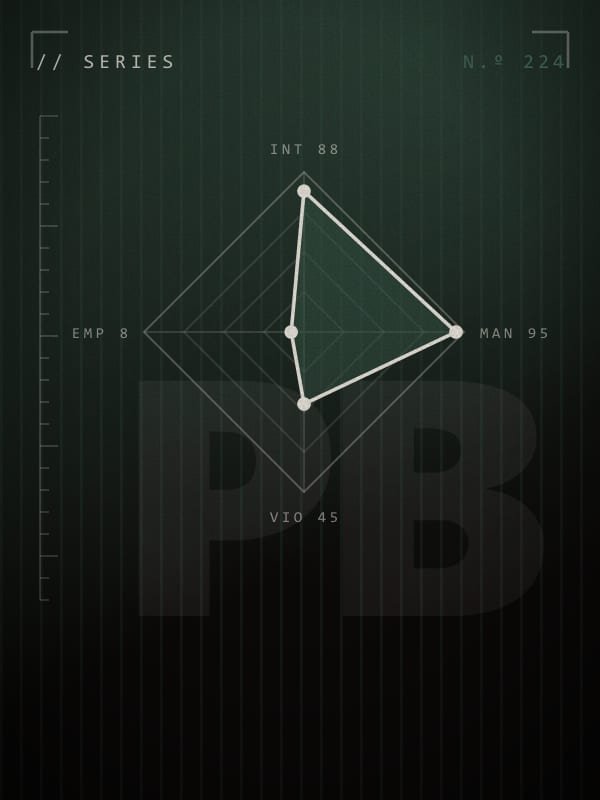
We rank the archive’s 149 TV villains by their manipulation, as each case file scores it. Top of the list is Charles Manson (Mindhunter), with 96 out of 100. Among the top ten, the most frequent theory is “Psychopathy” (3 of 10).

Sorted by manipulation · the top 25 of 149 TV villains · full live ranking →

01Poster of Charles Manson, villain from MindhunterCharles MansonDifferential reinforcement · MindhunterCharles Manson and differential reinforcement: the criminological question is not why they killed but how homicide is produced in other people…9602Poster of Jurek Walter, villain from NocturneJurek WalterPsychopathy · NocturneJurek Walter, the killer of Lars Kepler’s novels whom Apple TV brings to Nocturne, buries his victims alive and destroys the people who hunt him…9603Poster of Lalo Salamanca, villain from Better Call SaulLalo SalamancaPsychopathy · Better Call SaulLalo Salamanca and psychopathy (Hare, the PCL-R scale): superficial charm as a weapon. The likable, brilliant narco who cooks, jokes and hugs… while…9604Poster of Claire Underwood, villain from House of CardsClaire UnderwoodFeminist criminology · House of CardsFreda Adler’s emancipation hypothesis seems written for Claire Underwood: she reaches the same office as her husband and does what he did. The data…9505Poster of Frank Underwood, villain from House of CardsFrank UnderwoodFree will · House of CardsHouse of Cards and the theory of free will: Frank Underwood turns to the camera, looks you in the eye, and tells you what he is about to do before he…9506Poster of Hannibal Lecter, villain from Hannibal LecterHannibal LecterPsychopathy · HannibalHannibal and psychopathy: charm, intelligence and zero remorse. A clinical profile, not a verdict.9507Poster of Kilgrave, villain from MarvelKilgraveEvolutionary criminology · Jessica JonesKilgrave and criminological evolutionism: the worst logic of reproductive access taken by force. A man who can control minds and uses it so that he…9508Poster of Petyr Baelish, villain from Game of ThronesPetyr BaelishCognitive criminology · Game of ThronesPetyr Baelish and cognitive criminology: purely instrumental thinking as a way of life. A man who sees every person as a piece and every tragedy as a…9509Poster of Whiterose, villain from Mr. RobotWhiteroseCritical criminology · Mr. RobotCritical criminology studies the crimes the state and the corporation commit together. Whiterose holds a ministry in China, runs an army of hackers…9510Poster of David, villain from The Last of UsDavidDifferential identification · The Last of UsDavid and differential identification: the preacher who turns cannibalism into communion and predation into fatherhood. The file on the theory that…9411Poster of Terry Silver, villain from Cobra KaiTerry SilverSubterranean values · Cobra KaiTerry Silver and Matza and Sykes's subterranean values: the man who has achieved everything society asked him to achieve, using the prize to fund…9412Poster of Wendy Byrde, villain from OzarkWendy ByrdeDevelopmental dual taxonomy · OzarkWendy Byrde and Moffitt's dual taxonomy: the adult-onset offender, which is precisely the category the theory did not predict. The file on the type…9413Poster of Margo Banks, villain from The Hunting WivesMargo BanksMoral cost-benefit · The Hunting WivesMargo Banks, of The Hunting Wives, and moral cost-benefit: the queen of Maple Brook’s rich wives keeps a secret her world would never forgive. When a…9314Poster of Neal Caffrey, villain from White CollarNeal CaffreyDeterrence · White CollarNeal Caffrey and deterrence: the fraud genius so sure he would escape that no sentence could stop him. The only cure was to catch him for real and…9315Poster of Victoria Neuman, villain from The BoysVictoria NeumanWhite-Collar Crime · The BoysVictoria Neuman, of The Boys, and white-collar crime: the politician leading the fight against Vought is a supe raised by its CEO. Sutherland saw it…9316Poster of Charles Augustus Magnussen, villain from Sherlock HolmesCharles Augustus MagnussenIntelligence (IQ) and crime · SherlockCharles Augustus Magnussen neither shoots nor strikes: he memorizes. His only weapon is an intellect that files away the secrets of half the world.…9217Poster of Livia Soprano, villain from The SopranosLivia SopranoPsychoanalytic criminology · The SopranosLivia Soprano and psychoanalytic criminology: the most discredited lens in the discipline, applied to the show that put it on prime time. A woman who…9218Poster of Oh Il-nam, villain from Squid GameOh Il-namCultural criminology · Squid GameCultural criminology sees Squid Game’s player 001 as a consumer of thrills: a billionaire who bought other people’s deaths as a show, then stepped…9219Poster of Pablo Escobar, villain from NarcosPablo EscobarInstitutional anomie · NarcosPablo Escobar and institutional anomie: the case in which an illegal economy grew until it dictated terms to politics, the courts and the press. The…9220Poster of Assane Diop, villain from Arsène LupinAssane DiopOperant conditioning · LupinAssane Diop and operant conditioning: when the reinforcement is not just the loot, but the thrill of outsmarting everyone. And why punishment, so…9021Poster of Doctor Martin Brenner, villain from Stranger ThingsDr. Martin BrennerCritical criminology · Stranger ThingsCritical criminology studies the harms committed from inside the state. Dr Brenner is its fictional case: he locks up and numbers children in a…9022Poster of El Azotamentes, villain from Stranger ThingsThe Mind FlayerDifferential Coercion · Stranger ThingsThe Mind Flayer, of Stranger Things, and Colvin’s differential coercion: the shadow of the Upside Down possesses Will, Billy and half of Hawkins, and…9023Poster of Hermanos Rodríguez Orejuela, villains from NarcosThe Rodríguez Orejuela brothersDifferential association · NarcosThe Rodríguez Orejuela brothers and differential association: the cartel organized as a company that learned its techniques in the legal world. The…9024Poster of Hubert Pellegrini, villain from Arsène LupinHubert PellegriniClass conflict · LupinConflict theory asks who holds the power to name the thief. In Lupin, Hubert Pellegrini’s word was enough to have his chauffeur blamed for a theft he…9025Poster of Logan Roy, villain from SuccessionLogan RoyInstitutional anomie · SuccessionSuccession and institutional anomie: Logan Roy turns his own children into business units. It is the central thesis of the theory made tragedy — what…90