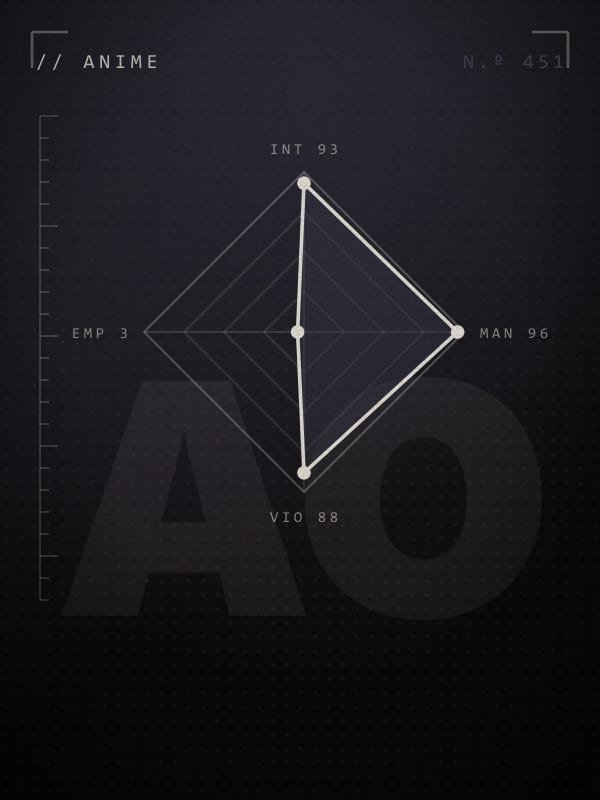
Eduardo «Lalo» Salamanca enters Better Call Saul like a breath of fresh air in a universe of grim narcos: he smiles, he jokes, he cooks dishes for the very people he has just threatened, he embraces strangers and takes an interest in their lives with a warmth that seems genuine. In a cartel peopled by silences and icy stares, Lalo is the charming one, the likable one, the one who disarms everyone with his geniality. And that is exactly where the danger lies. Because while he laughs and seduces, Lalo is measuring, calculating, weaving plans in which people are expendable pieces. When he decides to destroy someone, he does it with the same smile and without a shadow of doubt. That combination —magnetic charisma and absolute coldness— is what criminology has learned to dissect under the name of psychopathy.
// The theoryCharm as a weapon, not as an ornament
The psychologist Robert Hare devoted his career to turning a fuzzy concept —the «psychopath»— into something measurable. His instrument, the PCL-R scale (Psychopathy Checklist-Revised), evaluates twenty traits and groups them into two broad dimensions. Factor 1 gathers the interpersonal and affective core: superficial charm, grandiosity, pathological manipulation, easy lying and, above all, the absence of empathy and remorse. Factor 2 describes the lifestyle: impulsivity, irresponsibility, chronic antisocial behavior. Lalo Salamanca is, almost by the textbook, the portrait of Factor 1. His charm is not a pleasant trait that contrasts with his cruelty: it is the very mechanism of his cruelty. He seduces to obtain information, laughs to lower defenses, plays generous to create debts. And when the moment to act arrives, the absence of empathy that lets him manipulate is the same one that lets him kill without anything inside him resisting.
Psychopathy is not the monster of the movies
Here a nuance is in order, one Hare repeated tirelessly: real psychopathy does not resemble the deranged killer of the films. It is a measurable profile, a spectrum of traits scored by clinical criteria, not a label for anyone we find cruel. And, above all, most psychopaths are not killers: many never commit a violent crime, and Babiak and Hare showed that quite a few thrive in offices, boardrooms and politics, where charm and coldness prove profitable. What defines the psychopath is not blood but the affective deficit: the inability to feel the emotional weight of the other. Lalo is fiction, and he carries that profile into the terrain of the cartel, but his magnetism illustrates an uncomfortable truth about real psychopathy: we fail to recognize the psychopath not because he frightens us, but because we like him. Charm is precisely what disables our alarms.
Get the map of theories for free
Subscribe to the criminal archive —one case a week, no spam— and I'll send you The map of theories: the great currents of criminology on a single sheet.
// The subjectThe narco who smiles while he calculates
What makes Lalo a textbook case is the perfect coherence between his façade and his interior, empty of any moral brake. He does not fake warmth clumsily: he inhabits it naturally, because for him the relationship with others is instrumental from the very first second. When he investigates Gus Fring, he does not do it with threats, but with friendly curiosity, chats, casual questions that are in reality a covert interrogation. When he needs something from someone, he wraps it in generosity and humor until the victim feels indebted. And when he decides to remove an obstacle, the transition from the joke to the execution is instantaneous and without emotional transition: there is no rage, no sadistic pleasure, no hesitation. That coldness beneath the charisma is the purest trait of Factor 1: the emotion he displays is performative, a resource; the one he ought to feel —guilt, fear, compassion— simply does not appear. Lalo plans another person's death with the same serenity with which he stirs a pot, because in his affective circuit both things weigh the same: nothing.
Lalo Salamanca
// The crackCharisma does not excuse calculation
The crack in this case is the seduction the character himself exerts on the viewer. Lalo is so funny, so vital, so likable, that it is tempting to enjoy him as an endearing rogue and forget that he is a methodical killer. That is precisely the trap psychopathy sets in real life: charm is not the opposite of dangerousness, it is its vehicle. Understanding that Lalo's magnetism is a clinical trait —not a compensating virtue— does not make him any less responsible for every life he ruins. To explain is not to exonerate: to understand that his brain does not register remorse does not bring back any of his victims, nor does it turn cold calculation into innocence. Psychopathy describes a deficit, not an alibi; it explains why someone can kill without feeling, not why he should be allowed to.
There is a second crack, subtler and more dangerous: believing that the psychopath always gives himself away, that sooner or later the mask falls and reveals the monster. The reality of the PCL-R points to the opposite. Factor 1 works because it is convincing and sustained: the charm is not a disguise that cracks apart, but a stable way of operating in the world. Lalo does not make the mistake of seeming dangerous; his effectiveness depends on seeming harmless until the very last instant. And that is the discomfort the character leaves behind: that our intuition —«this person is too charming to be bad»— is exactly the cognitive failure the psychopath exploits. We do not distrust the one who makes us laugh, and there, says Hare, lies our vulnerability.
Distrust whoever disarms you too easily
Lalo teaches us to read a pattern that reappears off the screen, and not only in violent crime. The criminology of psychopathy trains us not to mistake charisma for goodness: superficial charm, grandiosity, the ease of lying without tension, the calculated generosity that creates debts, the absence of guilt in the face of harm caused. These traits appear in swindlers, in abusers, in manipulators who never spill a drop of blood yet leave shattered lives in their wake. Hare warned that the mistake is not to fear the obvious psychopath, but to lower one's guard before the charmer. The lesson of Lalo is not that likable people are dangerous —the vast majority are not— but that likability is proof of nothing, and that when someone seems too perfect, too pleasant, too in control of every interaction, it is worth watching whether behind the smile there is real warmth or only a calculation that has not yet finished being made.
Three key takeaways
- Lalo Salamanca embodies Factor 1 of psychopathy (Hare, the PCL-R scale): superficial charm, manipulation, grandiosity and, above all, absence of empathy and remorse. His charisma is not the opposite of his dangerousness: it is the instrument of it.
- Real psychopathy is a measurable profile, not the monster of the movies, and most psychopaths are not killers. What defines the psychopath is the affective deficit —the inability to feel the weight of the other— not violence.
- To explain is not to exonerate. Understanding that Lalo's brain does not register guilt does not bring back his victims nor excuse his cold calculation. Charm disables our alarms: that is why we fail to recognize the psychopath when we like him.
Sources · further reading
- Hare, R. D. (1993). Without Conscience: The Disturbing World of the Psychopaths Among Us. Guilford Press.
- Hare, R. D. (2003). The Hare Psychopathy Checklist-Revised (PCL-R), 2nd ed. Multi-Health Systems.
- Cleckley, H. (1941). The Mask of Sanity. Mosby.
- Babiak, P. & Hare, R. D. (2006). Snakes in Suits: When Psychopaths Go to Work. HarperCollins.
Case-file questionsFrequently asked questions
¿Quién es Lalo Salamanca?
Lalo Salamanca es un villano de Better Call Saul, analizado en KRIMINIS con la lente de la criminología. People like him.
¿Por qué Lalo Salamanca se convierte en villano?
Lalo Salamanca and psychopathy (Hare, the PCL-R scale): superficial charm as a weapon. The likable, brilliant narco who cooks, jokes and hugs… while planning with surgical coldness whom he is going to destroy.
¿Qué teoría criminológica explica a Lalo Salamanca?
El caso de Lalo Salamanca se analiza desde la Psicopatía. Psychopathy, as Robert Hare measures it with his PCL-R scale, is not the howling monster of the movies: it is a clinical profile made of concrete traits. Hare distinguishes a Factor 1 —superficial charm, manipulation, grandiosity, absence of empathy and remorse— from a Factor 2 —the impulsive, antisocial lifestyle. Lalo Salamanca, the smiling narco of Better Call Saul, is the almost perfect portrait of Factor 1: magnetic charisma in the service of cold calculation. He cooks for his enemies, laughs with them, embraces them… and executes his plans with total emotional indifference. The charm is not a mask he takes off: it is the instrument.