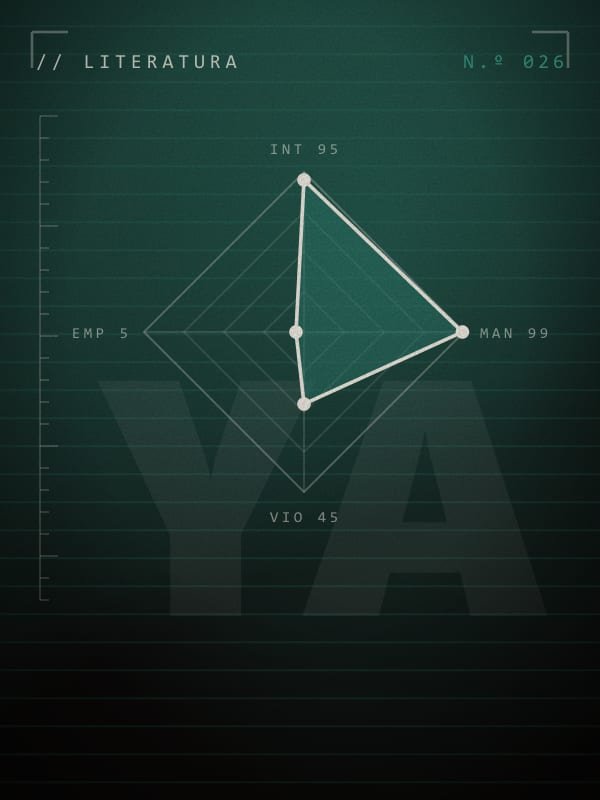
Petyr Baelish, «Littlefinger», begins as a nobody of low birth and ends up pulling the strings of entire kingdoms. His method: sow chaos —a betrayal here, a war there, a well-timed murder— and climb over the rubble. He is driven neither by hatred nor by passion, but by a constant calculation in which every person is a piece and every tragedy an opportunity. For cognitive criminology, Baelish is the portrait of purely instrumental thinking: a mind trained to see the world only as means and ends.
// The theoryThe attitude of ownership, turned into strategy
The cognitive criminology of Yochelson and Samenow lists among its «thinking errors» the attitude of ownership: treating people and things as resources available by right. Baelish raises it to an art. To him, no one is an end in themselves; everyone is a token whose value is measured by its usefulness to his rise. That distortion does not cloud his reason —on the contrary, it sharpens it—: it lets him calculate with a clarity that guilt would deny to others. His famous motto, «chaos is a ladder», is a thinking error turned into a philosophy of life: where others see suffering, he sees steps.
Coldness as a cognitive advantage
What is disturbing about Baelish is that his distortion is not a deficit, but a competitive advantage. While the other players are held back by loyalties, affections or scruples, he calculates without that burden. Cognitive criminology explains it: once thinking has eliminated the person behind the step, the brakes that slow the rest of us disappear. Baelish does not win by being cleverer than everyone —there are minds as sharp as his—, but because his cognitive style lets him do what the others do not dare to think. He is the uncomfortable reminder of the theory: sometimes the distortion does not disable the criminal, it makes him more effective.
Get the map of theories for free
Subscribe to the criminal archive —one case a week, no spam— and I'll send you The map of theories: the great currents of criminology on a single sheet.
// The subjectThe resentment that became a method
Beneath the calculation lies a wound: Baelish, humiliated in his youth by his humble origins and by an impossible love, learned that the world despises the weak and rewards those who manipulate. Cognitive criminology does not ignore that root —the resentment that shaped how he sees people—, but neither does it turn it into an excuse. The grievance explains why he built such an icy way of thinking; it does not justify the wars he provokes nor the corpses he leaves behind. Many humiliated people do not reduce humanity to a ladder. Baelish does, deliberately, over decades.
Petyr Baelish
// The crackNeither an admirable master, nor a puppet of his wound
The crack with Baelish is seduction: the show —and the viewer— almost admires his cunning, his ability to stay one step ahead of everyone. Cognitive criminology asks for another gaze: his «genius» is an impoverished, not enriched, style of thinking —he has lost the capacity to see people as anything more than tokens, and that blindness is his limit, not his gift—. The opposite crack: «his class wound made him this way». Resentment explains the origin of his distortion; it does not pull the trigger of each betrayal. Baelish chooses, move by move, to treat others as steps. He is fully responsible for the ladder he builds with corpses.
That Baelish finally dies trapped by one of his own schemes is consistent with the theory: closed thinking, unable to imagine that others might see through him, ends up stumbling over its own blind spot. The distortion that made him powerful is also the one that blinds him.
When distortion grants power
Baelish matters because he refutes the comforting idea that criminal thinking always disables. Sometimes —in power, in business, in politics— the cognitive style that erases the person behind the calculation produces winners, not losers. Cognitive criminology warns us about that profile: the functional manipulator who succeeds precisely because he thinks without the moral brakes of the rest. Detecting him is hard, because his distortion disguises itself as talent. And the uncomfortable lesson is that society often rewards what it should be watching: the one who has learned to see other people's chaos as his personal ladder.
«Chaos is a ladder», Littlefinger repeats, and he climbs. Understanding that his coldness is a style of thinking —not a superpower nor a fate— does not make him any less guilty of the wars he ignites: it returns him to his real size, that of a man who chose to see no one as anything more than a step.
Three key takeaways
- Baelish embodies the purely instrumental thinking of cognitive criminology: every person is a piece and every tragedy a step ("chaos is a ladder"). The "attitude of ownership" turned into a life strategy.
- His distortion does not disable him: it makes him more effective. Without the moral brakes of the rest, he calculates what others do not dare to think. Sometimes distortion grants power.
- Neither an admirable master (his coldness is impoverished thinking, and his blind spot kills him) nor a puppet of his class wound (resentment explains the origin, it does not excuse each betrayal).
Sources · further reading
- Yochelson, S. & Samenow, S. E. (1976). The Criminal Personality. Jason Aronson.
- Walters, G. D. (1990). The Criminal Lifestyle. Sage.
- Maquiavelo, N. (1532). El príncipe.
Case-file questionsFrequently asked questions
¿Quién es Petyr Baelish?
Petyr Baelish («Meñique») es un villano de Juego de Tronos, analizado en KRIMINIS con la lente de la criminología. He betrays, lies and starts wars without a shred of guilt.
¿Por qué Petyr Baelish (Meñique) se convierte en villano?
Petyr Baelish and cognitive criminology: purely instrumental thinking as a way of life. A man who sees every person as a piece and every tragedy as a step upward.
¿Qué teoría criminológica explica a Petyr Baelish?
El caso de Petyr Baelish se analiza desde la Criminología Cognitiva. Cognitive criminology describes distorted thinking styles that make harm feel logical. Petyr Baelish, "Littlefinger" from Game of Thrones, embodies purely instrumental thinking: "chaos is a ladder." Every person is a piece, every tragedy a chance to climb. His coldness is not an absence of reason, but a reason trained to see only means and ends.