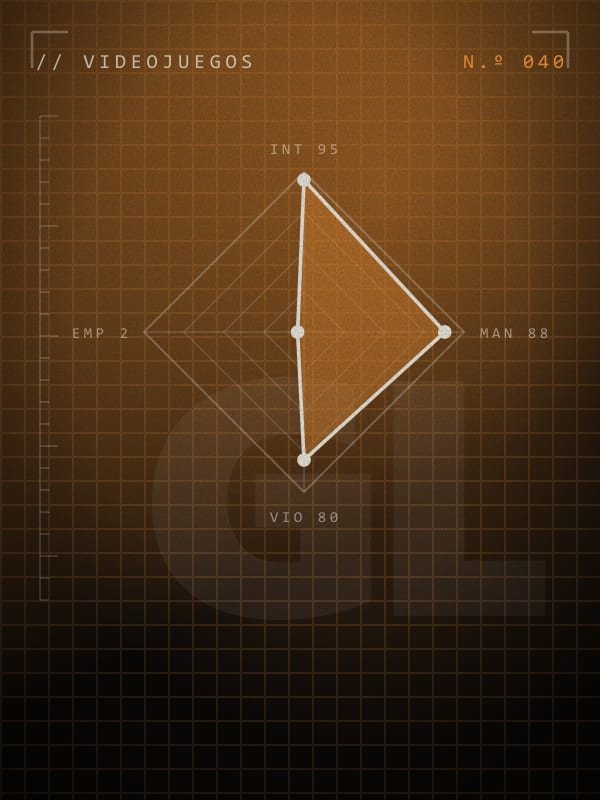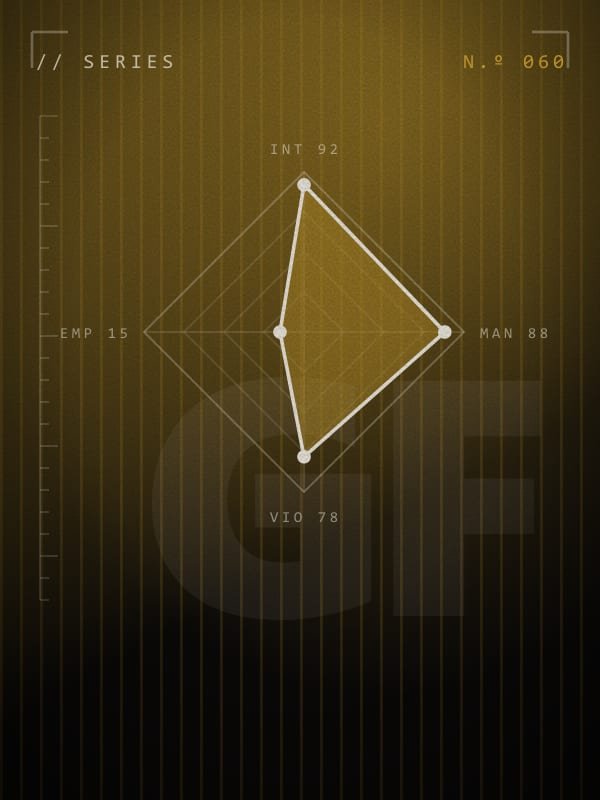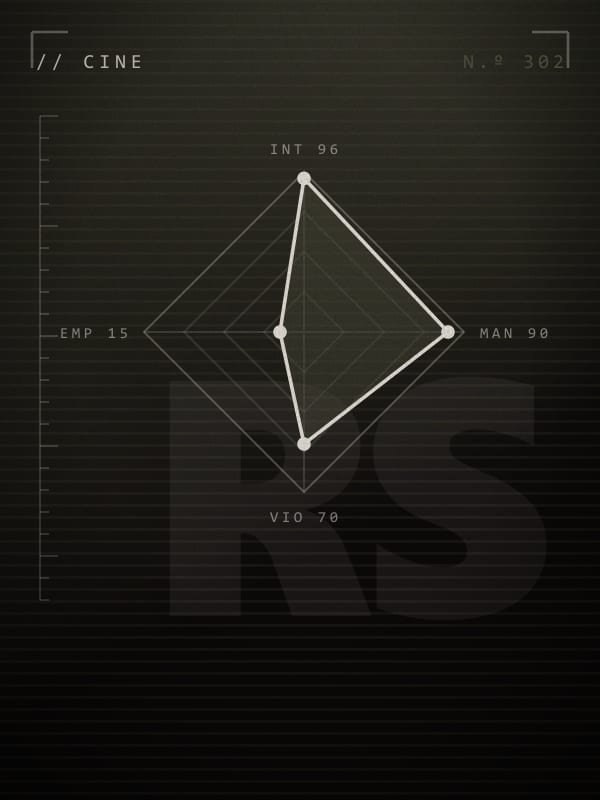
Hannibal Lecter is cultured, charming, brilliant and attentive. He is also a killer without a gram of remorse. That combination —flawless charm and utter moral emptiness— is no writer's whim: it is, almost point for point, the clinical portrait of psychopathy. With one caveat this file tries to hold from start to finish: the elegant Lecter is a fiction's fantasy; real psychopathy is far greyer.
// The theoryThe profile, not the sentence
Psychopathy is not "being insane". The psychiatrist Hervey Cleckley described it in 1941 as a mask of sanity: on the outside, impeccable normality; on the inside, the absence of the deep emotions that anchor everyone else —guilt, fear, attachment—. Decades later, Robert Hare turned that clinical intuition into something measurable and split it into two faces. The interpersonal-affective factor (Factor 1): superficial charm, grandiosity, pathological lying, manipulation and, above all, coldness —a lack of remorse and empathy—. And the behavioral factor (Factor 2): impulsivity, sensation seeking, irresponsibility, poor self-control and an early antisocial trajectory.
It helps to untangle a common vocabulary knot. Psychopathy, sociopathy and antisocial personality disorder (ASPD, the DSM-5 diagnosis) are not synonyms. ASPD is defined almost entirely by behavior —lying, aggression, breaking the law— and much of the prison population meets it; psychopathy adds the cold affective core Cleckley described, and is far rarer. In fact, most inmates with ASPD are not psychopaths. And not every psychopath ends up in prison: they are estimated at around 1 % of the general population, and many —the so-called successful psychopaths— thrive in business or politics without committing a single crime.
Hence the nuance behind the file's title: not every psychopath is violent, nor is every violent criminal a psychopath. It is a personality profile, not a criminal destiny.
The PCL-R scale
Hare's Psychopathy Checklist-Revised scores 20 items (0 to 2 each) on charm, grandiosity, lack of empathy, poor behavioral control… Above a threshold —around 30 out of 40 in North America— one speaks of a psychopathic profile. It is the standard tool in research and forensic practice, and its affective factor predicts recidivism better than criminal history alone. But it was designed as a clinical instrument, not a moral verdict.
Get the map of theories for free
Subscribe to the criminal archive —one case a week, no spam— and I'll send you The map of theories: the great currents of criminology on a single sheet.
// The subjectThe perfect mask
Lecter embodies Factor 1 above all: his charm is Cleckley's "mask of sanity" perfected, and his lack of guilt is total. His violence is not that of the textbook impulsive psychopath either —the Factor 2 kind, who explodes and lands in trouble—. His is instrumental or predatory: planned, cold, aesthetic, in the service of a goal, as opposed to the reactive violence of someone who loses control. Studies of aggression draw exactly those two forms, and the predatory kind is the signature of the psychopath who plans. That is why Lecter is so unsettling: nothing in him ever slips loose.
Hannibal Lecter
// The fault lineBorn or made?
Where does a Hannibal come from? Neuroscience points to differences in the emotion circuit. The work of James Blair flags a hypoactive amygdala —the psychopath conditions fear more poorly and struggles to read fear and sadness in others' faces, which binds their empathy—; Kent Kiehl speaks of a broader paralimbic dysfunction, with weaker connection between the amygdala and the ventromedial prefrontal cortex, the region that puts a moral brake on impulses.
But reducing it to biology is a dangerous leap. The most-cited case, that of Caspi and Moffitt (2002), showed that a variant of the MAOA gene was linked to antisocial behavior only if childhood maltreatment intervened: not the gene nor the environment alone, but their interaction. It is the lesson of Adrian Raine's neurocriminology: there is a biological substrate, yes, but environment, trauma and learning shape it. Determinism —"he was born that way, nothing can be done"— is not only bad science; it has been used to justify historic abuses in its name.
Fiction, moreover, tends to romanticize the brilliant psychopath: it turns him into an aesthete with a sky-high IQ when intelligence is no part of the profile. Worth repeating: most people who score high on the scale are not gourmets of crime, and will never kill anyone.
// The limitsThe label that weighs
Assessing risk… with care
The PCL-R is used in courts and prisons to estimate the risk of reoffending and to decide furloughs, sentences or commitments. It is useful, but it carries a real danger: pinning the "psychopath" label on someone can bias decisions for life and overpredict dangerousness —the same self-fulfilling prophecy mechanism as labeling—. It is even debated whether criminal conduct is an essential part of the disorder or just a frequent consequence. The tool is worth only as much as the prudence with which it is used.
Hannibal seduces because he embodies our subtlest fear: that the monster looks nothing like a monster, but pours us a drink and smiles. Real psychopathy is rarely so elegant… but that mask, Cleckley's, truly exists.
Three key ideas
- Psychopathy is a measurable profile (affective coldness + behavioral traits), not "being insane" nor a synonym for murderer.
- Not every psychopath is violent and not every criminal is a psychopath: many live integrated without breaking the law.
- The PCL-R helps assess risk, but the label can bias for life: it is worth only as much as the prudence with which it is used.
Sources · further reading
- Cleckley, H. (1941). The Mask of Sanity. Mosby.
- Hare, R. D. (1993). Without Conscience. Guilford Press.
- Hare, R. D. (2003). Hare Psychopathy Checklist-Revised (PCL-R), 2nd ed. Multi-Health Systems.
- Blair, R. J. R. (2005). The Psychopath: Emotion and the Brain. Blackwell.
- Caspi, A. et al. (2002). "Role of Genotype in the Cycle of Violence in Maltreated Children". Science, 297.
- Babiak, P. & Hare, R. D. (2006). Snakes in Suits. HarperCollins.
- Raine, A. (2013). The Anatomy of Violence. Pantheon.
Case-file questionsFrequently asked questions
¿Por qué Hannibal Lecter se convierte en villano?
Hannibal and psychopathy: charm, intelligence and zero remorse. A clinical profile, not a verdict.
¿Qué teoría criminológica explica a Hannibal Lecter?
El caso de Hannibal Lecter se analiza desde la Psicopatía. A stable pattern of emotional coldness, manipulation and absence of remorse, tied to neurobiological particularities. Not every psychopath breaks the law, and not every criminal is a psychopath: it is a profile, not a conviction.