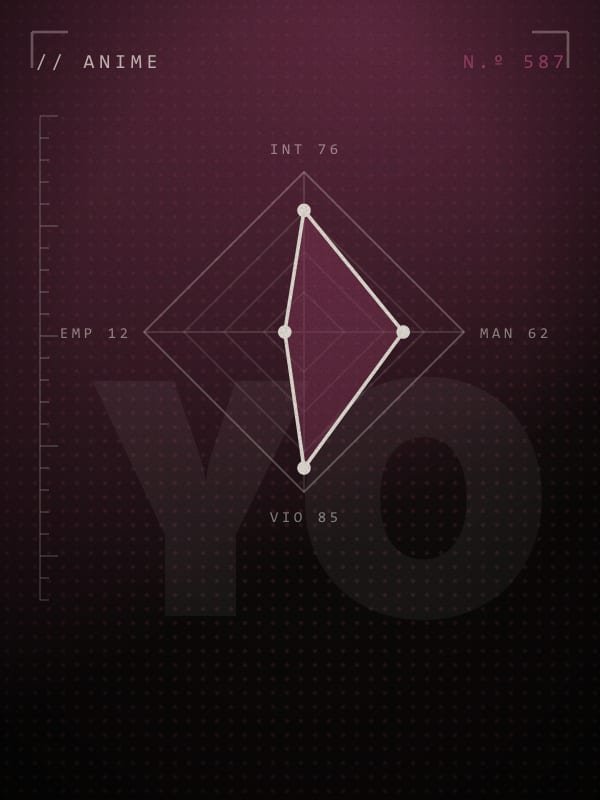
For more than a thousand years, Yorozu has carried a single idea in her chest: to unite with Ryomen Sukuna, the King of Curses in Jujutsu Kaisen. She met him only briefly during the Heian era, yet that fleeting encounter became the axis of an entire existence. She refined her cursed technique, killed, experimented on bodies and reshaped her own to «be worthy of him»; she waited across the centuries, reborn, still repeating that she loves him. But Sukuna barely remembers her, and never asked for any of it. That gap —between a devotion that fills an entire life and an other who never consented to be its object— is exactly what the psychology of bonds studies. John Bowlby and Mary Ainsworth mapped how we attach; in its pathological extreme, that map explains the obsessive fixation, the attachment that curdles into possession. Yorozu is its embodiment: someone who mistook the intensity of her own desire for a love shared with another.
// The theoryAttachment, from the safe bond to obsessive fixation
John Bowlby proposed in 1969 that human beings come into the world equipped to form attachments: emotional bonds with the figures who offer us protection. Those early bonds leave an «internal working model», a template of what to expect from others and from love. Mary Ainsworth gave the idea empirical form with the «Strange Situation», identifying attachment patterns: the secure child explores calmly because they trust the bond will hold; the anxious-preoccupied child clings, protests, cannot regulate the fear of being abandoned. In adulthood those styles color how we love. The anxious-preoccupied pattern —hunger for closeness, fear of loss, hypervigilance toward the other— is not in itself pathology: it becomes so when the fear of not being loved swallows the reality of the other person.
That is where the crossing into the clinical extreme happens. When the need for union stops registering the other's signals —their indifference, their refusal, their «no»— the bond turns into obsessive fixation, and in its most severe form into erotomania: the unshakable conviction that a certain person is destined for us, sustained without reciprocity and often against all evidence. J. Reid Meloy, studying stalkers, showed that behind the pursuit there is frequently a disordered attachment: the other has been turned into an idealized object onto which the whole self is projected. What looks like an excess of love is, in truth, a bond with an image, not with a person. And an image never says no.
Fixation loves an image, not a person
The decisive difference between love and obsessive fixation is not the intensity —fixation can be far more intense— but the recognition of the other as a separate person. Mature attachment tolerates that the loved one has a will of their own, and that this will may not point back at us. Pathological fixation cannot bear it: it needs the other to be an object that confirms the bond, never a subject who can decline it. Yorozu spends a thousand years refining a devotion that never asks Sukuna what he wants; she reads his indifference as a challenge to overcome, not as an answer. That is the mark of erotomania and of the anxious bond taken to its extreme —the attachment stops being a relationship and becomes a projection—. She loves the idea of «uniting» with him so fiercely that the actual Sukuna, with his own desires, simply disappears. When the other vanishes as a person, «love» has already become possession.
Get the map of theories for free
Subscribe to the criminal archive —one case a week, no spam— and I'll send you The map of theories: the great currents of criminology on a single sheet.
// The subjectA thousand years of a love that no one returned
What makes Yorozu a textbook case is the asymmetry of her bond. Her devotion to Sukuna is total, structuring, millennial —and almost entirely one-sided. She built her cursed technique, her cruelty and even a new body around the fantasy of union; she killed and experimented not out of simple sadism but as tribute, as a way of «being worthy» of him. But Sukuna never courted her, never promised her anything, barely retains her in memory. Yorozu does not see that void: she fills it with her own projection. Every sign of his indifference is reinterpreted as a test she must pass, every silence as a promise deferred. The anxious-preoccupied pattern, magnified across centuries, becomes a closed circuit in which the beloved no longer needs to participate. She confuses the force of her desire with a shared reality, and «uniting» —a word she repeats like a vow— means, in her mouth, that the other should dissolve into her plan. The tragedy is not that she loves too much: it is that what she calls love long ago stopped having a second person in it.
Yorozu
// The flawTo explain the obsession is not to excuse the harm
Here is the flaw, and it is a seductive one: framing Yorozu as a romantic tragedy, a woman «destroyed by love», risks turning her victims into scenery. Attachment theory explains how a bond curdles into fixation —the anxious template, the idealized image, the refusal that is not heard—; it does not convert the resulting harm into an unavoidable fate, nor into something poetic. Bowlby and Ainsworth described attachment styles as tendencies, not as destinies: countless people carry an anxious pattern and never turn another human being into an object to be conquered by force. Between the wound and the crime there is a distance filled with choices, and Yorozu made hers —to kill, to experiment on others, to treat consent as an obstacle rather than a limit—. To understand her fixation helps us recognize the mechanism; it does not soften what she did to those who were never part of her fantasy. To explain is not to exonerate. The memory that this file keeps is not that of a great unrequited love, but that of the people reduced to material for it. Obsessive love, when it stops accepting a «no», is not a deeper love: it is the negation of the other dressed as devotion.
When "I love you" refuses to hear "no"
Yorozu matters because she dismantles a dangerous cultural idea: that the intensity of desire measures the truth of love, and that a love intense enough justifies not accepting refusal. Our stories are full of «he insisted until she gave in» and «she was destined for him» —narratives that romanticize exactly the mechanism Meloy found behind stalking and Forward described in obsessive love: a bond that has stopped listening to the other. The lesson of attachment theory is the opposite. Healthy love needs two subjects, and therefore it needs the real possibility of a no; a «yes» that could not have been a «no» is not consent, and a bond that will not tolerate refusal is not attachment but appropriation. The warning sign is not how much someone loves, but whether their love makes room for the other person to exist separately —to decline, to leave, to want something else—. Yorozu never made that room. Recognizing the pattern is not about learning to fear millennial sorcerers, but about distrusting the everyday version: the devotion that turns the beloved into a possession, and calls it romance.
Three key takeaways
- Yorozu embodies attachment theory (Bowlby, Ainsworth) in its pathological face: the anxious-preoccupied pattern taken to the extreme of erotomania, where the fear of not being loved swallows the reality of the other person.
- A thousand years of devotion that Sukuna never returned reveal the core of obsessive fixation: it loves an idealized image, not a person, and cannot tolerate the other having a will —or a «no»— of their own.
- To explain is not to exonerate. An anxious attachment is a tendency, not a destiny; between the wound and the crime lie choices. Love that refuses refusal is not deeper love, but possession, and the memory is for those turned into material for it.
Sources · further reading
- Bowlby, J. (1969). Attachment and Loss, Vol. 1. Basic Books.
- Ainsworth, M. et al. (1978). Patterns of Attachment. Erlbaum.
- Meloy, J. R. (1998). The Psychology of Stalking. Academic Press.
- Forward, S. (1991). Obsessive Love: When It Hurts Too Much to Let Go. Bantam Books.
Case-file questionsFrequently asked questions
¿Quién es Yorozu?
Yorozu es un villano de Jujutsu Kaisen, analizado en KRIMINIS con la lente de la criminología. For centuries she idealized a man who barely looked at her.
¿Por qué Yorozu se convierte en villano?
Yorozu and attachment theory in its pathological face: how a millennial obsession with Sukuna turns a bond into possession —anxious attachment carried to the extreme of erotomania, the love that will not accept a no—.
¿Qué teoría criminológica explica a Yorozu?
El caso de Yorozu se analiza desde la Apego. Attachment theory (Bowlby, Ainsworth) describes how our earliest bonds shape the way we seek closeness, security and love. In its pathological face —anxious-preoccupied attachment taken to the extreme, obsessive fixation, erotomania— the bond stops being a tie between two people and becomes the possession of just one. Yorozu, the millennial sorcerer of Jujutsu Kaisen obsessed with Ryomen Sukuna, embodies this mechanism: centuries idealizing someone who barely knows her, killing and experimenting to «unite» with him, unable to accept that the other does not belong to her. The love that turns the beloved into an object.