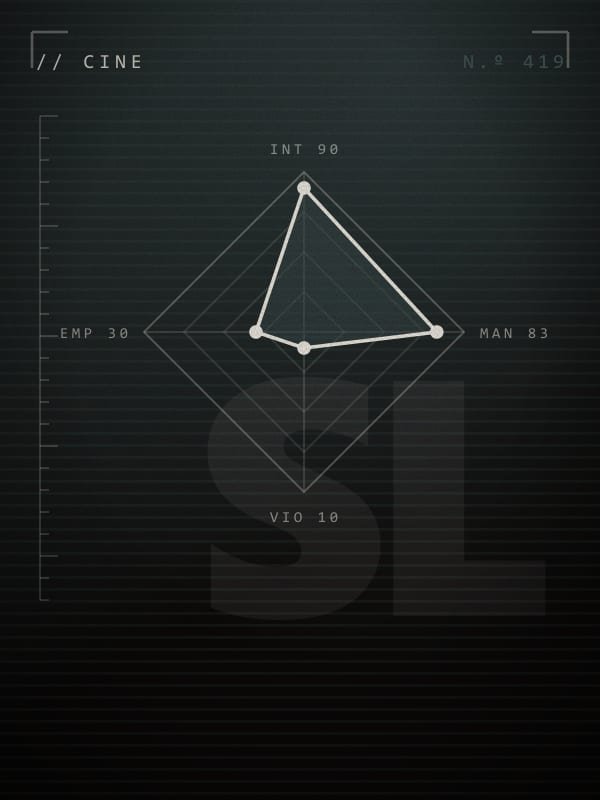
Simon Templar, “the Saint”, created in 1928 by Leslie Charteris, is one of the longest-lived vigilantes in fiction—the protagonist of dozens of novels, radio, television and film series. His nickname and his signature (a stick figure with a halo) conceal an ambiguous character: a white-glove thief and swindler who nonetheless aims his talent at blackmailers, mobsters, the corrupt and murderers—the “villains” the law cannot reach—. Templar masters all the arts of the professional criminal: defeating alarms, forcing entries, memorizing floor plans, calculating surveillance routines, entering and leaving impossible places. The difference from Raffles or Litton lies not in the technique, which is identical, but in the target: the Saint uses the reading of space to assault the real criminals. For CPTED, he is living proof that knowledge of how a space is breached is a morally neutral tool.
// The theoryThe same knowledge, the opposite end
All of CPTED rests on one specific skill: knowing how to read a space the way a criminal would read it—seeing its access points, its blind angles, its routines, its weak spots—in order to close them. It is exactly the same skill the thief exercises to exploit them. Simon Templar makes visible that this knowledge has, in itself, no moral sign: it is a key that opens in both directions. The thief uses it to rob the innocent; the CPTED analyst, to protect the innocent; the Saint, to rob the guilty. The technique of studying floor plans, calculating routes and defeating surveillance is identical in all three cases—what changes is against whom it is aimed and with what purpose. This neutrality is an uncomfortable but central idea for the discipline, because it means that whoever best knows how to defend a space is also whoever would best know how to attack it, and vice versa. Security professionals, the penetration testers who put buildings and systems to the test, the CPTED consultants who audit vulnerabilities: all of them exercise, on the side of the law, exactly the art of Templar. The discipline, at bottom, consists of training “saints”—people who master the thief’s knowledge and put it at the service of protection.
The paradox of the Saint
The same arts that make a great thief make a great guardian.
The tool is neutral; the end is not
Templar illustrates a principle that runs through all of security: that knowledge of vulnerability is a tool, and tools have no morality of their own—the use does. Knowing how to enter a house unseen can serve to rob it or to discover that it can be robbed and protect it. This ambivalence explains why the best way to harden a space is to deliberately adopt the attacker’s gaze: to walk through it asking “if I were a thief, how would I get in?”, which is precisely what Templar does before every job. CPTED professionalizes that gaze. Physical penetration testing—hiring someone to try to enter a building and report how they managed it—is the Saint’s art institutionalized: using the intruder’s knowledge to reveal the cracks before a real intruder finds them. The lesson is that this knowledge should not be feared or banned, but directed: the same eye that sees where to rob is the only one that sees where to protect. A civilization that wants to defend its spaces needs people who know how to breach them—and who choose the right side.
// The subjectThe vigilante on the border of the law
The Saint is a deliberately morally uncomfortable character: he commits crimes—theft, breaking and entering, sometimes something worse—but against people worse than himself, and with a code of his own that Charteris never leaves entirely clean. That ambiguity is part of his interest: Templar is neither a police officer nor an exemplary citizen, but someone who places himself on the border between crime and justice, using the weapons of the former in the service of the latter. For thinking about CPTED, that border is fertile: it reminds us that the knowledge the discipline needs—how security is broken—is the same knowledge criminals use, and that the line between the auditor and the thief is drawn not by technique, but by ethics and the law. To explain the appeal of the Saint is not to approve of anyone taking justice into their own hands (vigilantism has its own dangers), but to understand why his figure illuminates so well the double nature of knowledge about security: a key that, depending on who wields it, protects or plunders.
Simon Templar
Get the map of theories for free
Subscribe to the criminal archive —one case a week, no spam— and I'll send you The map of theories: the great currents of criminology on a single sheet.
// The crackNeither celebrate the vigilante, nor fear the knowledge
The crack with Templar has two versions. The first is to romanticize the vigilante: to conclude that, since the Saint uses crime for a good end, anyone with good intentions may skip the law and trespass on others’ space. It is dangerous—whoever believes themselves a vigilante rarely has Templar’s clean compass, and the end does not always sanctify the means. The second crack, the opposite one, is to fear and demonize the knowledge itself: to treat knowledge of how a space is breached as if it were intrinsically criminal, and therefore to give up training the professionals security needs. That is also a mistake: without people who know how one gets in, no one knows how to close things off. The honest reading separates the two things the Saint blends—the technique, neutral, and its use, subject to ethics and the law—and keeps the clean lesson: CPTED needs the thief’s knowledge, but placed, with rules and without shortcuts, at the service of protection.
That the same art serves to rob the innocent and to protect the innocent is the paradox Charteris hands the discipline: knowledge of vulnerability is not the enemy (it is the only tool we have); what matters, always, is where the hand that wields it points.
Training guardians with the thief’s knowledge
Templar matters for CPTED because he names the most useful and most uncomfortable truth in security: that whoever best protects a space is whoever would best know how to breach it. Every time you want to harden a building, an event or an infrastructure, truly effective defense comes not from someone who has never thought like an intruder, but from someone who has learned to think exactly that way—to read access points, blind angles and routines with the eye of one who would attack—and has put that eye at the service of protection. The discipline consists, in large part, of training Saints: professionals who master the thief’s knowledge and choose the side of the law. That is why this knowledge should not be feared or banned, but cultivated and directed with ethics. Security is not built by innocence, but by the attacker’s experience set to defend. The Saint is, in his uncomfortable way, the patron of all those who practice that trade.
Three key takeaways
- Simon Templar, Charteris’s "Saint", masters all the thief’s arts—defeating alarms, forcing entries, reading floor plans and routines—but turns them against the real criminals. The technique is identical to Raffles’s or Litton’s; the target changes.
- He embodies the idea that knowledge of how a space is breached is a morally neutral tool: the same key the thief uses to rob serves the CPTED analyst to protect. Whoever best knows how to defend a space is whoever would best know how to attack it.
- CPTED consists of training "saints": professionals (auditors, penetration testers) who master the intruder’s knowledge in the service of the law. Neither romanticize the vigilante (the end does not always sanctify the means) nor fear the knowledge: it must be directed.
Sources · further reading
- Charteris, L. (1928). Meet the Tiger. Ward Lock.
- Jeffery, C. R. (1971). Crime Prevention Through Environmental Design. Sage.
- Crowe, T. D. (1991). Crime Prevention Through Environmental Design. Butterworth-Heinemann.
Case-file questionsFrequently asked questions
Who is Simon Templar?
Simon Templar (“El Santo”) is a villain from The Saint, analysed on KRIMINIS through the lens of criminology. He studies floor plans, alarms and routines with the mastery of any professional burglar.
Why does Simon Templar become a villain?
Simon Templar and CPTED: the vigilante who masters the reading of space—access points, floor plans, routines—and turns it against the real criminals. The same knowledge, the opposite end.
Which criminological theory explains Simon Templar?
Simon Templar's case is analysed through CPTED. CPTED (Jeffery, Crowe) is the discipline of reading and designing space to prevent crime. Simon Templar, "the Saint" of Leslie Charteris, masters that same reading of space—access points, floor plans, blind angles—but turns it against the real criminals. He embodies the idea that the ability to analyze and breach a space is a neutral tool: CPTED uses that knowledge to protect, the thief to steal, and the Saint to do justice. The knowledge is the same; only the end changes.