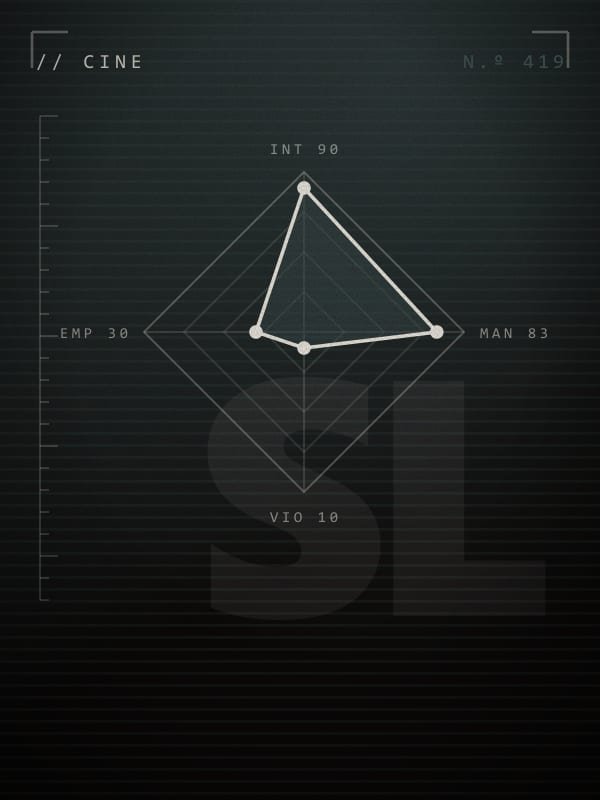
John Robie, "the Cat", the protagonist of Alfred Hitchcock's To Catch a Thief (1955)—played by Cary Grant—and of the David Dodge novel that inspired it, is a legendary jewel thief retired on the French Riviera. His signature is neither force nor deception: it is the climb. Robie enters the richest villas where no one is watching (the roof, the ledge, the top-floor terrace, the skylight), moving through the heights with an agility that earned him his feline nickname. When a series of robberies "in the Cat's style" reappears on the Riviera, Robie, the number-one suspect, must catch the imitator to clear his name. For CPTED, Robie is the personification of an uncomfortable lesson: that almost every security design thinks horizontally—doors, gates, windows at eye level—and forgets the third dimension.
// The theoryNatural surveillance has a ceiling
The flagship principle of CPTED is natural surveillance: designing so that space is seen and one is seen, because the offender fears eyes. But natural surveillance, as it is usually applied, has a physical limit: it looks at people's height. We light the streets, clear the hedges, orient the windows toward the sidewalk—and we systematically neglect what happens above our heads. John Robie exploits precisely that vertical blind spot. While the owners armor their ground floors, he arrives by air: he leaps from roof to roof, lowers himself down a façade, enters through the one window no one closed because it was "too high to be a problem." Robie demonstrates a central principle of the routine activities theory with which CPTED is in dialogue: crime occurs where an attractive target, a motivated offender and the absence of a capable guardian converge. And there is no absence of guardian more complete than that of the space no one even conceives of as vulnerable. No one watches what no one imagines can be attacked. Design only protects the threats it anticipates; the Cat lives off the ones it did not.
The blind spot the design cannot imagine
Robie illustrates the hardest failure to correct in any security design: not the known and neglected vulnerability, but the unimagined vulnerability. A weak bolt can be reinforced; a low window, barred. But you cannot protect what is not even perceived as a way in. Mature CPTED teaches that the analysis of a space must be exhaustive and three-dimensional: it is not enough to walk the perimeter on foot wondering where a thief would enter on foot; you have to look up, examine the neighboring roofs, the connected ledges, the trees that make climbing possible, the rooftops from which one reaches the next. The Cat knows the Riviera like a map of aerial routes his victims do not even know exists. That asymmetry of knowledge—the thief sees paths where the owner sees only sky—is the crack the discipline must close by imagining attacks it has not yet suffered. Designing security well demands the hardest exercise: thinking like the one who will attack from where you never expected.
// The subjectThe thief who hunts his own shadow
The irony of the plot is that Robie, to prove his innocence, must turn his own knowledge of the space into the service of defense: he thinks like the imitator who copies his method, anticipates which villa he will attack and by which route, and waits for him on the roof. He is, without knowing it, a perfect CPTED analyst: to catch the thief, he asks himself exactly what a good security designer would ask —"given this target, what is the invisible access route I would choose?"—. The film thus turns the thief into his own antidote: no one protects a house against the Cat better than another Cat. That is, for CPTED, the lesson in method: the best way to armor a space is to hire the eye of someone who would know how to breach it. Explaining Robie's art is not applauding his past thefts (he was a real thief), but recognizing that this same knowledge, turned to the side of defense, is exactly what intelligent prevention consists of.
John Robie
Get the map of theories for free
Subscribe to the criminal archive —one case a week, no spam— and I'll send you The map of theories: the great currents of criminology on a single sheet.
// The crackNo glamour without crime, no crime without a lesson
The crack with Robie is the one Hitchcock deliberately exploits: the glamour. The sunny Riviera, an impeccable Cary Grant, the robbery as an elegant ballet—everything pushes us to forget that the Cat is, after all, a thief who lived off the plunder of others. Romanticizing him until the crime is erased is a crack. But the opposite—dismissing him as a mere movie criminal with nothing to teach—wastes his value. The honest reading sees both layers: Robie is a retired offender, and he is a master class on security's vertical blind spot. Every roof he crosses is a reminder that natural surveillance, if it only looks at eye level, leaves half the house unprotected. CPTED learns from him to look up.
That it takes a thief to catch a thief is the thesis the film gives to the discipline: the knowledge of the intruder and that of the defender are the same knowledge seen from opposite sides. Whoever knows where one gets in also knows where to close off—and the best security design is the one that has learned to think like the Cat before the Cat appears.
Look up, imagine the unimagined
Robie matters to CPTED because he embodies the attack no design anticipates until it suffers it: the one that arrives through the forgotten dimension. Every time a space is protected, the temptation is to armor the obvious—the door, the ground floor, the visible perimeter—and take for granted what lies outside the natural gaze. The Cat teaches us to distrust that comfort: to ask not only "where would a thief enter on foot?" but "where would one willing to climb, to rappel down, to arrive from where no one looks?". Intelligent prevention does not protect only against known threats; it strives to imagine the unimagined, walking through its own space in three dimensions with the eyes of someone who sees routes where others see sky. Because crime, always, seeks the door the design forgot was a door.
Three key takeaways
- John Robie, "the Cat" from To Catch a Thief, is the climber who steals from above (roofs, ledges, terraces), exploiting the blind spot almost every design forgets: the third dimension. Natural surveillance, as applied, looks at eye level.
- He demonstrates that design only protects the threats it anticipates: you cannot protect what is not even perceived as a way in. CPTED analysis must be exhaustive and three-dimensional—look up, imagine the unimagined attack.
- To prove his innocence, Robie turns his knowledge to the side of defense: it takes a thief to catch a thief. Neither romanticize him for his glamour (he was a thief) nor ignore him: he is a master class on security's vertical blind spot.
Sources · further reading
- Dodge, D. (1952). To Catch a Thief. Random House.
- Cohen, L. E. y Felson, M. (1979). Social Change and Crime Rate Trends. American Sociological Review.
- Crowe, T. D. (1991). Crime Prevention Through Environmental Design. Butterworth-Heinemann.
Case-file questionsFrequently asked questions
Who is John Robie?
John Robie (“El Gato”) is a villain from To Catch a Thief, analysed on KRIMINIS through the lens of criminology. Every villa on the Riviera locks its doors and watches its gates.
Why does John Robie become a villain?
John Robie and CPTED: the climber who steals from above, the route no design foresaw. Natural surveillance watches the doors; the Cat comes in through the sky.
Which criminological theory explains John Robie?
John Robie's case is analysed through CPTED. CPTED (Jeffery, Crowe) designs spaces to shut down the opportunities for crime. John Robie, "the Cat" from Hitchcock's To Catch a Thief, is the thief who exploits the blind spot almost every design forgets: the heights. A rooftop climber who knows the Riviera villa by villa, he embodies the lesson that natural surveillance fails when it only looks at eye level, and that crime always seeks the route no one thought to watch.