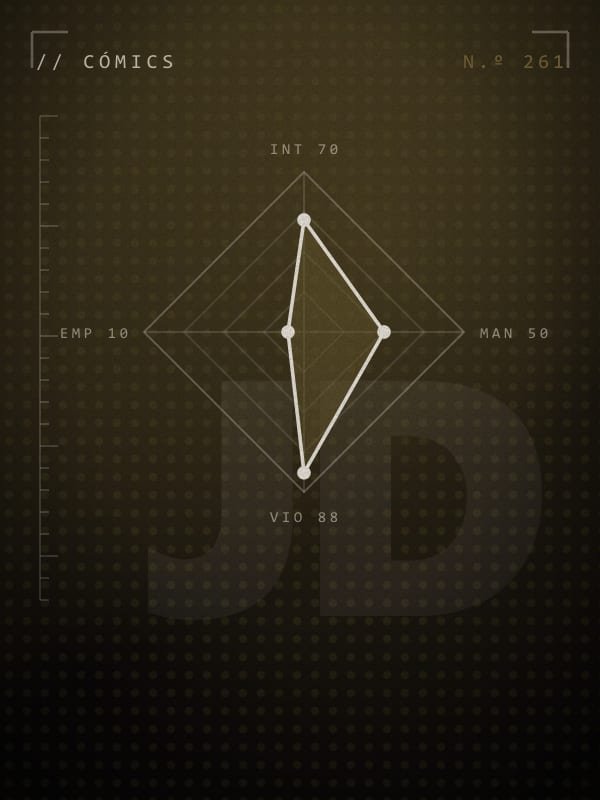
Naoya Zenin, heir to the Zenin clan in Jujutsu Kaisen, is easy to despise and, for that very reason, easy to misread. He is arrogant, cruel and viscerally misogynistic: he treats women as inferior by definition, humiliates his cousin Maki for daring to be strong without being a man, and wields violence with the lightness of someone who has never had to answer for it. The temptation is to read him as a one-note villain, a bad seed on the loose. But the theory of patriarchy and crime proposes something more uncomfortable: that Naoya's cruelty is not an eccentric trait of his character, but the faithful expression of a structure that precedes him -a clan order built on male dominance, one that rewards men for being born men and punishes women for existing without asking permission-. Naoya did not invent that order. He inherited it, believed it, and defended it with his fists.
// The theoryMasculinity as structure, not as excuse
The writer Kate Millett, in Sexual Politics, gave feminist criminology one of its founding insights: that the relationship between the sexes is, above all, a power relationship -that the intimate is political and that the domination of man over woman is a system, not a sum of private cases-. Decades later, Sylvia Walby theorized patriarchy as a web of structures that reinforce one another, and R. W. Connell contributed the decisive concept for reading Naoya: hegemonic masculinity, a cultural model that teaches men to value themselves through dominance, status and control over women. The key point is that this model is neither biology nor destiny: it is a script. And Naoya recites it in full. His contempt is not idiosyncrasy; it is clan doctrine. In a house where lineage and inherited technique are everything, and where women are treated as bargaining chips, Naoya learned that being a man and a firstborn amounted to being superior. Patriarchal violence, the theory says, is instrumental: it is not a loss of control, it is a way of exercising it. Every humiliation Naoya inflicts on Maki is not an outburst: it is a lesson about who is in charge, a reminder of a hierarchy he needs to see confirmed.
The privilege mistaken for merit
The most revealing thing about Naoya is not his hatred, but his matter-of-factness. He does not believe he is being cruel; he believes he is telling the truth. Here operates the mechanism the theory of patriarchy calls entitlement: privilege lived as a natural right, inherited position mistaken for personal virtue. Naoya did not earn his status -he was born into it-, but he defends it as if it were an achievement, and treats any challenge to that hierarchy as an intolerable affront. That is why Maki drives him mad: a woman without a cursed technique who nonetheless grows stronger than him refutes, by her mere existence, the entire narrative on which Naoya has built his identity. If she can, then his superiority was never merit, but scaffolding. The violence with which he reacts is not strength, it is fragility: that of an order that only holds up as long as no one contradicts it. The theory of patriarchy insists on this point -hegemonic masculinity does not produce secure men, but men who need to dominate in order not to collapse-. Naoya humiliates because he fears; he despises because, deep down, he has sensed that his throne is borrowed.
Get the map of theories for free
Subscribe to the criminal archive —one case a week, no spam— and I'll send you The map of theories: the great currents of criminology on a single sheet.
// The subjectThe perfect product of a rotten clan
Naoya is, in the most literal sense, a product. The Zenin clan is a machine for manufacturing men like him: it relegates women, measures people by their inherited technique, and cultivates among its heirs the certainty that power is deserved by blood. Naoya is not an anomaly within that system; he is its most polished specimen, the one who internalized the script without a crack. And here the theory adds a nuance that keeps it from becoming a caricature: patriarchy does not say that «men» are like this. The proof is in the story itself -other men in the series' universe break with that model, and the Zenin clan is not all of masculinity, but one masculinity, the most rigid and toxic one-. Naoya is what that particular model produces when taken to the extreme and no one corrects it: a man who mistakes cruelty for authority and contempt for clarity. His violence against Maki is the heart of the case, because in it the naked logic can be seen: he does not attack her for what she does, but for what she is -a woman who refuses to occupy the place the hierarchy assigned her-. The symbolic femicide, the attempt to erase the woman who defies the order, is the coherent conclusion of everything Naoya believes.
Naoya Zenin
// The crackExplaining the structure does not absolve the heir
The crack with Naoya has two edges, and it is worth holding on to both. The first is the risk of dissolving him into the structure: saying «it was the clan, it was patriarchy» until the analysis becomes an alibi, as if Naoya were a cog without a will. The theory does not say that. Millett, Walby and Connell analyze structures precisely to pinpoint responsibility with more precision, not less. That Naoya was shaped by a misogynistic order explains why there are so many like him, it does not pardon this one. Others were born into the same clan and did not choose his path; he did. Every humiliation of Maki, every act of contempt, every blow was his decision, and the structure that made it easy for him did not hold his hand. Explaining is not excusing. The second edge is the opposite: stopping at «Naoya is an exceptional pig» and failing to see that his contempt was only possible because an entire clan -its rules, its history, its tolerance- authorized and applauded it. Reducing him to a repugnant individual reassures us, but blinds us to what matters: that the Naoyas do not spring up alone, but in systems that normalize their dominance long before they raise a hand.
The honest reading holds both things at once. Naoya is responsible -for every humiliation, for every attempt to crush Maki for the crime of being strong while being a woman-. And his cruelty is also that of a structure that taught an entire clan that women were worth less and that domination was the natural order of things. The memory that matters here is not that of the arrogant heir, but that of the women his privilege sought to erase: the women of the Zenin clan treated as currency, and the cousin who refused to disappear and returned to him, measure for measure, the truth he did not want to hear.
Recognizing the script before it strikes
Naoya matters because he teaches us to read misogyny as a system and not as character. It is comfortable to point at the obvious villain -the one who insults and hits in broad daylight- and feel safe. But feminist criminology insists that this man is the tip of an iceberg: beneath him lies the cultural script that told him he was worth something by dominating, the institution that rewarded his arrogance, the custom that called inequality «tradition». Naoya's contempt did not begin with a blow; it began long before, in every clan rule that placed men above and in every silence that allowed it. That is why the lesson is not to wait for the cruel heir in order to condemn him, but to recognize the script while it still disguises itself as normality: in the man who mistakes privilege for merit, in the one who experiences a woman's «no» as an affront, in the one who needs to demean others to feel like somebody. Changing that script -teaching a masculinity that does not equate worth with dominance- is prevention, and also a way of freeing men themselves from a model that turns them into jailers of those beside them.
Three key takeaways
- Naoya Zenin embodies the theory of patriarchy (Millett, Walby, Connell): his misogyny is not a personal flaw, but hegemonic masculinity made flesh -a cultural script that teaches men to value themselves through dominance and control over women-.
- His cruelty is privilege mistaken for merit: he inherits a status and defends it as an achievement. That is why Maki unhinges him -a strong woman refutes his superiority-, and his violence is not strength, but the fragility of an order that only holds up when it goes uncontradicted.
- Explaining is not excusing. That the clan shaped him explains why there are so many like him, it does not pardon this one: every humiliation was his decision. The memory is for the women his privilege sought to erase, not for the heir.
Sources · further reading
- Millett, K. (1970). Sexual Politics. Doubleday.
- Walby, S. (1990). Theorizing Patriarchy. Blackwell.
- Connell, R. W. (2005). Masculinities (2ª ed.). University of California Press.
Case-file questionsFrequently asked questions
¿Quién es Naoya Zenin?
Naoya Zenin es un villano de Jujutsu Kaisen, analizado en KRIMINIS con la lente de la criminología. He was born a man and the firstborn of a powerful clan, and he decided that this made him superior to anyone who was neither.
¿Por qué Naoya Zenin se convierte en villano?
Naoya Zenin and the theory of patriarchy: cruelty as an assertion of dominance. How contempt for women is not a personal flaw of the clan's prince, but the script of an entire structure.
¿Qué teoría criminológica explica a Naoya Zenin?
El caso de Naoya Zenin se analiza desde la Teoría del patriarcado y el delito. The theory of patriarchy and crime (feminist criminology; Kate Millett, Sylvia Walby, R. W. Connell) understands violence against women not as an anomaly of exceptional aggressors, but as the logical consequence of a structure of male dominance. Naoya Zenin, heir to the Zenin clan in Jujutsu Kaisen, embodies that structure made flesh: a man convinced that his gender and his birth grant him the right to command, humiliate and dispose of others -especially the women of the clan, like Maki-. His cruelty does not spring from a private trauma, but from a privilege no one ever taught him to question. Hegemonic masculinity as a script, and violence as the way that script imposes itself.