Gyokko, Upper Moon Five of the demon army in Demon Slayer, does not see himself as a monster: he sees himself as a misunderstood artist. He emerges from a porcelain vase, twists human bodies until they become "sculptures" and expects, as the most natural thing, the world to kneel before his genius. When someone fails to admire his work -when the swordsmith Haganezuka ignores him completely, absorbed in his blade-, the haughty artist crumbles in an instant and erupts in fury. In that contrast, between the displayed grandiosity and the rage that sustains it, the theory of the criminal personality recognizes a very specific profile: that of pathological narcissism.
// The theoryFrom Eysenck's temperament to the Dark Triad
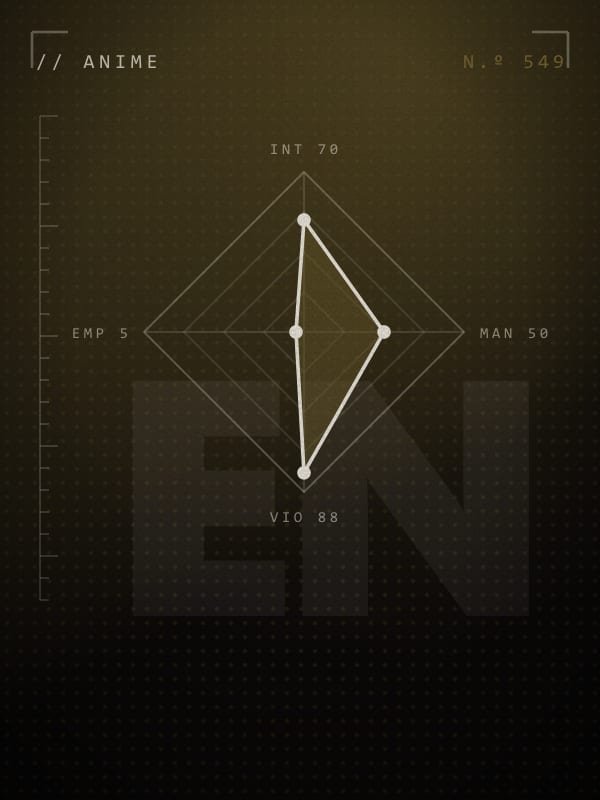
The idea that a crime-prone personality exists begins with Hans Eysenck, who in 1964 measured it along three axes -extraversion, neuroticism and psychoticism- and linked antisocial behaviour to a difficult temperament that learns poorly from punishment. Decades later, psychology refined that intuition. In 2002, Delroy Paulhus and Kevin Williams formulated the Dark Triad: three distinct profiles sharing a core of contempt for others -Machiavellianism (cold manipulation), subclinical psychopathy (impulsivity and lack of empathy) and narcissism (grandiosity)-. Narcissism, precisely, is the key to reading Gyokko. He is no mere show-off: he displays the three classic pillars of pathological narcissism -an outsized grandiosity ("I am a genius"), an insatiable need for admiration (he demands an audience, applause, reverence) and a total absence of empathy (people are not people, they are material for his work)-. And, like every pathological narcissist, he carries the hidden flip side of that grandiosity: an ego as inflated as it is brittle.
Fragile grandiosity: the genius who needs applause
The paradox of pathological narcissism is that grandiosity is not strength, but its disguise. The ego that proclaims itself brilliant is not enough on its own: it depends on the applause of others to sustain the fiction. That is why Gyokko does not create in solitude -he needs to show off, to boast, to be admired-, and that is why any crack in that mirror sinks him. When Haganezuka, in the middle of battle, simply ignores him to keep polishing his blade, Gyokko does not take a physical blow: he takes a narcissistic wound. Indifference to his work is, for him, unbearable, because it disproves the only truth on which he has built himself. The response is narcissistic rage: a disproportionate fury, not at a real threat, but at the audacity of not worshipping him. The narcissist hates not so much the one who attacks him as the one who reminds him that he is not what he claims to be.
Get the map of theories for free
Subscribe to the criminal archive —one case a week, no spam— and I'll send you The map of theories: the great currents of criminology on a single sheet.
// The subjectHorror disguised as a work of art
What is revealing about Gyokko is how he dresses up his cruelty. He does not kill out of hunger or duty, like other demons: he kills to create, and that creation he calls art. He twists corpses into impossible poses and displays them with the pride of the sculptor showing off his finest piece. There operates the coldest trait of the profile: the absolute objectification of the other. Empathy is not dimmed, it is absent -his victims awaken in him not a flicker of recognition, because he never registered them as fellow beings, only as raw material-. That is the mark the Dark Triad identifies as its common core: the instrumental contempt for others, which here reaches the extreme of turning human suffering into decorative material. And yet, alongside that coldness lives the most childish vanity: Gyokko boasts of his rank, brags about his promotion to Upper Moon, seeks Muzan's approval like a child showing off a drawing. Calculated coldness toward his victims and a desperate hunger for recognition from above: the two faces of the same ego.
Gyokko
// The crackThe trait does not compel killing
Here it is worth slowing down, because the theory of the criminal personality carries a warning its own authors never tire of repeating. Paulhus and Williams found that Dark Triad traits -narcissism included- are far more abundant outside prisons than within: in offices, in politics, in everyday relationships. That is: the vast majority of people with marked narcissistic traits will never commit a crime, let alone an atrocious one. Narcissism is a personality trait, not a sentence; it describes a probability, never a verdict. That is why it would be a mistake to read Gyokko as if his vanity pushed him inevitably toward horror. Grandiosity and the hunger for admiration explain his style -why he kills "making art", why he demands applause, why he erupts at criticism-, but they do not, on their own, manufacture a murderer. Between the trait and the crime there always stands a decision.
To explain is not to excuse. Understanding that Gyokko embodies pathological narcissism helps name what he does and recognize the mechanism -the fragility behind the arrogance, the fury at the wound-, but it does not dilute his responsibility one bit. Each body he turned into a "work" was a person he chose not to see. The honest reading holds both things: the trait illuminates the portrait, and at the same time reminds us that millions share that trait without harming anyone. The memory, as always, is not for the artist who admired himself, but for those he reduced to material.
Telling the difficult ego from the dangerous ego
Gyokko matters because he exaggerates, to the point of caricature, something we recognize on a human scale: the ego that needs to be admired and rages when it is not. The theory of the criminal personality teaches us to look at that profile without two common errors. The first, demonizing the trait: treating every vain or recognition-hungry person as a criminal in the making, when narcissism alone does not predict violence. The second, the opposite: ignoring the signal when narcissism combines with empathic coldness and instrumental contempt for others -there, and only there, a warning light begins to flicker on-. The lesson is not to fear whoever shows off, but to learn to tell apart the vanity that merely tires us from the one that has stopped seeing people as people. Gyokko is the reminder, taken to the extreme of myth, of what happens when grandiosity is left alone with the total absence of empathy.
Three key takeaways
- Gyokko embodies the pathological narcissism of the Dark Triad (Paulhus and Williams), heir to Eysenck's criminal personality: grandiosity, hunger for admiration and absence of empathy, with victims reduced to "material" for his art.
- His grandiosity is fragile: the genius who proclaims himself needs the applause of others, and responds with narcissistic rage -disproportionate fury- to the wound of the ego, as when Haganezuka ignores him.
- To explain is not to excuse. Narcissism is abundant outside prisons and almost never leads to crime: the trait is a probability, not a sentence. Between vanity and horror there always stands a decision.
Sources · further reading
- Paulhus, D. L. & Williams, K. M. (2002). «The Dark Triad of Personality». Journal of Research in Personality, 36(6).
- Eysenck, H. J. (1964). Crime and Personality. Routledge & Kegan Paul.
- American Psychiatric Association (2013). DSM-5: Trastorno narcisista de la personalidad. APA.
- Kernberg, O. F. (1975). Borderline Conditions and Pathological Narcissism. Jason Aronson.
Case-file questionsFrequently asked questions
¿Quién es Gyokko?
Gyokko es un villano de Demon Slayer, analizado en KRIMINIS con la lente de la criminología. He turns human bodies into "sculptures" and expects the world to bow before his talent.
¿Por qué Gyokko se convierte en villano?
Gyokko, the Upper Moon who sculpts corpses and demands admiration, read through pathological narcissism: grandiosity, a hunger for applause and a blind fury when anyone dares not to applaud.
¿Qué teoría criminológica explica a Gyokko?
El caso de Gyokko se analiza desde la Personalidad criminal. The theory of the criminal personality (Eysenck and, above all, the Dark Triad of Paulhus and Williams) places narcissism among the profiles that combine grandiosity, a need for admiration and contempt for others. Gyokko, Upper Moon Five in Demon Slayer, embodies it without nuance: he believes himself a brilliant artist, turns corpses into "art", demands reverence and erupts in fury when someone dares to criticize him. His is the portrait of pathological narcissism -displayed grandiosity, zero empathy and an ego so fragile that any wound turns to rage-.