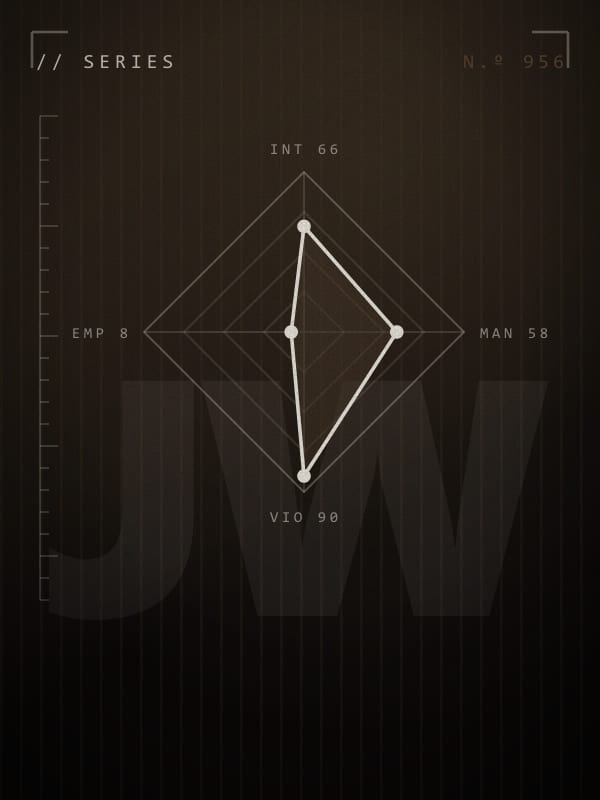
In “Gliding Over All” (S5E8 of Breaking Bad), Todd takes Walter White to a motel to meet his uncle. Jack Welker, played by Michael Bowen, runs a white-supremacist gang with men inside the prisons, and Walt has come to hire him for a job: kill ten inmates, Mike Ehrmantraut’s nine men who might talk, plus their lawyer, spread across three prisons, all within a two-minute window. Around the table, the gang goes over the logistics like a crew planning a shift: how many of their own are in each facility, who makes the schedule now, which man on the night shift would have to pull a double. Jack is frank with his client. Killing them all can be done; killing them in three prisons at once, he says, is more complicated than taking out Bin Laden. Walt does not budge: figure it out, that is what he is paying for. The next day, Walt watches the seconds tick by on his watch while his ten witnesses are stabbed or burned to death in their cells. This file covers Jack’s entire arc, ending included.
// The theoryMurder as a service
In 1937, Edwin Sutherland published The Professional Thief, written almost entirely by a real thief he called Chic Conwell. What it described was not a desperate or a sick man but a professional: someone with techniques learned from others, a vocabulary of his own, a code among colleagues, a reputation to protect and one key piece, the fix, the network of police officers, lawyers and officials that turns risk into a negotiable cost. In 1973, Peter Letkemann widened the lens in Crime as Work: for some offenders, crime is work, with skills, routines and an almost job-like relationship to risk. And in 1981 Ken Levi, in a study of a hit man, showed how even the most extreme trade is learned and sustained within a professional frame: the contract is treated as business and the victim as a job to be finished. The theory has a limit worth stating from the start. Sutherland’s thief despised violence, because it brought trouble. Violence is exactly what Jack sells.
The fix, the price and the contract
What Jack offers has the three pieces of a trade. The first is the fix: men inside three prisons and someone who controls the schedule, an access Walt cannot buy anywhere else. The second is the price: there is a rate per head, and Walt knows it, because on the next job he offers to triple it. The third is the contract: an accepted job is a debt between the two parties, and the whole relationship between Jack and Walt turns on one word, owe. The trade is not in the cruelty. It is in the fact that murder comes with terms.
// The subjectThe man who names the price
Three moments in the final season show how he works. In “To’hajiilee” (S5E13), Walt hires him to kill Jesse Pinkman and asks for it to be quick and painless, a bullet to the back of the head he does not see coming. Jack approves: there are too many savages out there. But when Walt wants to talk money and offers to triple the price per head from last time, Jack turns him down. He does not want money: he wants Walt to cook for them and teach Todd to raise the purity and give the meth the blue touch that, so he has been told, is all the craze with Slavic buyers. A professional does not charge what he is offered, but what the job is worth to the person ordering it. Later, trapped in the desert, Walt calls him to come and save him, and as soon as he sees Hank arrive he calls him off. Jack shows up in the To’hajiilee desert anyway with his crew and their guns, and the gang opens fire on Hank Schrader and Steven Gomez.
The second moment is the most searched-for in the series. In “Ozymandias” (S5E14), Gomez is dead and Hank is wounded. Walt begs: Hank is his brother-in-law, he is family, and in exchange for his life he offers Jack the eighty million dollars he has buried right there. Jack hears him out and puts it to Hank, who refuses to ask for anything and tells him to do what he is going to do. Jack shoots him. Then he uses Walt’s coordinates to dig up the barrels, takes six and leaves him one, about eleven million, because, he explains, his nephew respects him. Walt reminds him that he still owes him Pinkman, and, at Todd’s suggestion, the gang takes Jesse alive to their compound to get out of him whatever he has told the feds. The third moment comes in “Granite State” (S5E15): with the money in hand, Jack no longer cares about meth, because they have won the lottery. It is Todd who insists on cooking, and Jack gives in with a few jokes. Jesse is kept chained in a pit, forced to cook, and when he tries to escape, Todd kills Andrea in front of him while Jack, from the truck, reminds him that there is still the kid.
Jack Welker
Get the map of theories for free
Subscribe to the criminal archive —one case a week, no spam— and I'll send you The map of theories: the great currents of criminology on a single sheet.
// The crackWhat kills him is not a miscalculation
(Spoiler warning.) In “Felina” (S5E16), Walt returns to the compound with a machine gun hidden in the trunk of his car and offers Jack a new method of cooking without methylamine. Jack turns it down the way a manager would: Lydia still gets them the precursor and, if it ain’t broke, why fix it? He orders Walt taken out back and killed. Then Walt plays the contract card: Jack promised to kill Jesse and did not, so now he is his partner. That is where the professional disappears. Jack does not reason, he takes offense. Partner with a rat? This man is calling him a liar; he has insulted him and all of his men. He has Jesse brought in to prove he is not a partner but a slave, and in that gesture he gives Walt the seconds he needs. Wounded, Jack offers him the money, tells him that if he pulls the trigger he will never find it, and Walt shoots him before he finishes the sentence.
That ending marks the limit of the theory. The trade explains how Jack works, but not why he falls: what undoes him is a code of honor that fires at an insult, the ground Wolfgang and Ferracuti described in The Subculture of Violence (1967). Nor should the portrait of the efficient professional hide what his gang is. The racism is not decoration: at the motel meeting, someone rules out hiring outside help because they will not mix their blood with Mexicans. Reading Jack through the trade helps us see how violence is organized, not admire it. Explaining Jack is not excusing him: a price per head does not turn a murder into a job, it only makes it easier to order.
The power of whoever is inside
The one thing Walt could not do himself was reach ten men locked up in three prisons. That is what Jack sells him, and it is what makes real prison gangs so dangerous. The economist David Skarbek, in The Social Order of the Underworld (2014), argues that in American prisons these gangs arose to provide an order and a protection the state did not provide, and that this capacity to govern inside the walls gives them power outside as well. The series dramatizes it in a single scene: ten inmates in state custody die within two minutes because someone, inside, controls the schedule.
Three key ideas
- Crime as a trade (Sutherland, 1937; Letkemann, 1973) describes people who live off crime as a profession, with technique, price, reputation and a “fix” that buys impunity; Levi (1981) showed that even contract killing can be lived that way.
- Jack Welker, Breaking Bad’s Uncle Jack, sells killings under contract: the ten inmates in three prisons in “Gliding Over All,” the hit on Jesse in exchange for a cook, and in “Ozymandias” he kills Hank and keeps six of Walt’s seven barrels.
- The crack: he does not fall to a miscalculation but to an insult; in “Felina” he takes it as an affront that Walt calls him Jesse’s partner, and that code of honor, closer to the subculture of violence, costs him his life.
Sources · further reading
- Sutherland, E. H. (1937). The Professional Thief. University of Chicago Press.
- Letkemann, P. (1973). Crime as Work. Prentice-Hall.
- Levi, K. (1981). “Becoming a Hit Man: Neutralization in a Very Deviant Career”. Urban Life, 10(1), 47-63.
- Wolfgang, M. E. and Ferracuti, F. (1967). The Subculture of Violence. Tavistock.
- Skarbek, D. (2014). The Social Order of the Underworld: How Prison Gangs Govern the American Penal System. Oxford University Press.
- Gilligan, V. (creator) (2008-2013). Breaking Bad, season 5. AMC.
Case-file questionsFrequently asked questions
Who is Jack Welker?
Jack Welker (“Tío Jack”) is a villain from Breaking Bad, analysed on KRIMINIS through the lens of criminology. Walt offers him eighty million dollars for his brother-in-law’s life.
Why does Jack Welker (Uncle Jack) become a villain?
Jack Welker, Breaking Bad’s Uncle Jack, and crime as a trade: the neo-Nazi gang leader sells killings with a price, a deadline and a contract. He kills Hank, takes Walt’s money and falls to an insult, not a mistake.
Which criminological theory explains Jack Welker?
Jack Welker's case is analysed through Crime as a trade. Crime as a trade (Edwin Sutherland, The Professional Thief, 1937; Peter Letkemann, Crime as Work, 1973) describes people who live off crime as a profession: with technique, prices, reputation, contacts who buy impunity and a code among colleagues. Jack Welker, Breaking Bad’s “Uncle Jack” (season 5), leader of a white-supremacist gang and Todd Alquist’s uncle, is its coldest version: he sells contract killings, inside prison and out. He kills Hank Schrader in “Ozymandias,” keeps almost all of Walter White’s money and dies in “Felina” because he takes a trap as an insult.


