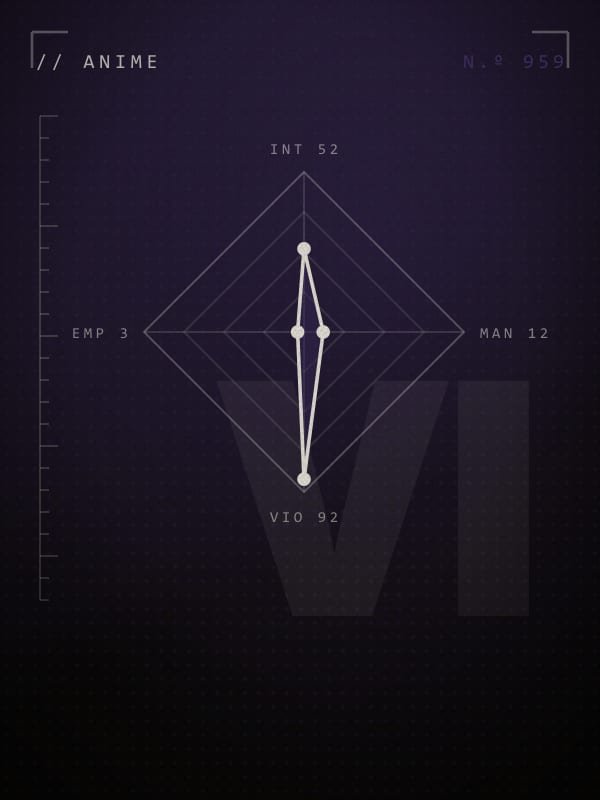
He barely says a word in the entire series. Combustion Man—the silent assassin from Avatar: The Last Airbender— enters the scene like a force of nature: a hulking man with a third eye tattooed on his forehead, able to fire explosions with his mind. Prince Zuko hires him to do what he himself cannot: kill Aang, the Avatar. And that is his entire motive. He does not know his victim, does not hate him, does not share the Fire Nation’s cause. He accepts a job, weighs what he stands to gain and what he stands to lose, and hunts a twelve-year-old boy halfway across the world with the coldness of someone fulfilling a contract. For the economic model of crime, this mercenary is not a psychological monster or a fanatic: he is an almost textbook illustration of an uncomfortable thesis—that much of crime is, above all, a business.
// The theoryCrime as a business decision
In 1968, the economist Gary Becker—a future Nobel laureate—published “Crime and Punishment: An Economic Approach” and turned criminology on its head with a provocative idea: let us stop asking why someone is a criminal and ask instead how much they gain by being one. For Becker, the offender is not a sick person, nor a victim, nor a rebel: he is a rational agent who does what any entrepreneur would do faced with an opportunity—weigh the expected benefit against the expected cost—and acts according to how the numbers work out. And the expected cost, he stressed, is not simply the penalty, but the penalty multiplied by the probability of suffering it, plus the legal opportunities forgone by turning to crime. If the expected utility of the offense exceeds that of spending that same time and those same resources on an honest activity, the offense occurs. You can read the full theory in the economic model of crime.
Few fictional characters embody this logic as cleanly as Combustion Man. The hired killer is, literally, the homo economicus of crime: someone who has turned murder into a profession, with its fee, its method and its risk management. He does not kill for sadistic pleasure—that would be another profile—nor out of conviction—that would be the terrorist or the soldier. He kills because he is paid, and he stops killing when it would stop paying off. His relationship with the victim is not one of hatred, but of contract: to him, Aang is not an enemy, he is a job. Violence ceases to be the expression of a personal conflict and becomes what the model says it can become: the cold execution of a transaction.
Murder as a service
The most disturbing contribution of Becker’s model is that it treats crime as an industry with supply and demand. There are those who demand that someone die—Zuko, in this case, pressured by his own father and sister—and those who offer that service in exchange for a price. Combustion Man is pure supply side: a specialized provider covering a need his client cannot meet on his own. Seen this way, the hired killer is not a pathological anomaly, but the rational response of a market to solvent demand. As long as there is someone willing to pay for a death, there will be someone who calculates that offering it—risk included—pays off. The character’s coldness, that total absence of rancor or ideological cruelty, is not a flaw in the writing: it is exactly what the model predicts of a criminal who responds to incentives and not to passions. When crime is a service, the criminal does not need to hate you to kill you. It is enough that the numbers add up.
// The subjectA relentless provider, not a fanatic
What makes Combustion Man so effective—and so terrifying—is precisely his lack of personal motivation. The villains of Avatar tend to burn inside: Ozai scorches the world out of a thirst for dominance, Azula kills out of fear of not being perfect, Zhao kills out of ambition and vanity. The hired killer burns for nothing. He pursues Aang with mechanical persistence, attempt after attempt, because abandoning the job would mean not getting paid and being seen as a professional who does not deliver. His third eye, the weapon that makes him unique, is also an unwitting metaphor for the economic model: a cold sight that aims and calculates, indifferent to the humanity of what it targets. In Becker’s terms, he is the offender the theory explains better than almost any other—the one who literally brings a calculator.
And yet the character himself also reveals the model’s deterrent lever. Becker weighed probability and severity together; it was later deterrence research (Nagin, 2013) that found that, in order to make crime costlier, the certainty of failing usually matters more than the harshness of the punishment. Combustion Man does not fall to a sentence, but to a miscalculation: he underestimates his targets, presses on beyond what is prudent and ends up destroyed by his own weapon when Sokka changes the conditions of the confrontation. The rational agent crashes when the equation stops working out—when the real cost suddenly exceeds the expected benefit he had estimated. His end is not a moral punishment: it is a balance sheet that closes in the red.
Combustion Man
Get the map of theories for free
Subscribe to the criminal archive —one case a week, no spam— and I'll send you The map of theories: the great currents of criminology on a single sheet.
// The crackWhen the calculator is not enough (and why it does not exonerate)
The crack in the model when applied to this character is twofold, and it is worth naming it honestly. The first: the mercenary is the best possible case for Becker, and precisely for that reason he misleads. The model illuminates, like no other theory, premeditated and lucrative crime—the hitman, the drug trafficker, the white-collar swindler—and falls almost mute before impulsive and passionate crime, which is the most common. No one stabs their brother-in-law in an after-dinner argument after estimating the conditional probability of being convicted. Taking Combustion Man as proof that all crime is calculation would be to fall into the “economic imperialism” against which the discipline itself had to react, introducing bounded rationality: we calculate, yes, but badly, with emotions, biases and incomplete information. The hired killer is the lucid exception, not the rule.
The second crack is the usual one in this archive: to explain is not to exonerate. Understanding that Combustion Man kills for money and not out of hatred does not make him less responsible—if anything, it makes him more unsettling. The crime of passion at least acts driven by an inner storm; the mercenary chooses with a cool head, weighs the value of another person’s life on his spreadsheet and decides that the price is worth it. The economic model does not depict an innocent cog moved by forces beyond it, but an agent fully capable of deciding, who decides to kill because it pays off. That lucidity is an aggravating factor, not an alibi. Remembrance, here, is not for the professional who pulled the mental trigger, but for all the real-world Aangs whom someone put a price on without even knowing them.
Recognizing the crime that pays
Combustion Man matters because he forces us to face a truth that compassionate theories prefer to dodge: much crime is committed, quite simply, because it pays. Not every offense is a symptom of a social wound or the eruption of a passion; a good part of it is a rational business that a lucid actor has decided to set up because the numbers work out. Ignoring this leads to naive policies—believing that more empathy or more context is enough to defuse someone who kills for hire. Against the criminal who calculates, the effective response is not a sermon, but changing the arithmetic: raising the certainty of failing, making crime costlier, making the honest path pay off more than the trigger. But the same character is a reminder of the model’s limit: it brings the mercenary into sharp focus and blurs the impulsive killer. The mature lesson is not that crime is always a business, but that sometimes it is—and that confusing the two, treating all violence as calculation or denying that any of it is, leads to the wrong response.
Three key takeaways
- Combustion Man embodies the economic model of crime (Becker, 1968): crime as a rational cost-benefit decision. As a hired killer who kills without hatred or ideology, he is the homo economicus of crime—a provider who offers death as a service in exchange for a price.
- Crime as a transaction: he does not need to hate Aang to pursue him, it is enough that the numbers add up. And his downfall illustrates Beckerian deterrence—he does not fall to a sentence, but because the equation stops working out when Sokka changes the conditions.
- To explain is not to exonerate. The mercenary is the case the model explains best, but also its trap: it ignores impulsive crime (the most common) and, above all, killing with a cool head for money is an aggravating factor, not an alibi. Remembrance is for the victims.
Sources · further reading
- Becker, G. S. (1968). Crime and Punishment: An Economic Approach. Journal of Political Economy, 76(2).
- Ehrlich, I. (1973). Participation in Illegitimate Activities: A Theoretical and Empirical Investigation. Journal of Political Economy, 81(3).
- Cornish, D. B. & Clarke, R. V. (1986). The Reasoning Criminal: Rational Choice Perspectives on Offending. Springer-Verlag.
- Nagin, D. S. (2013). Deterrence in the Twenty-First Century. Crime and Justice, 42(1).
Case-file questionsFrequently asked questions
Who is Hombre Combustión?
Hombre Combustión (“Combustion Man”) is a villain from Avatar: The Last Airbender, analysed on KRIMINIS through the lens of criminology. He did not know Aang, did not hate him, did not fear him.
Why does Combustion Man become a villain?
Combustion Man and the economic model of crime: murder as a service, the criminal as a rational agent weighing cost against benefit. A mercenary who does not hate his victim—he only charges to kill her.
Which criminological theory explains Hombre Combustión?
Hombre Combustión's case is analysed through Economic model of crime. The economic model of crime (Gary Becker, 1968) understands offending as a rational cost-benefit decision: one offends when the expected utility exceeds the expected cost. Combustion Man, from Avatar: The Last Airbender, is an almost perfect illustration of that thesis: a hired killer contracted by Zuko to kill the Avatar, with no ideology or grudge, who offers death as a service in exchange for a price. His crime is not a cry of pain or an outburst: it is a transaction. And precisely for that reason it shows at once the power and the limits of treating all behavior as cold calculation.