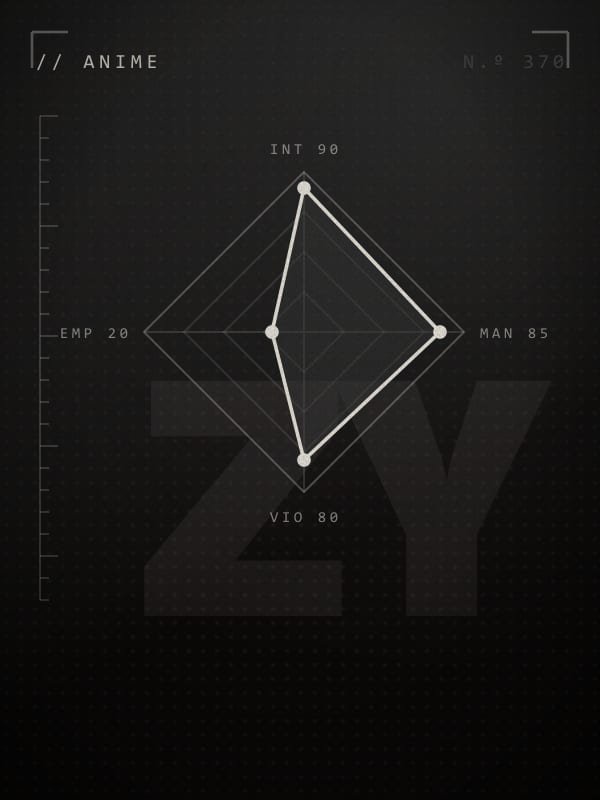
Azula, princess of the Fire Nation in Avatar: The Last Airbender, is the image of perfection: a firebending prodigy from childhood, a relentless strategist, feared alike by enemies and allies. Her father, Fire Lord Ozai, raised her as his ideal heir, the one who «did everything right», against a brother he despised. But that perfection is a tense facade: Azula's poise does not rest on a firm self, but on the supports around her —the power of the throne, the terror she inspires, the loyalty of her two childhood friends—. For the containment theory of Reckless, Azula is a textbook case: external containment bearing all the weight of a hollow inner containment. And when those supports are withdrawn, nothing is left underneath to hold her.
// The theoryThe two brakes that hold behavior in place
Walter C. Reckless set out in The Crime Problem his containment theory (containment theory): against the pressures and temptations that push anyone toward deviance, what keeps a person within the norm are two layers of brake. External containment is the social scaffolding around the individual —affective bonds, supervision, belonging to a group, a structure of clear roles and expectations, limits imposed from outside—. Internal containment is the brake the person carries within: a solid self-concept, tolerance for frustration, goals of one's own, a guiding conscience, the capacity to resist temptation with no one watching. Reckless stressed that the two compensate for each other: a robust inner containment protects even if the environment collapses, and a strong external containment can hold up someone with a weak inner brake… as long as that structure exists. The problem appears when a person depends almost entirely on the external layer. Azula is exactly that: her behavior held for years because power, fear and loyalties worked as scaffolding; on the inside, her own brake was a brittle construction.
The perfect facade and the hollow beneath it
Azula's perfection is not inner strength: it is its opposite. A truly solid self-concept tolerates error, loss and disloyalty without falling apart. Azula's, by contrast, was a rigid facade built for a father who rewarded only victory and punished any crack. Reckless singled out the self-concept as the core of internal containment: the image one has of oneself that lets one say «I'm not the kind who sinks». Azula's was anchored entirely in external indicators —winning, dominating, being feared, being the favorite—, not in anything of her own and stable. That is why her tolerance for frustration was almost nil: every loss was not a setback but an existential threat to the only identity she knew. As long as the external scaffolding held, the facade passed for strength. The theory teaches us to tell them apart: external containment (what surrounds you) and internal containment (what you carry inside) look the same from outside, until the day the environment falls and only then do you see which of the two was really holding you up.
Get the map of theories for free
Subscribe to the criminal archive —one case a week, no spam— and I'll send you The map of theories: the great currents of criminology on a single sheet.
// The subjectWhen the supports are withdrawn
Azula's collapse is an almost clinical experiment on what happens when external containment is withdrawn one layer after another. First she loses control of power: the structure of the throne and the military campaign, which gave her a clear role and a mission, blur away. Then her two childhood allies betray her —the only relationships that came close to a bond—, and with them goes the loyalty on which she had propped up her security. Finally, the very father who made her discards her by leaving without her, withdrawing the approval that was the foundation of her whole self-concept. Without power, without loyalties and without Ozai's approving gaze, no external brake is left standing. And then the hollow shows: internal containment was never able to hold her on its own. Azula plunges into paranoia —she sees betrayals everywhere, purges her servants, isolates herself— and into an open psychotic crisis, with hallucinations and a disintegration of the identity that the perfect facade had kept at bay. It is not that she «went mad» all of a sudden: it is that the only thing keeping her standing was withdrawn.
Azula
// The crackThe trauma explains the collapse, it does not excuse it
Here is the crack, and it has to be held without slipping to either side. On one hand, Azula's upbringing was toxic by the book: a tyrannical, manipulative father who shaped her as an instrument, who taught her that love is earned by winning and that any weakness is punished, who used her as a weapon and discarded her when she stopped being useful. That environment built a hollow inner containment —a self-concept with no foundations of its own, a destroyed tolerance for frustration— and explains, in the theory's terms, why her collapse was so total. Reckless himself noted that internal containment does not arise from a vacuum: it forms in childhood, in bonds, in how one learns to handle failure. Azula was denied that formation. On the other hand, explaining is not excusing: understanding why her inner brake was fragile does not erase the people Azula terrorized, manipulated and assaulted when her power was intact. The origin of a fracture does not cancel responsibility for what is done from within it.
The honest reading holds both things at once: Azula is at once a victim of her father's machinery and someone who caused real harm. Her tragedy is not that she was «evil by nature», but that they built her a facade of perfection over a void, and left her alone the day the void was laid bare. Avatar has the courage to show the collapse not as a satisfying punishment, but as something that stirs pity: the fall of someone who was never allowed to build a self that could withstand the fall.
Borrowed containment always gives way
Azula matters because she dismantles a dangerous intuition: that whoever seems strongest, most flawless and most in control is the one with the most solid inner brake. Containment theory warns the opposite. A facade of rigid perfection —the one who «never fails», who dominates by fear, who cannot tolerate a single error— usually indicates not a robust inner containment, but an external containment doing all the work. That balance is borrowed: it works until the environment changes. Withdraw the power, the status or the relationships that hold someone like that up, and out comes what was never formed within. The practical lesson —for thinking about criminology, clinical practice or one's own life— is twofold: first, that the brake that truly protects is the internal one, the one that stays standing when no one is watching and everything has been lost; and second, that this brake is built in upbringing, in bonds, in learning to fail without ceasing to be oneself. Whoever is denied that construction is handed a facade that the first blow of fate will shatter.
Three key ideas
- Azula illustrates Reckless's containment theory: her behavior rested on a powerful external containment (power, fear, loyalties) over a hollow inner containment. The perfect facade hid the fact that there was no brake of her own underneath.
- When the external supports are withdrawn —the power, the allies who betray her, the approval of the father who discards her— nothing is left to hold her, and she collapses into paranoia and psychotic crisis. The perfect control was borrowed.
- The crack: a toxic upbringing (a tyrannical father who shaped her as a weapon) explains why her inner containment was fragile, but explaining is not excusing. She is at once a victim of her maker and responsible for the harm she caused.
Sources · further reading
- Reckless, W. C. (1961). The Crime Problem. Appleton-Century-Crofts.
- Reckless, W. C. (1967). A New Theory of Delinquency and Crime. Federal Probation.
- Wong, S. K. (2005). The Effects of Adolescent Activities on Delinquency: A Differential Involvement Approach. Journal of Youth and Adolescence.
Case-file questionsFrequently asked questions
¿Quién es Azula?
Azula («princesa de la Nación del Fuego») es un villano de Avatar: la leyenda de Aang, analizado en KRIMINIS con la lente de la criminología. She is the flawless princess: prodigy, strategist, feared.
¿Por qué Azula (princesa de la Nación del Fuego) se convierte en villano?
Azula and containment theory: behavior is held in place by external brakes (bonds, power, structure) and internal ones (self-concept, tolerance for frustration). The perfect facade hides a hollow inner containment, and when the external one falls, nothing is left to hold her.
¿Qué teoría criminológica explica a Azula?
El caso de Azula se analiza desde la Teoría de la contención. Containment theory (Reckless) holds that behavior is kept under control thanks to two layers: an external containment (bonds, supervision, structure, power) and an internal one (a solid self-concept, tolerance for frustration, goals). Azula, princess of the Fire Nation in Avatar: The Last Airbender, displays a powerful external containment —the throne, the fear she imposes, the loyalty of her allies— over a fragile, hollow inner containment, shaped by a tyrannical father. When the external supports are withdrawn, the inner layer is not enough to hold her and she collapses into paranoia and psychotic crisis. The perfect control was borrowed.