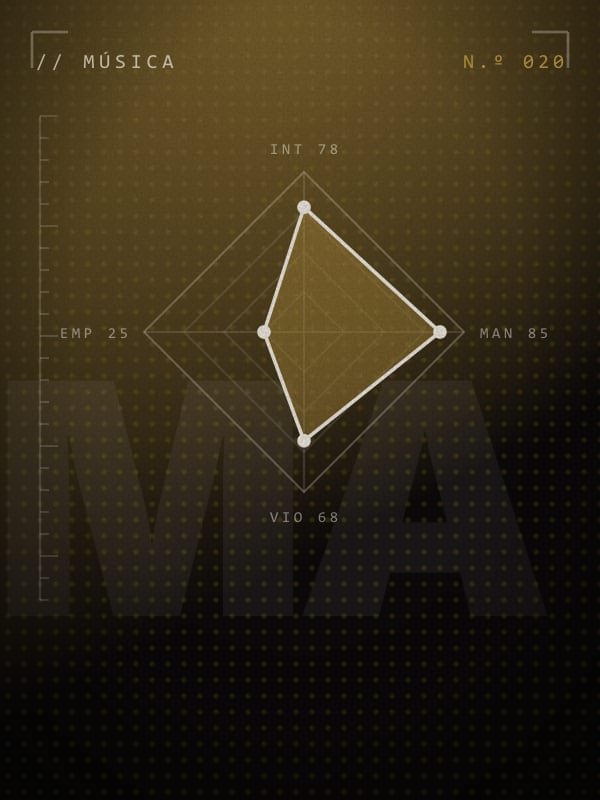
Handsome Jack, CEO of Hyperion, narrates his own genocide on the planet Pandora as if it were a heroic epic. He tortures, lies and massacres, and he calls you —the player— a bandit. His last words sum it all up: «You're a bandit… and I'm the goddamn hero!». He isn't lying to you: he believes it. And that conviction is his most dangerous weapon. Because crime, as rational choice teaches, isn't only calculated: it is also justified.
// The theoryCrime is calculated… and excused
Rational choice theory understands crime as a decision of costs and benefits: Becker and Clarke framed it as an equation. But the pure equation isn't enough to sustain an atrocity: human beings need not to feel like monsters while they carry it out. That's where a piece that completes the calculation comes in: the techniques of neutralization of Gresham Sykes and David Matza, the self-justifications that silence the conscience before acting.
The techniques of neutralization
Sykes and Matza (1957) identified five alibis we use to offend without guilt: denial of responsibility, denial of injury, denial of the victim («they had it coming»), condemnation of the condemners, and appeal to higher loyalties. Jack runs the whole playbook: everyone on Pandora is a «bandit» (denial of the victim) and he's merely civilizing a savage world (higher loyalty). With those two phrases, any massacre costs him nothing on his conscience.
Get the map of theories for free
Subscribe to the criminal archive —one case a week, no spam— and I'll send you The map of theories: the great currents of criminology on a single sheet.
// The subjectThe hero of his own movie
Jack genuinely experiences himself as the protagonist of a revenge-and-redemption film. It isn't calculated hypocrisy —that would be another story—: it is neutralization that is truly believed. And that sincerity is what allows him to plan a mass murder with a smile: he doesn't repress the guilt, he has dissolved it. The most fearsome rational criminal isn't the one who hides that he's the bad guy, but the one who has convinced his own conscience that the ledger is on his side.
Modern psychology refined those alibis. Albert Bandura gathered them under the name moral disengagement: the mechanisms by which a person switches off their own compass without ceasing to believe they're decent —euphemistic language («collateral damage» instead of the dead), the dehumanization of the victim («bandits», not people), and the displacement of responsibility onto the cause or the boss—. Jack activates them all at once: that's why he can smile while ordering a massacre. It isn't that he lacks a conscience; it's that he has learned to silence it on demand.
Handsome Jack
// The crackWhen the alibi turns massive
What's unsettling is that neutralization isn't just a thing for video-game villains. The great crimes of the State, corporate crimes and atrocities run on the same phrases: «they were the enemy», «I was just following orders», «it was for the good of the company, the nation, the future». Hannah Arendt called it the banality of evil: most executioners don't see themselves as executioners, they see themselves as correct officials —or heroes—.
The classic experiments confirmed it with ordinary people. In Stanley Milgram's obedience study, most volunteers administered shocks they believed were painful to a stranger simply on hearing an authority say «continue». They weren't sadists: they were normal people who had shifted responsibility to whoever was giving the orders. Jack's neutralization isn't a video-game villain's delusion; it's the same switch Milgram flipped in a laboratory, turned up to the volume of genocide.
And here, the usual caution. Understanding how an ordinary person comes to do terrible things —by deactivating their conscience with excuses— does not make those things excusable. «I thought I was the hero» explains the mechanism, but it is not a defense. Neutralization illuminates the path toward harm; it does not absolve it.
The sociologist Stanley Cohen went a step further in States of Denial: he described how entire societies live alongside atrocities by way of «not quite knowing» —literal denial («it didn't happen»), interpretive denial («it's not what it looks like») and implicatory denial («it's none of my business»)—. It is Jack's neutralization on a collective scale: the machinery that lets an enormous harm happen in broad daylight without almost anyone feeling responsible. Hyperion isn't a science-fiction company; it's any structure that hands out excuses off the shelf.
Break the alibi before the crime
If crime needs opportunity and also a self-justification, prevention includes dismantling the alibi: demanding accountability, naming victims as victims, and cultivating environments that don't hand out ready-made excuses («they had it coming»). Atrocity is reduced by making it harder for someone to tell themselves the story in which they're the good guy.
Handsome Jack is a comedy monster, but his logic is dead serious and it's everywhere. The most dangerous criminal isn't the one who knows he's the villain: it's the one who is sure he's the hero, doing his sums with a clear conscience.
Three key takeaways
- Crime isn't only calculated (rational choice): to sustain an atrocity you need a moral alibi that silences the guilt.
- Sykes and Matza called them techniques of neutralization: denying the victim, appealing to higher loyalties… Jack uses them all by calling his victims «bandits» and himself the «hero».
- Neutralization explains how ordinary people commit atrocities (Arendt's banality of evil), but to explain is not to excuse: «believing you're the hero» is not a defense.
Sources · further reading
- Sykes, G. M. & Matza, D. (1957). «Techniques of Neutralization: A Theory of Delinquency». American Sociological Review, 22(6).
- Matza, D. (1964). Delinquency and Drift. Wiley.
- Arendt, H. (1963). Eichmann en Jerusalén: un estudio sobre la banalidad del mal. Viking Press.
- Becker, G. S. (1968). «Crime and Punishment: An Economic Approach». Journal of Political Economy, 76(2).
- Bandura, A. (1999). «Moral Disengagement in the Perpetration of Inhumanities». Personality and Social Psychology Review, 3(3).
- Cohen, S. (2001). States of Denial: Knowing about Atrocities and Suffering. Polity Press.
Case-file questionsFrequently asked questions
¿Quién es Handsome Jack?
Handsome Jack («Jack») es un villano de Borderlands, analizado en KRIMINIS con la lente de la criminología. The most dangerous criminal isn't the one who knows he's doing evil, but the one who is convinced he's the hero.
¿Por qué Handsome Jack se convierte en villano?
Borderlands and rational choice: Handsome Jack calculates, tortures and massacres… convinced he is the hero. The moral alibi as part of the criminal calculus.
¿Qué teoría criminológica explica a Handsome Jack?
El caso de Handsome Jack se analiza desde la Elección racional. Rational choice sees crime as a decision of costs and benefits. Handsome Jack adds the piece that makes it sustainable: the moral alibi. He doesn't see himself as a villain, he sees himself as the hero —and that self-justification is what lets him calculate atrocities without so much as a flinch.