The 10 most intelligent villains in fiction (according to criminology)
From the most courteous cannibal to the crime detective: ten minds that turned intellect into their most lethal weapon. We rank them by their quotient in the KRIMINIS archive and read them with real criminology —rational choice, planning, manipulation—, because explaining how they think is not admiring them.
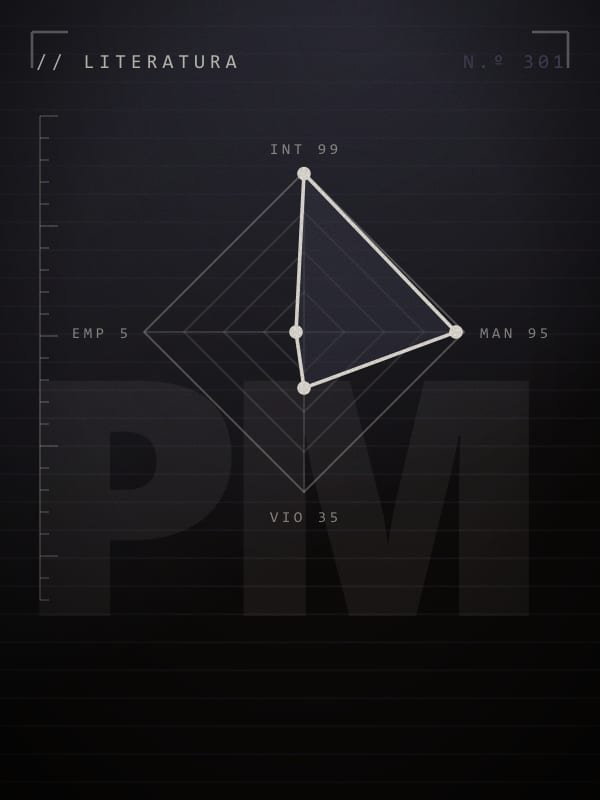
There are villains who scare you with their strength, and villains who scare you with their minds. The latter are far worse. A monster with claws can be dodged; a mind that runs three moves ahead has already anticipated your escape before it even occurs to you to run. The intelligent villain fascinates precisely because he doesn't need to shout: he plans, calculates, manipulates and waits. And when he falls —if he falls at all— it isn't a sword that brings him down, but a miscalculation. That is his greatness and his tragedy.
Before we begin, the guiding principle of this house: explaining how a villain thinks is not admiring him or excusing him. Dissecting criminal intelligence serves to recognize the real mechanism underneath —how someone weighs costs and benefits before doing harm, how he plans to avoid capture, how he manipulates those around him— not to applaud it. Criminology has a name for almost everything these characters do. And the first of those names is rational choice: the idea that crime, very often, is not an outburst, but a decision calculated by someone who weighs what he gains against what he risks.
We've ranked the top-10 according to the intelligence score that each file has in the KRIMINIS archive. You can look at it on the interactive leaderboard and compare figures yourself. Here they are, from highest to lowest, the ten most dangerous minds in fiction.
// Rank 1 · 99Hannibal Lecter: intelligence as predation
A brilliant psychiatrist, cultured, refined and a cannibal. Hannibal Lecter tops the ranking because his intellect is no ornament: it is the weapon. He reads people like an open book, anticipates their reactions and steers them, with chilling courtesy, exactly where he wants them. His dangerousness lies not in the scalpel, but in his ability to manipulate psychologists, investigators and victims alike. Read through criminology, Lecter is the perfect manipulator: he never acts on impulse, always by design, and turns conversation into a minefield from which he emerges the winner.
// Rank 2 · 99Professor Moriarty: crime as pure science
The "Napoleon of crime". James Moriarty is Sherlock Holmes's intellectual nemesis precisely because he plays the same game with the sign reversed: a brilliant mathematician who applies deductive rigor to organizing crime. He doesn't dirty his hands; he weaves a web in which he is the invisible center of a spider. His intelligence is dangerous because it is structural: he doesn't commit crimes, he orchestrates them, so that punishment almost never reaches him. It is rational choice raised to architecture: every operation weighed to maximize the benefit and minimize the trail.
// Rank 3 · 99Lelouch vi Britannia: the strategist who plays with lives
An exiled prince and tactical genius, Lelouch of Code Geass plans entire revolutions the way one moves pieces on a board. His intelligence combines two lethal things: an enormous strategic capacity and a power of manipulation that lets him give irresistible orders. What's interesting, criminologically, is how he rationalizes each sacrifice in the name of a higher end —a very real mechanism of moral neutralization that turns an idealist into someone capable of calculating deaths on a spreadsheet. Planning is his religion; the problem is what he is willing to include in the plan.
// Rank 4 · 98Light Yagami: the student who thought he was justice
With a notebook that kills and an extremely high IQ, Light Yagami of Death Note becomes the most efficient serial killer imaginable… and the textbook example of rational choice taken to the extreme. Light doesn't kill at random: he calculates schedules, alibis, patterns, always weighing the risk of being discovered against the power he gains. His mental duel with the detective L is pure anticipation chess. And his downfall is the perfect criminological lesson: overconfidence in one's own intelligence is, almost always, the error that gives the planner away.
// Rank 5 · 98Adrian Veidt / Ozymandias: the smartest man in the world
In Watchmen, Adrian Veidt is literally "the most intelligent man on the planet", and he proves it by executing a monstrous plan on a global scale without anyone stopping him in time. His dangerousness lies in the scale of his calculation: he reasons with cold utilitarianism, willing to commit an enormous evil in exchange for a supposed greater good. Ozymandias is rational choice turned into planetary social engineering, and his famous line —having done it all long before anyone could react— sums up the terror of the villain who thinks years ahead while everyone else reacts by the minute.
// Rank 6 · 98Judge Holden: erudition in the service of horror
The most unsettling on the list. Judge Holden, from Cormac McCarthy's Blood Meridian, is a learned giant who speaks several languages, masters science, geology and rhetoric, and uses all that erudition to articulate a philosophy of war and destruction. His intelligence doesn't plan heists: it justifies evil with a seductive eloquence. He is the literary reminder that intellect is not morally good in itself; a brilliant mind can become horror's most persuasive advocate. Culture and cruelty, in him, coexist without contradiction.
// Rank 7 · 98Sōsuke Aizen: the master of planned betrayal
For much of Bleach, Sōsuke Aizen appears to be a kindly captain while, in reality, he has orchestrated every event for over a century. His intelligence is that of the great long-term manipulator: everything the viewer thought he understood turns out to be part of a plan Aizen anticipated. "It was all within my calculations" is practically his motto. Criminologically, he embodies extreme planning and sustained deception: the ability to maintain a façade for decades is a form of manipulation more frightening than any show of force.
// Rank 8 · 97Keyser Söze: the villain who barely exists
The intelligence of Keyser Söze, from The Usual Suspects, is so pure that his greatest achievement is making people believe he doesn't exist. All his power rests on absolute control of information: he manipulates an entire narrative, right in front of the police, and walks out the door. He is proof that the ultimate weapon of the clever criminal is not violence, but narrative: whoever controls the story controls who is a suspect and who is invisible. His famous idea about the devil's greatest trick sums up an uncomfortable criminological truth: you can't catch someone you don't believe exists.
// Rank 9 · 97Johan Liebert: the manipulator without fingerprints
Johan Liebert, the "monster" of Naoki Urasawa's eponymous work, is perhaps the purest manipulator on this list. He rarely raises a hand: he convinces others to do the harm, pushing ordinary people into the abyss with words alone. His intelligence is psychological, almost hypnotic: he understands other people's weaknesses and activates them like triggers. He is the villain who leaves no evidence because he never pulls the trigger. Read through criminology, Johan is the perfect illustration of manipulation as a crime without a fingerprint: the perfect crime committed with borrowed hands.
// Rank 10 · 97Ernst Blofeld: the brain behind the crime empire
Closing the top-10 is James Bond's archenemy and head of SPECTRE. Ernst Stavro Blofeld is the prototype of the modern criminal mastermind: he's not a thug, he's a chief executive of crime who plans global operations, manages an enormous organization and delegates the violence while he thinks. His intelligence is organizational and strategic, that of the man who sees the whole board. Blofeld codified in pop culture the figure of the criminal genius who directs from the shadows: proof that, in large-scale crime, the mind that plans is worth more than any army.
Intelligence is neither good nor bad: it is a multiplier
These ten villains share a trait that criminology has been studying for decades: they don't act on impulse, but by calculation. Rational choice, meticulous planning and manipulation are real mechanisms, not screenwriters' fantasies. Recognizing them in fiction trains you to recognize them outside it —in fraud, in abuse, in the con—, where the criminal hardest to catch is not the most violent, but the one who thinks best. Intelligence doesn't manufacture villains; it multiplies the reach of someone who has already decided to do harm.
If this ranking teaches anything, it's that intellect is a morally neutral amplifier. The same traits that make these characters memorable —anticipation, cold blood, the reading of people— are virtues in a surgeon, a chess player or a good detective. The difference lies not in the capacity, but in the end to which it is put. That's why their fascination is also a warning: they remind us that the most brilliant mind in the room can be the most dangerous, and that it's worth knowing how to read it. If you want to keep pulling the thread, our X-ray of the villain takes apart, piece by piece, what makes a mind cross the line.
Three keys to reading the intelligent villain
- The intelligent villain rarely improvises: he embodies rational choice, weighing benefit against risk before acting (Light Yagami and Moriarty are the perfect example).
- His weapon is not always force, but manipulation and the control of information: Keyser Söze and Johan Liebert win without barely touching anyone.
- Intelligence is a neutral multiplier: recognizing how these characters think helps detect the same mechanism in real crime. Explaining is not admiring.
Sources
- Cornish, D. B. and Clarke, R. V. (1986). The Reasoning Criminal: Rational Choice Perspectives on Offending. Springer-Verlag.
- Sykes, G. and Matza, D. (1957). "Techniques of Neutralization: A Theory of Delinquency". American Sociological Review, 22(6), 664-670.
- Hare, R. D. (1993). Without Conscience: The Disturbing World of the Psychopaths Among Us. Guilford Press.
Preguntas frecuentes
Who are the most intelligent villains in fiction?
The article gathers ten villains, from the most courteous cannibal to the crime detective, ranked by their quotient in the KRIMINIS archive. They are minds that turned intellect into their most lethal weapon, and here they are read with real criminology to understand how they think, not to admire them.
How do you measure which villain is more intelligent?
The ranking is ordered by the quotient each villain has recorded in the KRIMINIS archive. On top of that figure a criminological reading is applied —rational choice, planning and manipulation— to explain why their intelligence is so dangerous.
Why does intelligence make a villain more dangerous?
Because an intelligent villain doesn't improvise: he plans and manipulates, and from the standpoint of rational choice that means calculating means and ends to maximize his objective. Intellect thus becomes his most lethal weapon, though explaining how he reasons never amounts to justifying him.