The KRIMINIS Report: What 451 Fictional Villains Reveal About Evil
451 villains scored on four axes and cross-referenced with 100 criminology theories. Fictional evil has a profile, and it isn't the one you'd guess.

Fiction has been manufacturing villains for centuries, yet we almost never measure them. At KRIMINIS we did exactly that: 451 villains from film, TV, anime, comics, video games and literature, each scored 0-100 on four axes — intelligence, manipulation, violence and empathy — and filed under one of 100 criminology theories. The result is, as far as we know, the largest quantitative map of imaginary evil ever built. And when you crunch the whole thing, patterns emerge that no single film ever tells you. A caveat: this study dates from August 2026. The archive now holds 988 villains, and the living version of these figures, recalculated with every new batch, is the X-ray of evil.
// 1 · The compositeThe average villain of fiction
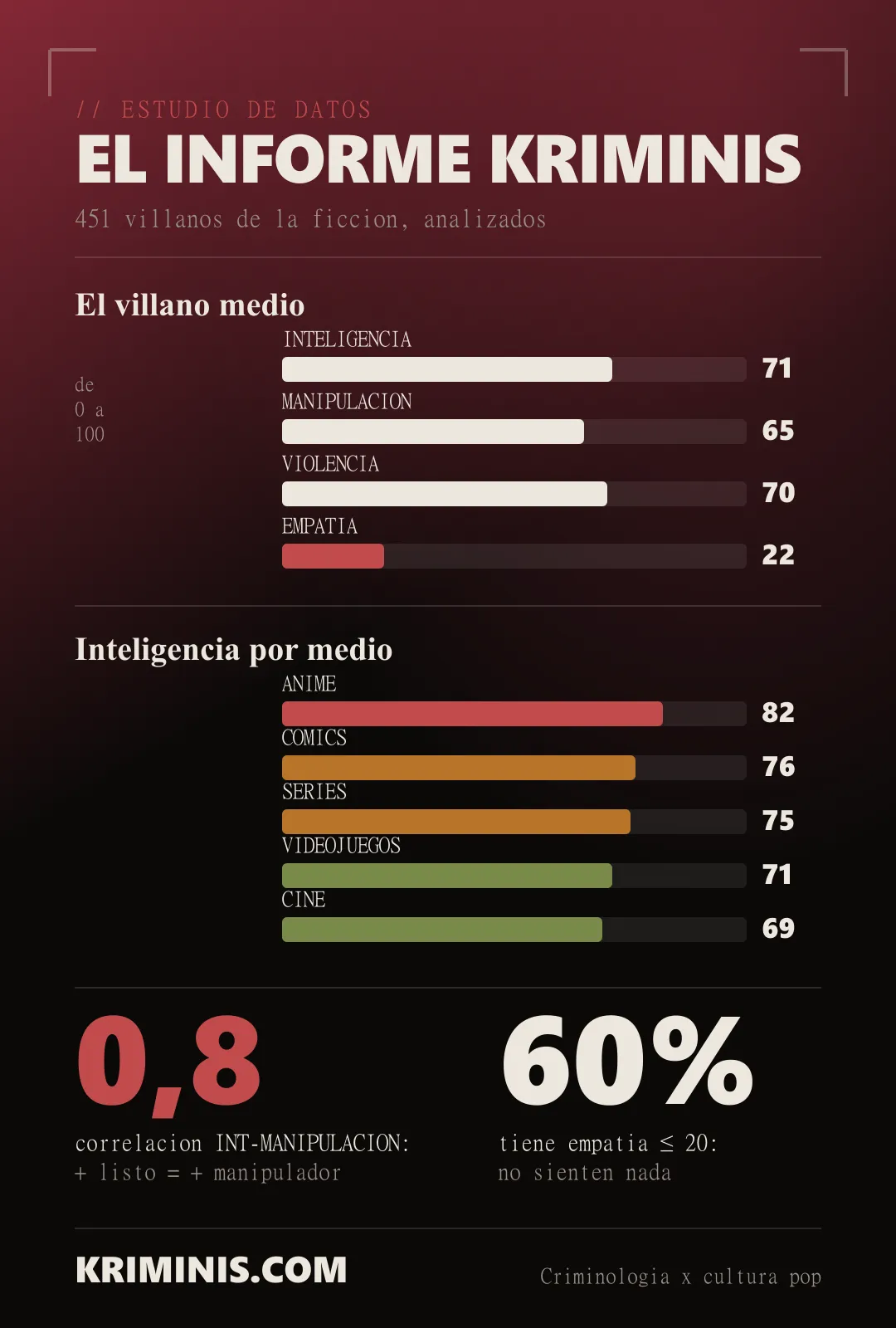
Average all 451 and a surprisingly sharp profile appears. The typical villain is smart, calculating and brutal… but above all, cold. Empathy is, by far, the lowest axis: while intelligence, manipulation and violence hover around 65-71, empathy collapses to 22. In other words: what fiction understands as "evil" is not so much violence as the absence of connection with others.
The average villain, in 4 figures
Intelligence 71 · Manipulation 65 · Violence 70 · Empathy 22. And the tell: 59.6% of all villains score 20 or less on empathy. Six in ten fictional villains, effectively, feel nothing.
// 2 · Each medium, its monsterAnime breeds the most extreme villains
Here is the first strong pattern: the medium decides the kind of villain. Anime produces, by a wide margin, the most intelligent villains (82 on average) and also the most violent (84) in the archive — extreme in both directions. TV series, by contrast, breed the most manipulative ones (73): the prestige-TV villain does not hit, he weaves. And film, the medium with the most villains (253), lands near the average on almost everything.
// 3 · The findingThe smarter the villain, the more manipulative (and less brutal)
The strongest pattern in the whole archive is not a villain: it is a correlation. Cross intelligence with manipulation across all 451 and you get a coefficient of 0.8 — very high. Intelligence and manipulation almost always travel together: the brilliant villain does not need to hit, he persuades. Meanwhile intelligence and violence correlate negatively (−0.2): the brain replaces the fist. Fiction has, without knowing it, a very clear criminological thesis about power: the truly dangerous ones are not the strongest, they are the smartest.
The fist and the brain
That intelligence predicts manipulation (r = 0.8) and subtracts violence fits what criminology calls the rational-choice offender: whoever calculates minimizes risk, and physical violence is costly and loud. The clever villain delegates or avoids it. That is why the scariest ones in the archive — Hannibal, Moriarty — barely raise their voice.
// 4 · The recordsThe archive extremes
Sort all 451 by each axis and the usual suspects lead — plus a few you would not expect. In intelligence, a technical tie at the top between Hannibal Lecter and Professor Moriarty (99). In manipulation, the podium goes to two textbook puppeteers: Johan Liebert (Monster) and Shakespeare's Iago (99) — the oldest villain in the archive proving that technique does not age. And in violence, a name that is not softened fiction: Amon Göth hits the absolute maximum, 100.
The empathy axis tells another story. At the bottom crowd the faceless monsters — the shark, Slender Man, Pyramid Head — with a clinical 0: entities, not people. And at the top, the "villains" who are really the misunderstood: Quasimodo, Jean Valjean, Robin Hood. Empathy, in the archive, is the exact border between the monster and the antihero.
Fictional evil, in data
- The average villain: Intelligence 71 · Manipulation 65 · Violence 70 · Empathy 22 (n = 451).
- 59.6% score 20 or less on empathy: six in ten villains, effectively, feel nothing.
- Anime breeds the most intelligent (82) and most violent (84) villains; TV series, the most manipulative (73).
- Intelligence and manipulation correlate at 0.8; intelligence and violence, negatively: the brain replaces the fist.
- The most common theory among villains is rational choice, followed by psychopathy.
Method and sources
- Sample (August 2026): 451 fictional villains with a full profile, from an archive of 454 case files and 100 criminology theories. Axes scored 0-100 by the KRIMINIS team based on the source work.
- Explore the data yourself, villain by villain, in The KRIMINIS Explorer · or browse the full catalogue.
- And you — what is your criminal profile? Find out with the test.
- You may cite this study by linking to this page (kriminis.com). Analysis by KRIMINIS · Criminology × pop culture.
// Quick challengeWhich theory best explains El archivo KRIMINIS?
Frequently asked questions
Who is the most intelligent fictional villain according to the data?
In the KRIMINIS archive (451 villains scored 0-100), the top intelligence score is shared by Hannibal Lecter and Professor Moriarty, both at 99, followed closely by Light Yagami and Adrian Veidt (Ozymandias) at 98.
Which medium has the most dangerous villains?
Anime, strikingly: it produces the most intelligent villains (82 on average) and also the most violent (84) of any medium analysed. Television series, by contrast, breed the most manipulative villains (73 on average).