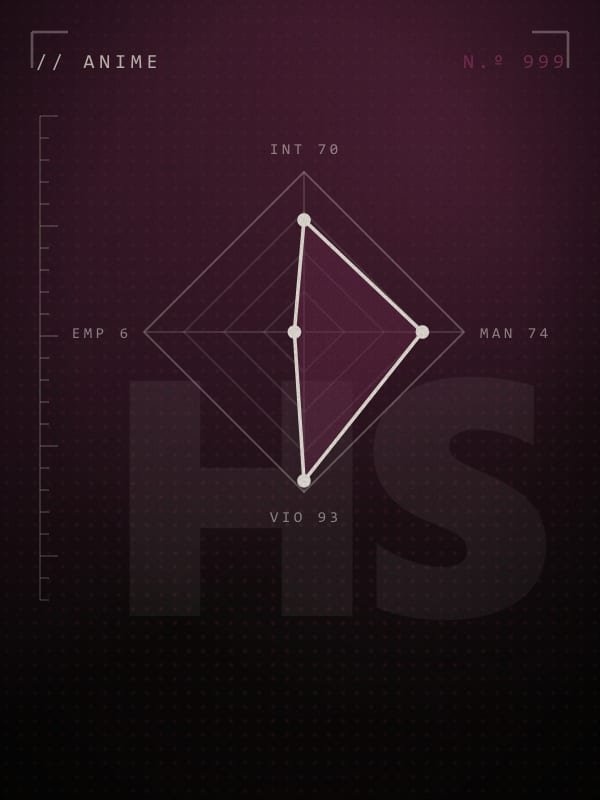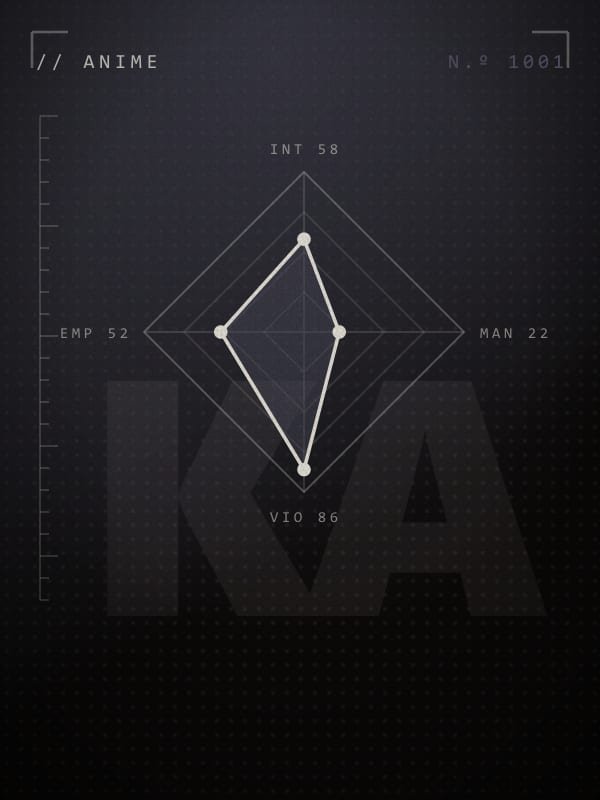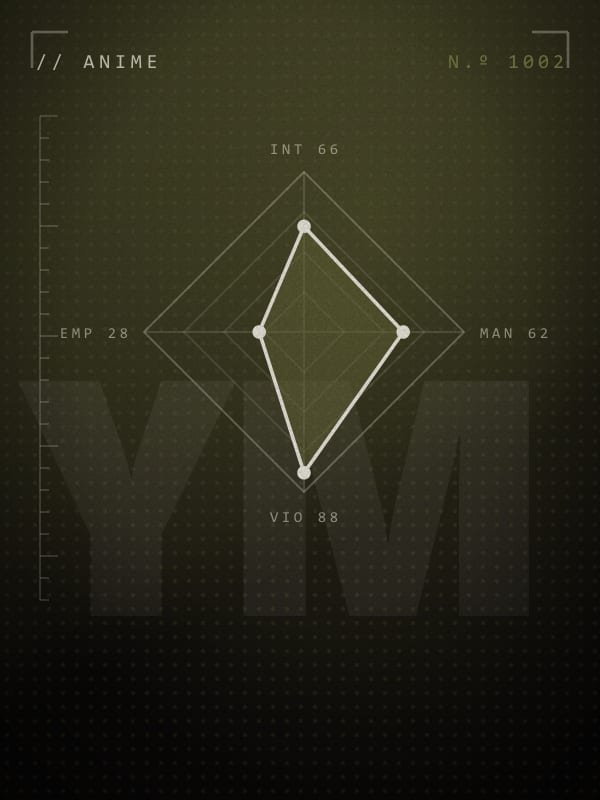
In the Tenjiku arc of Tokyo Revengers, Toman’s First Division gathers at Takemichi Hanagaki’s house to prepare for the war against Tenjiku. A car horn sounds. A car is waiting outside, and inside it is Yasuhiro Muto, “Mucho,” captain of the Fifth Division. Chifuyu warns that this is bad news: Mucho holds a special position in the gang. His men pin down Takemichi’s friends and he beats Takemichi to the ground, even though fighting between members is forbidden in Toman (manga chapters 138-139; anime episode 40). Takemichi wakes up tied up in a warehouse, next to Inupi and Koko, who have been beaten too. Mucho, a judoka, huge and unusually calm for a delinquent, is the captain Mikey gave a unique assignment: his division may fight inside the gang itself to punish traitors, even without the leader’s permission. In the warehouse he confesses that the traitor is him. He is one of the founders of Tenjiku, Izana Kurokawa’s gang, and from that moment Toman is his enemy. This case file also covers his ending (spoilers ahead).
// The theoryThe question turned around
In Causes of Delinquency (1969), Travis Hirschi turned criminology’s question around. Instead of looking for what pushes someone to offend, he asked what holds the rest of us back, since we could do it too. His answer, based on thousands of questionnaires from California teenagers, was the social bond: delinquency appears when a person’s tie to conventional society loosens or breaks, and it needs no special motive. Hirschi broke that tie into four elements: attachment to people whose opinion matters to us, commitment to what we would lose by offending, involvement in activities that leave no time for anything else, and belief that the rules are legitimate. He added a controversial claim about gangs: the idea that delinquents have warm, intimate relationships with one another struck him as a romantic myth. In his view, their friendships were cold and brittle.
Four bonds, one recipient
Mucho has all four of Hirschi’s bonds, and they are tight. Attachment: he met Izana in a juvenile detention center, along with the rest of the so-called S-62 Generation, and treats him as a king. Commitment: on the night of the battle he tells Izana that he has made the S-62’s dreams come true, and those dreams are of a great criminal organization (ch. 153). Involvement: his whole life takes place inside the gang. Belief: he has a code, punish the traitor, and he applies it with a civil servant’s discipline. What he lacks is a single tie to the conventional order Hirschi measured: family, school or a job. His bonds are extremely strong, but they hold Mucho to crime instead of keeping him from it.
// The subjectThe gang’s police officer
Three moments define him. The first is the interrogation in the warehouse (chs. 140-142; episode 41). Mucho explains that Izana does not just want to bring Mikey down: he wants Koko’s talent for money, Kisaki’s brains and Mikey’s charisma to build the most powerful criminal syndicate. So he gives Koko an ultimatum: either he joins Tenjiku or Mucho kills Inupi and Takemichi, whose face he stomps on as he says it. When Takemichi asks whether he is betraying Mikey, he answers that it might have been different if he had met him first. Koko gives in to save his friends. The second comes in the battle against Toman in Yokohama (chs. 160-164; episodes 45 and 46). Mucho takes Inupi down with a judo throw while Izana tells Hanma why Mucho ended up in juvenile detention: he threw a man onto concrete and left him paraplegic. Then Angry, from Toman, knocks him down. Mucho remembers the day he swore loyalty to Mikey, but also Izana’s order to kill someone, and he pulls a knife. Kakucho, Izana’s other great loyalist, steps in, stops the blade and knocks him out with a punch so that Tenjiku will not ruin him. The third is the end of the battle: Mucho weeps at Toman’s resolve, wonders what Izana really wanted and, when it is all over, tells Mikey to leave, because the S-62 will stay behind (chs. 167 and 179).
Yasuhiro Muto
Get the map of theories for free
Subscribe to the criminal archive —one case a week, no spam— and I'll send you The map of theories: the great currents of criminology on a single sheet.
// The crackA bond that was not cold
Mucho refutes the most disputed part of Hirschi. His bond with Izana is neither cold nor brittle: it is born in a juvenile detention center, survives years apart and, as soon as Izana returns, outweighs his captaincy. Later research sides with the series: Peggy Giordano, Stephen Cernkovich and M. D. Pugh (1986) found that the friendships of delinquent teenagers were no less intimate than those of other teenagers. Control theory explains well why what ties us down holds us back. It explains less well the case where what ties us down pushes toward crime, and for that we also need to look at what is learned inside the group. And there is one more irony. Mucho was Toman’s instrument of control, the one who punished disloyalty. (Manga spoiler.) In the timeline that leads to Bonten, half a year after the battle, Mucho is released and finds Haruchiyo Sanzu waiting for him: his vice-captain, whom he had treated as a younger brother. Sanzu takes him to the pier where the battle was fought and kills him with a katana for betraying Mikey (ch. 206). It is the code Mucho enforced, carried out against him.
Explaining Mucho is not excusing him. The man he left paralyzed, Takemichi beaten in his own home and the knife he drew on Izana’s orders are his decisions, not side effects of a bond. But the manga suggests that a bond can change direction. In the final timeline (chs. 277-278), when Takemichi and Mikey rewrite the past, Mucho is among those who are saved, and Izana has turned Tenjiku into a nonprofit organization that helps orphans. Mucho works there as a volunteer. He still follows the same king, but that king now points somewhere else.
Strengthening bonds is not enough: it matters with whom
Social control theory has inspired many prevention policies: strengthen young people’s ties to family, school, sports or work so that they have something to lose. Mucho is a reminder of the fine print. A very loyal kid is not necessarily protected: it depends on whom he is loyal to. Gangs do not recruit kids without bonds, but kids with an enormous need to belong, and they offer them a king, a code and a task. Prevention does not mean breaking the loyalty of a kid like Mucho, but making sure there is another place worthy of it before someone like Izana claims it.
Three key ideas
- Social control theory (Hirschi, 1969) explains crime by the weakening of four bonds to the conventional order: attachment, commitment, involvement and belief; Hirschi also believed that friendships between delinquents were cold and brittle.
- Yasuhiro Muto, “Mucho,” captain of Toman’s Fifth Division and the man charged with punishing traitors, turns out to be a founder of Tenjiku: he abducts Takemichi, Inupi and Koko, forces Koko to join Izana and, in the battle of Yokohama, pulls a knife on his king’s orders.
- The crack: his bond with Izana, born in a juvenile detention center, is warm and lasting, and it pushes him toward crime instead of holding him back; in the manga, the code of loyalty he enforced is finally carried out against him by Sanzu.
Sources · further reading
- Hirschi, T. (1969). Causes of Delinquency. University of California Press.
- Giordano, P. C., Cernkovich, S. A. and Pugh, M. D. (1986). “Friendships and Delinquency”. American Journal of Sociology, 91(5), 1170-1202.
- Kornhauser, R. R. (1978). Social Sources of Delinquency: An Appraisal of Analytic Models. University of Chicago Press.
- Wakui, K. (2017-2022). Tokyo Revengers. Kodansha (chs. 138-142, 153, 160-167, 179, 206 and 277-278).
- Liden Films (2023). Tokyo Revengers, season 3 (Tenjiku arc), episodes 40-46.
Case-file questionsFrequently asked questions
Who is Yasuhiro Muto?
Yasuhiro Muto (“Mucho”) is a villain from Tokyo Revengers, analysed on KRIMINIS through the lens of criminology. His job in Toman was hunting traitors.
Why does Yasuhiro Muto (Mucho) become a villain?
Mucho, captain of Toman’s Fifth Division in Tokyo Revengers, and Hirschi’s social control theory: the gang’s internal police had the strongest of bonds. Only they were not with Toman, but with Izana.
Which criminological theory explains Yasuhiro Muto?
Yasuhiro Muto's case is analysed through Social control. Social control theory (Hirschi, 1969) does not ask why someone offends but what holds them back: the attachment, commitment, involvement and belief that tie them to the conventional order. Yasuhiro Muto, “Mucho,” captain of Toman’s Fifth Division in Tokyo Revengers, is the man charged with punishing the gang’s traitors, and he turns out to be one of the founders of Tenjiku, Izana Kurokawa’s gang. He has all four of Hirschi’s bonds, and strong ones. The problem is where they point.