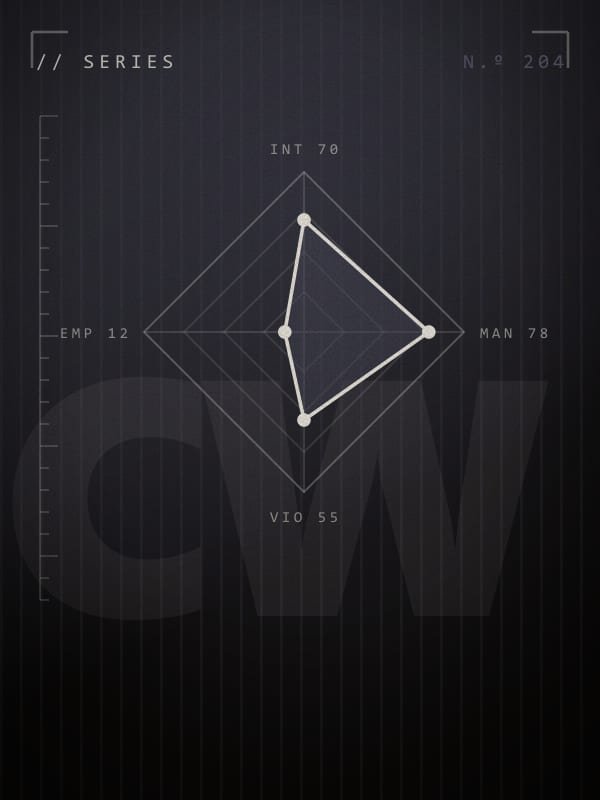
Commander Fred Waterford does not strike in back alleys or act in the shadows. He is one of the architects of Gilead, the theocracy that has turned the United States into a State where women cannot read, own, or decide, and where the fertile ones are handed out as reproductive property among the commanders. His violence —including the ritualized rape of his handmaid— is not a crime the system pursues: it is the system. For the theory of patriarchy and crime, Waterford shows male dominance in its purest form: made law.
// The theoryPatriarchy as structure, not as anomaly
The theory of patriarchy holds that violence against women is not the work of isolated monsters, but the logical consequence of a structure of power that prizes men for dominance. Gilead is that thesis taken to its didactic extreme: it removes all ambiguity and shows patriarchy undisguised, written into the legal code. What in our society operates diffusely —through culture, institutions, roles— is explicit in Gilead: women are property, by law, and the violence that keeps them subjugated is official policy.
Waterford is not an exceptional pervert; he is an ordinary man of his system, who carries out with ease what his structure has normalized. Therein lies the uncomfortable lesson: patriarchy does not need monsters to produce mass violence against women; ordinary men who apply a structure of domination without questioning it are enough.
Double victimization, institutionalized
The theory of patriarchy stresses double victimization: a woman suffers at the hands of the aggressor and of the system that should protect her. Gilead takes this to the limit by eliminating the distinction: here the aggressor is the system. No police will report Waterford because Waterford is the law; no court will shield his handmaid because the court exists to subjugate her. It is double victimization institutionalized one hundred percent —a portrait of what happens when the apparatus that should protect women is designed, from top to bottom, to dominate them—. Our reality is not Gilead, but the theory warns that every time the system minimizes, distrusts, or protects the aggressor, it slides one degree in that direction.
Get the map of theories for free
Subscribe to the criminal archive —one case a week, no spam— and I'll send you The map of theories: the great currents of criminology on a single sheet.
// The subjectDomination also imprisons the one who dominates
The series does something subtle with Waterford: it shows that patriarchy also degrades him. He is a man incapable of a relationship between equals, trapped in the role of master that makes him petty, insecure, and pathetic; even his own wife, Serena, a collaborator with the system, ends up crushed by him too. The theory captures this: hegemonic masculinity does not "liberate" a man, it locks him into a script of domination that poisons all his bonds. Waterford has all the power and no real intimacy. Patriarchy does not make even its beneficiaries happy; it only makes them masters.
Cmdt. Waterford
// The crackNeither impossible dystopia, nor alibi for the system
The crack with Waterford is to reassure ourselves thinking "this is science fiction, it doesn't happen here." Atwood insisted that she invented nothing: every horror of Gilead has occurred in some real place and time. The dystopia is not an impossibility, it is an extrapolation —a warning about where the structure pulls if it is not stopped—. The other crack is to use the structure as an alibi: "Waterford is only obeying the law of his world." The theory rejects it: that patriarchy is systemic does not excuse the one who carries it out. Waterford chooses every abuse; "it was the law" was never a moral defense —we have known that since Nuremberg—. The structure explains why there are so many Waterfords; it pardons none of them.
That his world has legalized his violence makes it graver, not lesser: it reveals that patriarchy, without counterweights, produces not exceptions but a regime. Waterford is what happens when domination stops hiding.
Watching the degrees toward Gilead
Waterford matters because he is the extreme thermometer of the theory. We do not live in Gilead, but every concrete regression —a law that curtails women's autonomy, a system that revictimizes the complainant, a culture that treats her body as property— is one degree in that direction. The theory of patriarchy trains us to see them: not as isolated incidents, but as movements of a structure. Preventing the Waterfords is not only about pursuing aggressors, it is about actively defending the opposite of patriarchy —legal equality, autonomy, a system that believes women—. The dystopia does not arrive all at once; it arrives degree by degree, and each one can be stopped.
Waterford recites that Gilead brought a "better" world. The phrase the series leaves hanging in the air —"better for everyone, except for them"— is the exact definition of patriarchy: an order that calls the subjugation of half of humanity the common good.
Three key takeaways
- Waterford is patriarchy made law: in Gilead male dominance is not individual conduct but the legal structure, and violence against women is State policy.
- Double victimization, institutionalized: the aggressor IS the system. No exceptional monster is needed; ordinary men who apply a structure of domination without questioning it are enough.
- Neither impossible dystopia (Atwood invented nothing) nor alibi ("it was the law" does not excuse). The lesson is to watch the degrees toward Gilead and actively defend equality and autonomy.
Sources · further reading
- Atwood, M. (1985). El cuento de la criada. McClelland & Stewart.
- Walby, S. (1990). Theorizing Patriarchy. Blackwell.
- Connell, R. W. (1995). Masculinities. University of California Press.
Case-file questionsFrequently asked questions
¿Quién es Cmdt. Waterford?
Cmdt. Waterford («Fred») es un villano de El cuento de la criada, analizado en KRIMINIS con la lente de la criminología. He is not an abuser acting in the shadows: he is a lawmaker who has made the subjugation of women the law of the land.
¿Por qué Cmdt. Waterford (Fred) se convierte en villano?
Commander Waterford and the theory of patriarchy: male dominance raised to the level of the State. In Gilead, women are not doubly victimized by a flaw in the system —the entire system is designed to subjugate them—.
¿Qué teoría criminológica explica a Cmdt. Waterford?
El caso de Cmdt. Waterford se analiza desde la Teoría del patriarcado y el delito. The theory of patriarchy holds that gender violence is the consequence of a structure of domination, and that the penal system, made by and for men, revictimizes women. Commander Waterford, from The Handmaid's Tale, takes that structure to its purest form: in Gilead patriarchy is no longer individual conduct, it is official law, and violence against women is State policy.