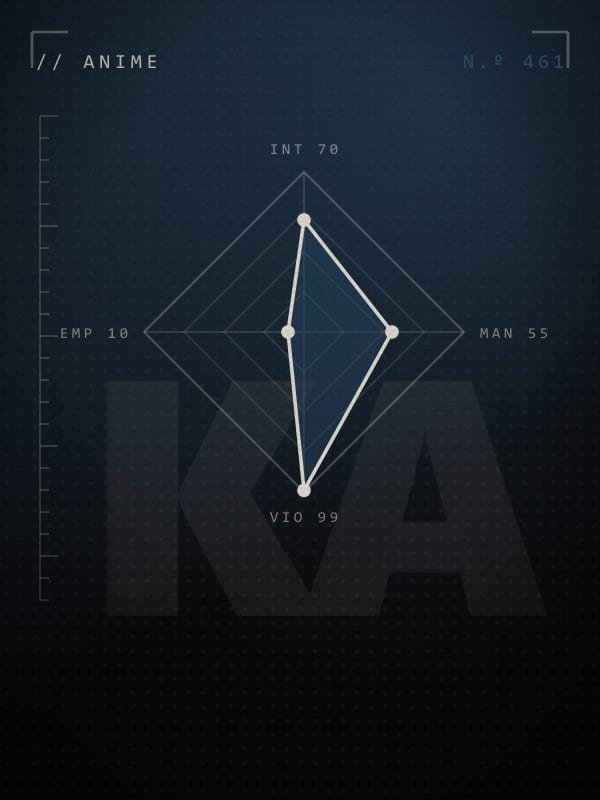
Rob Lucci, elite CP9 agent in One Piece, does not fit the image of the criminal who screams his own evil. He is quiet, disciplined, lethal; he carries out the World Government's orders with an efficiency that looks like that of a model civil servant. And that is what is disturbing: he kills innocents —comrades who no longer serve a purpose, inconvenient witnesses, anyone who crosses his mission— without ever experiencing that he is doing something wrong. Lucci does not believe he is a killer. He believes he is an instrument of Dark Justice (Dark Justice), the doctrine that the safety of the system justifies any cruelty. For Sykes and Matza's theory of neutralization, he is not a monster with inverted morals: he is someone who has turned an ideology into the perfect inner alibi —the excuse that switches off guilt just long enough to pull the trigger—.
// The theoryThe five excuses that switch off guilt
In 1957, Gresham Sykes and David Matza published "Techniques of Neutralization" with a simple and devastating idea: almost no one breaks the law believing themselves a villain. The offender broadly shares everyone's morality —he knows that killing and doing harm is wrong— and, precisely for that reason, he needs a permit that he signs to himself before crossing the line. He does not invert his values: he neutralizes them momentarily with learned excuses, and then recovers them. They catalogued five formulas. The denial of responsibility ("it wasn't me, it was the circumstances, the orders"). The denial of injury ("really, no one was truly harmed"). The denial of the victim ("they had it coming; they were a threat"). The condemnation of the condemners ("who are you to judge me?"). And the appeal to higher loyalties ("I did it for something bigger than myself"). Matza later added the concept of drift: the moral brake is released just enough, the act is committed, and conscience returns to its place. Lucci runs through the five techniques almost in order, and Dark Justice is the name that binds them all into a single grand permit.
Ideology as industrialized neutralization
What is remarkable about Lucci is that he does not improvise his excuses: he has them institutionalized. Sykes and Matza described individual techniques, alibis one whispers to oneself; but Dark Justice is those same techniques turned into state doctrine. The appeal to higher loyalties is no longer "I did it for my own people," but "I did it for the world order": the highest loyalty imaginable, the one no concrete victim can counterbalance. The denial of the victim comes preloaded: whoever falls before Lucci is not a person, but a "threat to order," a label that strips them of their humanity in advance. And the denial of responsibility dissolves into the chain of command —"I'm only doing my duty"—, where no one fully decides and therefore no one bears the guilt. Ideology does for Lucci the work the common criminal has to do alone: it hands him the alibis already written, respectable, signed by authority. That is why he can kill without falling apart: his conscience is not broken, it is administered by a system that promises him that cruelty, if it serves order, is not cruelty but service.
Get the map of theories for free
Subscribe to the criminal archive —one case a week, no spam— and I'll send you The map of theories: the great currents of criminology on a single sheet.
// The subjectThe killer who thinks he is a civil servant
Let us go through Lucci's alibis one by one. When he executes those he considers obstacles, he activates the denial of the victim: there are no victims, there are enemies of the world, and enemies of the world are owed no compassion. When he is asked about the price in lives, he appeals to the higher loyalty: the peace of countless people justifies the sacrifice of a few —a calculation that sounds like moral arithmetic and works like anesthesia—. When he acts, he shelters behind the denial of responsibility: he is an agent, he follows orders, he serves a justice that precedes him and will outlive him; the decision, at bottom, is not his. Against those who call him a monster, he deploys the condemnation of the condemners: the pirates, the rebels, those who oppose the Government are the real chaos, and whoever judges him defends that chaos. And the denial of injury beats within all his logic: what he destroys is not harm, it is cleansing; he does not break the order, he maintains it. Five techniques, one man, a single word that wraps them: justice. Lucci is not a psychopath with no moral brake —he is something more unsettling: a man with a perfectly functional moral brake that a doctrine has taken it upon itself to disconnect permanently. He believes in good. It is just that he has accepted a definition of good that absolves him of everything he does in its name.
Rob Lucci
// The crackWhen the alibi does not cover the pleasure
Here the crack appears, and it is double. The first is internal to Lucci himself: his violence exceeds duty. If he really were only a neutral instrument, he would complete the mission and nothing more; but Lucci enjoys strength, seeks combat, savors dominance over his rival. That pleasure overflows the alibi. Neutralization only works while the act seems necessary: the moment cruelty becomes joyful, the excuse cracks, because one no longer kills for order, one kills because one likes to kill. Sykes and Matza warned of something similar with subterranean values: the thrill, the excitement of risk, the taste for force that conventional culture condemns in public. Dark Justice gives Lucci a respectable cover for an appetite that the cover does not explain. And there the alibi stops covering him: duty does not oblige you to enjoy it.
The second crack is the usual one in this house: to explain is not to excuse. Understanding that Lucci kills sheltered by institutional neutralizations does not turn him into a victim of the system nor remove a gram of his responsibility. On the contrary: the theory of neutralization points to responsibility with more precision, not less. Lucci is not an innocent cog dragged along by a doctrine —he is an agent who chose to believe it, who reproduces it with every execution and who, when the excuse falls short, carries on for his own pleasure. Dark Justice explains how he silences his guilt; it does not decide for him. The memory that matters is not that of the efficient executioner, but that of the innocents whom a single label —"threat to order"— was enough to condemn.
The perfect alibi is the one the State hands out
Lucci matters because he shows where the most dangerous neutralization lives: not in the thief who tells himself "it was only a loan," but in the institutional violence that exonerates itself as duty. The five techniques reach their purest form when whoever uses them keeps their image as decent people intact —when the crime comes with a uniform, with a signed order and with a noble word out front—. "I was only following orders" is the perfect neutralization precisely because it distributes responsibility until it disappears, and because it clothes it in a loyalty —the homeland, order, security— that presents itself as non-negotiable. Recognizing the Luccis does not consist in waiting for the monster who screams his own evil, but in distrusting the respectable alibi: the cruelty that calls itself service, the harm that is rebranded as cleansing, the victim who is labeled a threat so as not to have to look at them. A decent society is not measured by how it defeats the obvious killer, but by whether it knew how to refuse to sign his permit.
Three key takeaways
- Rob Lucci embodies the techniques of neutralization (Sykes and Matza, 1957): he kills without feeling like a criminal because he neutralizes guilt with excuses —he denies the victim, denies his responsibility, appeals to higher loyalties— before each act.
- The "Dark Justice" is those five techniques industrialized: the World Government's ideology hands him the alibis already written and respectable, turning murder into "duty" and the victim into a "threat to order."
- The crack is double: his pleasure in force exceeds duty and overflows the alibi, and to explain is not to excuse. Understanding his neutralizations points to his responsibility with more precision, not less. The memory is for the innocents.
Sources · further reading
- Sykes, G. M. & Matza, D. (1957). «Techniques of Neutralization: A Theory of Delinquency». American Sociological Review, 22(6).
- Matza, D. (1964). Delinquency and Drift. Wiley.
- Bandura, A. (1999). «Moral Disengagement in the Perpetration of Inhumanities». Personality and Social Psychology Review, 3(3).
- Cohen, S. (2001). States of Denial: Knowing about Atrocities and Suffering. Polity Press.
Case-file questionsFrequently asked questions
¿Quién es Rob Lucci?
Rob Lucci es un villano de One Piece, analizado en KRIMINIS con la lente de la criminología. He kills innocents without flinching and sleeps soundly.
¿Por qué Rob Lucci se convierte en villano?
Rob Lucci and the techniques of neutralization (Sykes and Matza): the excuses with which an elite assassin kills without feeling like a criminal. When "duty" and "justice" switch off guilt just long enough to pull the trigger.
¿Qué teoría criminológica explica a Rob Lucci?
El caso de Rob Lucci se analiza desde la Neutralización. The techniques of neutralization (Sykes and Matza) describe the rationalizations with which someone breaks the law without feeling like a criminal: denying the victim, denying responsibility, appealing to higher loyalties. Rob Lucci, elite CP9 agent in One Piece, embodies them all under a single umbrella: the "Dark Justice" of the World Government. Convinced that the order of the system justifies any cruelty, he kills without mercy —even innocents— without ever experiencing himself as a villain. It is institutional violence that exonerates itself as duty.