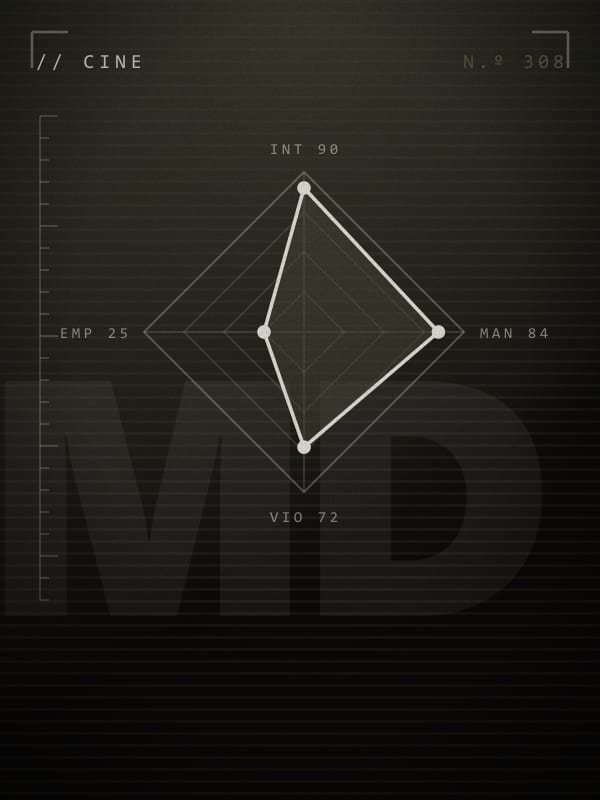
Adrian Veidt gave up an inherited fortune to prove he could build another one from scratch — because he is, literally, the smartest man in the world. Under the name Ozymandias, that unrivalled intellect confronts the greatest problem of his age: two superpowers on the verge of annihilating each other in a nuclear war. And he solves it as he would solve any equation: by manufacturing a common threat —a fake, monstrous attack that levels New York and kills millions— so that terror unites humanity and halts the apocalypse. He does not do it out of hatred or madness. He does it because, after running the numbers, it pays off. Ozymandias is the oldest criminological theory —rational choice— pushed to a godlike, chilling extreme.
// The theoryCrime as calculation
Rational choice theory starts from a simple and powerful idea: crime is not a disease or a destiny, but a decision. The agent weighs what can be gained, what can be lost and the odds of getting caught — and acts if the balance is in their favour. The economist Gary Becker formalised it in 1968 with his "economic approach to crime": the offender is a rational actor who maximises their utility like any consumer, which is why punishment works by raising the "price" of crime. Cornish and Clarke refined it in The Reasoning Criminal (1986): even the seemingly impulsive criminal makes, in their own way, decisions — choosing targets, moments, methods. Rational choice does not look at the offender's soul; it looks at their ledger.
Ozymandias is that ledger taken to infinity. Where Walter White calculates the drug business and Raskólnikov calculates whether a "useless" life is worth less than the good he could do with the stolen money, Ozymandias performs the same operation on the scale of a species: he places on one pan of the scale the millions he is going to kill and on the other the billions that nuclear war would take, and concludes —with impeccable logic— that his crime is the lesser evil. He is a perfect rational actor: no impulse, no passion, no miscalculation. And that is precisely why his case is the most unsettling in the whole theory — because it proves that rationality, on its own, has no brake.
Being rational is not being good
The lesson Ozymandias lays bare is the difference between two things we tend to confuse: instrumental reason and moral reason. The sociologist Max Weber separated them as instrumental rationality (calculating the most effective means to a goal) and value rationality (judging whether the goal and the means are good). Ozymandias is an absolute genius of the first and a void in the second: he chooses the means impeccably —a brilliant plan, executed flawlessly— but takes the end for granted without subjecting it to any moral limit. His famous line "I did it thirty-five minutes ago" is pure means-calculation: he foresaw that the heroes would come, so he acted first. Rational choice describes how he decides; it does not dictate what he should decide. And there lies his blind spot: a perfect calculation in the service of an end without scruples is not sanity — it is the most dangerous form of madness, the kind that has all the answers and no conscience.
Get the map of theories for free
Subscribe to the criminal archive —one case a week, no spam— and I'll send you The map of theories: the great currents of criminology on a single sheet.
// The subjectThe arrogance of being right
What makes Ozymandias a textbook villain —and not a tragic hero— is not his calculation, but his arrogance: the certainty that he, and he alone, can compute the correct answer for all of humanity and carry it out without asking anyone's permission. His name gives him away: Ozymandias is the king in Shelley's poem whose colossal statue lies broken in the desert, with the inscription "look on my works, ye Mighty, and despair" — a monument to arrogance that time pulverises. Adrian believes himself above the rest of the species, entitled to decide who dies for the good of all, and that is the trap of reason without limits: it turns the one who calculates into a god who claims the lives of others as a variable. He says he has "made himself feel every death," and perhaps it is true — but the feeling did not stop him, because for him conscience was just one more datum in the equation, not a limit. Ozymandias is not cold because he is incapable of feeling: he is cold because he has decided that his feelings must not outweigh his conclusion.
Adrian Veidt
// The crackThe rational actor who does not exist
Rational choice has cracks that science itself widened. The first: the perfectly rational actor it assumes —the one who calculates all costs and benefits with complete information— barely exists. The economist Herbert Simon proved it with his idea of bounded rationality: we decide with partial information, mental shortcuts and biases, not with perfect spreadsheets. Most real crimes are not master plans à la Ozymandias, but hurried, emotional, badly calculated decisions — in fact, if criminals calculated well, they would offend less, because crime rarely "pays off." Ozymandias is a fantasy: the criminal the theory imagines in its pure form and that reality almost never produces. His perfect calculation is as unreal as the utterly irrational criminal at the opposite extreme.
The second crack is moral, and it is the one Watchmen underlines without mercy: what if the calculation, besides being monstrous, is wrong? Ozymandias bets the lives of millions that his plan will work and the peace will last — but the comic ends with a devastating doubt (Rorschach's journal, about to expose everything, and the line "nothing ever ends"). Rational choice presupposes that consequences can be foreseen; history, and the chaos theory that Ozymandias himself venerates, say the opposite. Trusting that one person alone can compute the good of humanity and sacrifice innocents for an uncertain conclusion is not only immoral: it is, at bottom, a failure of rationality — the arrogance of believing that individual reason is enough to play providence. The "lesser evil" is only lesser if you are right; and no one, not even the smartest, has that guarantee.
Reason needs a moral ceiling
Ozymandias matters because his logic is not comic-book: it is the logic of everyone who justifies horror with a spreadsheet. "A few must be sacrificed for the good of the many," "the end justifies the means," "someone has to make the hard decisions" — the grammar of Ozymandias is that of tyrants, technocrats and fanatics of every era, and also, in its civilian version, that of the calculation that reduces people to figures. Rational choice is a valuable tool for understanding and preventing crime (raising its costs, reducing its opportunities), but Ozymandias marks its frontier: instrumental reason needs a moral ceiling that no calculation can pierce — limits, rights, the inviolability of the person— or it becomes the perfect alibi for the greatest of crimes. Being logical is not enough. The question Ozymandias never truly asked himself is not "will the calculation work out?" but "do I have the right to make it?".
That is why Ozymandias is one of fiction's most debated villains: Watchmen refuses to tell us whether he was right, and that refusal is its genius. It leaves us with the discomfort of a calculation that might work and that, even so, we feel to be monstrous — and in that crack between the effective and the just lives the entire debate. Adrian Veidt solved the world the way one solves a chess problem, and believed that intelligence gave him the right to move the human pieces. Rational choice theory explains his calculation; what it cannot give him —what no calculation gives— is the only thing that would have stopped him: a value that was not for sale. The smartest man in the world had everything but that. And that is why his work, like that of the king in the poem, is doomed to break.
Three key takeaways
- Rational choice (Becker, 1968; Cornish and Clarke) sees crime as a decision: costs, benefits and risks are weighed. Ozymandias takes it to a godlike extreme — a perfect intellect that calculates that killing millions is the "lesser evil" to save billions.
- His case separates instrumental reason (of means) from moral reason (of values), following Weber: he is a genius of the first and a void in the second. Being logical is not being good — the most impeccable calculation can justify horror if nothing limits the end.
- The cracks: the perfectly rational actor barely exists (Simon, bounded rationality — real crime is hurried, not a master plan); and the calculation presupposes foreseeing consequences that no one guarantees. Instrumental reason needs a moral ceiling — rights that no calculation can pierce.
Sources · further reading
- Becker, G. S. (1968). «Crime and Punishment: An Economic Approach». Journal of Political Economy, 76(2).
- Cornish, D. B. y Clarke, R. V. (1986). The Reasoning Criminal: Rational Choice Perspectives on Offending. Springer.
- Simon, H. A. (1955). «A Behavioral Model of Rational Choice». Quarterly Journal of Economics, 69(1).
- Weber, M. (1922). Economía y sociedad. [sobre la racionalidad de fines y de valores].
Case-file questionsFrequently asked questions
¿Quién es Adrian Veidt?
Adrian Veidt («Ozymandias») es un villano de Watchmen, analizado en KRIMINIS con la lente de la criminología. Adrian Veidt —Ozymandias— is the most intelligent man on the planet, and he uses it to solve a problem: humanity is marching toward nuclear war.
¿Por qué Adrian Veidt (Ozymandias) se convierte en villano?
Watchmen and rational choice pushed to its godlike extreme: the smartest man in the world runs the numbers, decides that murdering millions is the price of saving billions — and executes it with the cold precision of a spreadsheet. Ozymandias is instrumental reason without a single moral brake.
¿Qué teoría criminológica explica a Adrian Veidt?
El caso de Adrian Veidt se analiza desde la Elección racional. Rational choice theory sees crime as a decision: the agent weighs costs, benefits and risks and acts if it pays off. Ozymandias takes it to its purest and most terrifying form: a perfect intellect that applies that calculation on a planetary scale and concludes, in cold blood, that killing millions is the acceptable "cost" of the "benefit" of peace. His case lays bare the limit of instrumental reason: being logical is not being good — the most impeccable calculation can justify horror if no one places a value above the outcome.