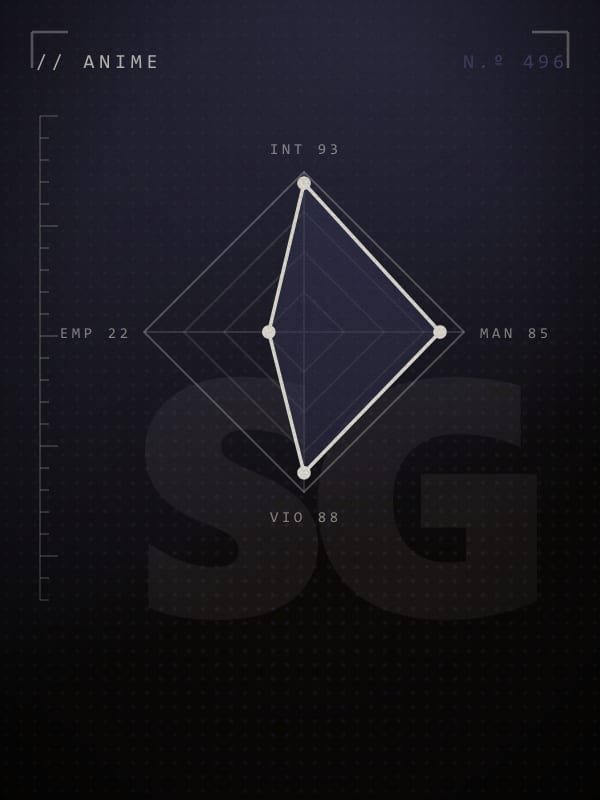
Chrollo Lucilfer, leader of the Genei Ryodan —the Phantom Troupe— in Hunter × Hunter, is a thief of unsettling serenity: cultured, gentle in his gestures, capable of ordering a massacre in the tone of someone handing out chores. But what truly defines him is not his coldness, but his relationship with the group. For Chrollo, the Troupe is a family —a collective body they call the spider— and he, the head, declares himself expendable: if the head falls, the legs go on; if legs fall, they are replaced. Loyalty does not flow toward him, it flows toward the whole. That idea —that a criminal should place the collective above himself and build an entire ethic upon it— is the heart of a precise criminological theory: the delinquent subculture.
// The theoryA world that inverts the rules of the one that expelled it
In Delinquent Boys (1955), the sociologist Albert Cohen asked himself a question that strain theory did not quite answer: why is much of delinquency not after money, but status? His answer was memorable. The boys society leaves behind are measured by a yardstick —ambition, manners, success— that they can barely meet; repeated failure produces status frustration; and then they do something brilliant and terrible: they band together and flip the scoreboard. They create a subculture where exactly the opposite of what the respectable world rewards is what counts. What that world despises becomes a medal. It is building prestige by other means when the front door is shut. Cohen was not alone: Cloward and Ohlin described different subcultures according to which illegitimate opportunities were at hand, and Walter Miller pointed to toughness and cunning as values of their own. In all of them, the gang is a collective solution to a shared problem, not the sum of scattered acts of wickedness.
The inversion of values made into ethics
Cohen's mechanism is not just breaking the norms of the respectable world, but turning them upside down until an alternative code is built. The Phantom Troupe takes it to the extreme: it is born in Meteor City, the dump where the people the world throws away end up —people with no record, no official name, literally discarded—. Excluded from all legitimate status, its members manufacture their own. Stealing the most heavily guarded treasures, confronting the most powerful hunters, surviving the impossible: that grants prestige within the spider. And upon that inversion they raise an ethic with firm rules —strength matters, but loyalty to the collective matters more—. It is not the absence of morality; it is a different morality, coherent and shared, built exactly upon the ruin the society threw them into.
Get the map of theories for free
Subscribe to the criminal archive —one case a week, no spam— and I'll send you The map of theories: the great currents of criminology on a single sheet.
// The subjectThe leader who declares himself replaceable
What is revealing about Chrollo is that his leadership works by negating the model of leader we know. In an ordinary gang, the boss protects his position and demands personal loyalty; Chrollo does the opposite: he subordinates his own life to the continuity of the group. The spider is the subject, not him. That inverted hierarchy —where the head serves the body and not the other way around— is the delinquent subculture in its purest form: status within the gang is not inherited nor imposed, it is earned by contributing to the collective, and the greatest virtue is not individual brilliance but belonging. That is why the members of the Troupe, capable of any atrocity toward the outside, keep an almost sacred fidelity among themselves; and that is why an attack on one of their own unleashes in them a fury that no other loss provokes. Cohen would describe it without hesitation: when the legitimate paths to respect and belonging are closed, the group manufactures them on its own, and whoever offers them —here, Chrollo— becomes the axis of a loyalty the outside world never gave them.
Chrollo Lucilfer
// The crackUnderstanding the spider is not absolving the one who weaves
The crack with Chrollo is twofold. The first is turning origin into an alibi: reading Meteor City, exclusion and status frustration as an excuse that erases the decisions. The delinquent subculture does not say that. Cohen explains structures and groups precisely to understand the phenomenon better, not to dissolve anyone's responsibility. Chrollo chooses: he chooses to steal, chooses to kill, chooses the target of each strike. That there exists a subculture giving meaning to those acts does not make them inevitable nor exculpate whoever orders them. The gang explains the framework; it does not sign the orders. To explain is not to excuse.
The second crack is the opposite, and the theory itself points to it. The delinquent subculture presupposes a coherent and shared group, and real gangs are messier: people come and go, loyalty wavers, David Matza's "drift" reminds us that almost no one lives permanently inside the code. The Phantom Troupe, with its iron cohesion and its flawless ethic, is a refined fiction —cleaner and more total than any gang that exists—. Taking it as a faithful portrait of why gangs form would be a mistake; it serves, instead, as an extreme case that illuminates the mechanism: denied status rebuilt in a world apart. And the belonging Chrollo offers his own does not cancel what he does to everyone else: behind every stolen treasure and every strike of the spider there are victims whose memory does not fit in the pride of the collective.
Belonging is a need, not a whim
Chrollo matters because he teaches us to read the gang as what Cohen saw in it: a response —rational, though destructive— to a problem society failed to solve first. People need respect and belonging; when the legitimate paths are closed, the subculture offers them, and whoever stays inside will defend them with a ferocious loyalty precisely because nothing else gave them. The lesson is not to admire the spider, but to recognize the void from which it is born. Modern evidence confirms it: the programs that truly reduce gang activity are not only policing, but those that compete with them by offering real belonging —mentors, employment, community—. Meteor City is not just the backdrop of the Troupe; it is the warning that a world which discards people should not be surprised that those people invent their own, with its inverted rules and its own terrible sense of honor.
Three key takeaways
- Chrollo Lucilfer and the Phantom Troupe embody the delinquent subculture (Cohen): a group excluded from legitimate status that inverts the values of the respectable world and manufactures its own, where stealing and surviving the impossible grant prestige.
- Its defining trait is loyalty to the collective above the individual: the spider is worth more than any leg, and Chrollo, the head, declares himself replaceable. Status is earned by contributing to the group, and belonging is the supreme virtue.
- To explain is not to excuse. Meteor City and status frustration frame the Troupe, but they do not sign its crimes: Chrollo chooses each strike. And the theory warns of its limits —real gangs are more fragile than this fiction of perfect cohesion—.
Sources · further reading
- Cohen, A. K. (1955). Delinquent Boys: The Culture of the Gang. Free Press.
- Cloward, R. A. & Ohlin, L. E. (1960). Delinquency and Opportunity. Free Press.
- Thrasher, F. M. (1927). The Gang. University of Chicago Press.
- Matza, D. (1964). Delinquency and Drift. Wiley.
Case-file questionsFrequently asked questions
¿Quién es Chrollo Lucilfer?
Chrollo Lucilfer es un villano de Hunter × Hunter, analizado en KRIMINIS con la lente de la criminología. He leads the most feared band of thieves in the world and yet says without hesitation that he is expendable: the spider survives even when its legs fall.
¿Por qué Chrollo Lucilfer se convierte en villano?
Chrollo Lucilfer and the delinquent subculture: how the Phantom Troupe invents a world with its own rules, where status is earned by stealing and loyalty to the group is worth more than any life, including the leader's.
¿Qué teoría criminológica explica a Chrollo Lucilfer?
El caso de Chrollo Lucilfer se analiza desde la Subcultura delincuente. The delinquent subculture (Albert Cohen) explains how groups excluded from legitimate status invent their own world of inverted values, where prestige is earned precisely by doing what respectable society condemns. Chrollo Lucilfer, leader of the Genei Ryodan —the Phantom Troupe— in Hunter × Hunter, embodies that logic with uncommon clarity: a band born in the garbage dump of Meteor City, with its hierarchy, its rituals and an internal ethic where loyalty to the collective (the spider) stands above any member, including the leader himself.