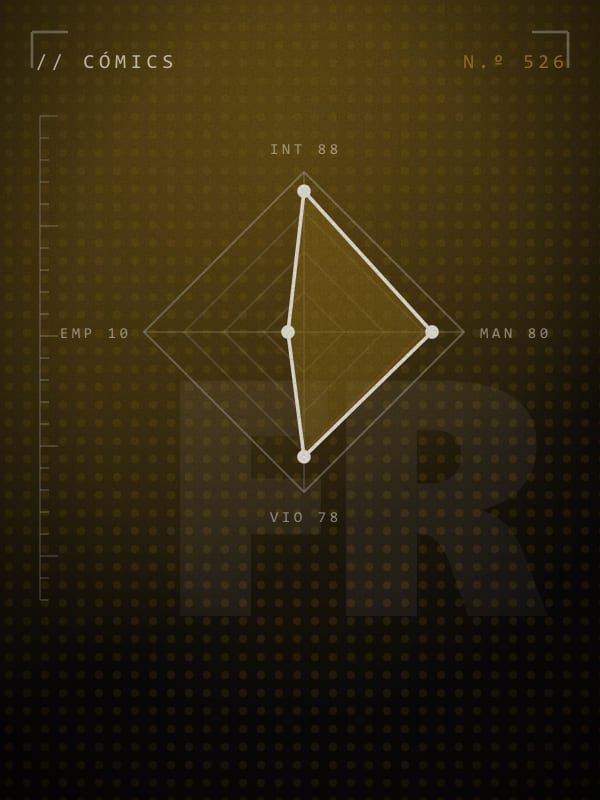
Mister Sinister —Nathaniel Essex— is a Victorian scientist who, obsessed with evolution and genetics, made himself immortal so he could pursue his project across the centuries: the genetic manipulation of mutants to create «superior» beings. He collects DNA, experiments on people, breeds lineages, clones and manipulates lives the way one works with laboratory samples. For Mister Sinister, no living being is an end in itself; all are material for his work. For criminological eugenics, he embodies its laboratory face: the total dehumanization of the one who reduces people to their genetics.
// The theoryReduction to genes
The eugenics of Galton rests on a prior mental operation: reducing people to their genetic value. To be able to select who reproduces and who does not, one must first stop seeing human beings as individuals with dignity and start seeing them as carriers of «good» or «bad» genes. Mister Sinister embodies that reduction taken to the extreme: he literally sees people as DNA sequences, genetic potential to be exploited. The theory stresses that this dehumanization is the prerequisite of the eugenic horror —just as Quaritch needs to see the native as an obstacle in order to exterminate him, the eugenicist needs to see the person as a sample in order to experiment on her—. Mister Sinister does not hate his victims; something worse: he does not see them as victims, nor even as people, but as biological material. And in that gaze, not in any passionate cruelty, lies the root of eugenics.
The scientist without conscience
Mister Sinister illustrates the specific danger of eugenics as a scientific project: the dissociation between knowledge and conscience. He is brilliant, methodical, rigorous —a great scientist in technical terms— and utterly amoral: his rigor includes no ethical question about what he does. He embodies the temptation that twentieth-century science knew firsthand: that the pursuit of knowledge and the power to manipulate life can advance while moral conscience lags behind. The Nazi doctors who experimented on prisoners, the scientists who designed sterilization programs, were technically competent; what they lacked was not science, but the recognition that their «samples» were human beings. Mister Sinister is the reminder that intelligence without ethics is not a safeguard against horror, but its most efficient tool —and that the important question before any advance is not only "can we?", but "should we?"—.
Get the map of theories for free
Subscribe to the criminal archive —one case a week, no spam— and I'll send you The map of theories: the great currents of criminology on a single sheet.
// The subjectCuriosity turned into cruelty
What is disturbing about Mister Sinister is that his engine is neither hatred nor greed, but curiosity —a runaway scientific curiosity, freed from every moral brake—. He wants to know, he wants to perfect, and to that end he will do anything to anyone. This motivation makes him, in a sense, more unsettling than a villain driven by ambition: curiosity without conscience is infinite, it has no goal that, once reached, would sate it. Real eugenics had much of this —a «scientific» impulse to improve, measure and control human life that, stripped of ethics, led to atrocity—. Mister Sinister is responsible for every life he destroys in his experiments, and his case teaches that the worst cruelty is not always born of malice: sometimes it is born of a curiosity that has forgotten that its objects of study are people.
Mr. Siniestro
// The crackNeither "science is neutral" nor "knowledge bears no guilt"
The crack with Mister Sinister is the alibi of scientific neutrality: «he only researches, science is neutral, the problem is the use». Eugenics belies that comfort —there is research whose very object (classifying humans by their genetic value, selecting who should exist) is intrinsically inseparable from a monstrous end, and carrying it out is already crossing the line—. Not all science is neutral; some is rotten in its premise. The opposite crack is anti-scientific rejection: concluding that genetics or biological research are dangerous in themselves and must be feared. Not that either: responsible genetics cures diseases and saves lives. The difference, which Mister Sinister erases, is conscience —the science that recognizes the dignity of people versus the one that reduces them to samples—. Neither demonize knowledge nor absolve it of all ethics: demand that it never stop seeing a human being where Mister Sinister sees only DNA.
That Mister Sinister is immortal —that he pursues his project across the centuries, imperturbable— is a precise metaphor for eugenics itself: a temptation that does not die, that survives every refutation and reappears with each new technology, always ready to reduce people once again to their genetics.
Ethics as part of science
Mister Sinister matters because he embodies the lesson science learned from the eugenic horror: that ethics is not an external add-on to research, but a constitutive part of it. Out of the Nazi experiments and the eugenic abuses were born the modern codes of bioethics —informed consent, ethics committees, limits on experimentation with humans—, precisely to prevent there being licensed Mister Sinisters again. His relevance is total in the era of CRISPR, gene editing and synthetic biology: we have never had so much power to manipulate life, and that is why the question Mister Sinister never asks himself has never been more important. The lesson is that the genetic progress that can cure is the same one that can re-edit eugenics, and that the only difference lies in whether we keep the awareness that every «sample» is a person. Mister Sinister is the scientist who lost that awareness —and the warning not to lose it ourselves—.
Three key takeaways
- Mister Sinister is the laboratory face of eugenics: an immortal who treats people as genetic material for his perfection project. Total dehumanization —seeing DNA where there are people—.
- He embodies the scientist without conscience: brilliant and utterly amoral, driven by a runaway curiosity with no ethical brake. Intelligence without ethics does not protect against horror: it is its most efficient tool.
- Neither "science is neutral" (there is research rotten in its premise: classifying humans by their genetic value) nor "knowledge bears no guilt" (nor demonizing genetics). The difference is conscience: never stop seeing the person where he sees only DNA.
Sources · further reading
- Gould, S. J. (1981). La falsa medida del hombre. Norton.
- Annas, G. J. & Grodin, M. A. (1992). The Nazi Doctors and the Nuremberg Code. Oxford University Press.
- Saini, A. (2019). Superior: The Return of Race Science. Beacon Press.
Case-file questionsFrequently asked questions
¿Quién es Mr. Siniestro?
Mr. Siniestro («Nathaniel Essex») es un villano de X-Men, analizado en KRIMINIS con la lente de la criminología. To him, people are not people: they are sequences, samples, genetic potential.
¿Por qué Mr. Siniestro (Nathaniel Essex) se convierte en villano?
Mister Sinister and eugenics: the immortal scientist who treats living beings as laboratory samples for his genetic-perfection project. Total dehumanization.
¿Qué teoría criminológica explica a Mr. Siniestro?
El caso de Mr. Siniestro se analiza desde la Eugenesia Criminológica. Eugenics (Galton) reduces people to their genetic value. Mister Sinister, of X-Men, embodies it in the laboratory: an immortal obsessed with the genetic manipulation of mutants, who treats living beings as material for his perfection project. Total dehumanization —seeing in every person not an end, but a sample—.