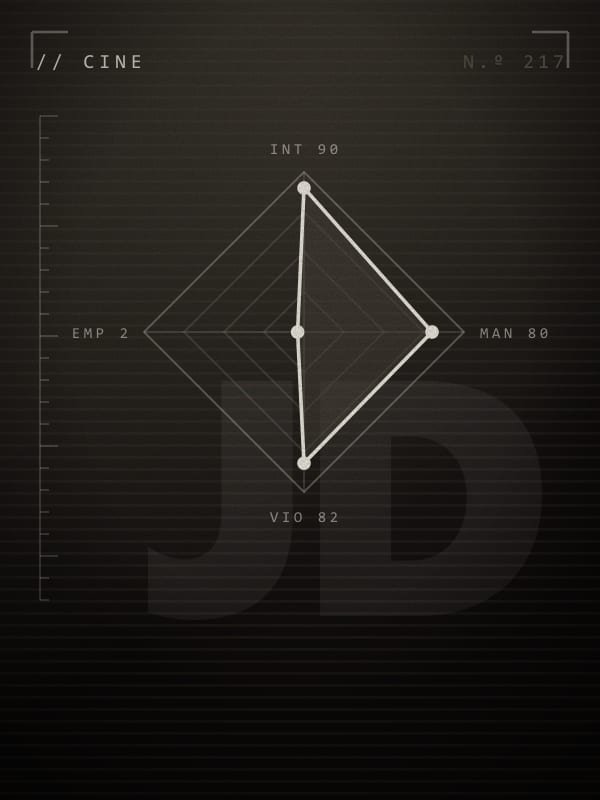
The High Evolutionary is a scientist of almost divine power with a single obsession: to create the perfect species. To achieve it, he experiments on living beings, modifies them, vivisects them and —when they fall short of his ideal— exterminates entire populations and planets and starts over. There is no gratuitous cruelty in him: there is something worse, the absolute indifference of one who regards all beings as mere drafts toward his masterpiece. For criminological eugenics, the High Evolutionary is the eugenic dream taken to its purest, most monstrous form: perfection as an alibi for genocide.
// The theoryPerfection as an alibi for extermination
Galton’s eugenics proposed "improving the species" by selecting its biology —promoting the "superior", eliminating the "inferior"—. The High Evolutionary is that idea without the disguise of scientific respectability it had in real history: he pursues biological perfection and, in its name, believes himself authorized to do anything to "imperfect" beings. His motto —"I do not seek to create the perfect: I seek to create perfection"— is the essence of eugenic logic: the replacement of real, concrete, valuable life with an abstract ideal on whose altar every sacrifice is justified. The theory points to him as the mechanism of horror: when the perfection of the species becomes the supreme good, every real individual ceases to have value of its own and becomes disposable material. Extermination is not a flaw in his project; it is his method.
The ideal that devours the real
The High Evolutionary illustrates the philosophical heart of eugenic horror: the tyranny of the ideal over the real. His obsession with future perfection makes him utterly indifferent to present suffering —the animals he tortures, the creatures he creates and discards, the worlds he erases—, because all of it is, for him, a toll on the way to his work. It is exactly the logic that led real eugenicists to sterilize and kill "for the good of future humanity": when an abstract ideal (the perfect race, the improved species) is placed above concrete lives, genocide becomes an act of progress in the eyes of the one committing it. The film makes it explicit: each of the High Evolutionary’s atrocities is justified by the promise of a perfect world that never arrives. And that is the theory’s warning: distrust anyone who asks you to sacrifice real lives in the name of a future perfection, because that is, always, the first step toward extermination.
Get the map of theories for free
Subscribe to the criminal archive —one case a week, no spam— and I'll send you The map of theories: the great currents of criminology on a single sheet.
// The subjectThe god who only produces pain
The most revealing thing about the High Evolutionary is his failure: despite all his power and all his cruelty, he never attains the perfection he pursues —he leaves behind only a trail of suffering and broken creatures—. The film is deliberate about this: the dream of perfecting life produces not perfection but pain. His most cherished creation (Rocket, the raccoon) rebels precisely because he retains the humanity, the imperfection and the bond his creator despises. Eugenics, embodied in him, reveals its central lie: that "improving" the species by eliminating the imperfect improves nothing, it only destroys. The High Evolutionary is not a creator god; he is a torturer with delusions of grandeur, and his obsession does not elevate him, it turns him into the greatest monster of his galaxy.
el Evolucionario Supremo
// The crackNeither "a misunderstood genius", nor "just science fiction"
The crack with the High Evolutionary is the temptation to see him as a tragic, misunderstood genius, a visionary who went too far: he is not —he is a torturer who disguises his cruelty as science—, and buying his story of "perfection" is exactly the error that made real eugenics possible. The opposite crack is to dismiss him as "just science fiction", an exaggerated villain with no connection to reality. On the contrary: his logic is identical to that of the historical eugenicists who sterilized and killed "for the good of the species", and his fantasy of redesigning life is the same one that surfaces today in debates about gene editing and "designer babies". To recognize in him not a fantasy villain but the heir of Galton and of the scientists who dreamed of purifying humanity is precisely the lesson fiction allows —and one best not lost—.
That his imperfect creation (Rocket) is also the most endearing and valuable is the refutation the film sets against eugenics: the worth of a being lies not in its perfection, but in its life, its bonds and its irreducible singularity —precisely what the dream of the perfect species sets out to erase—.
Distrust the dream of perfection
The High Evolutionary matters because he embodies, in recognizable terms, the temptation that eugenics never stops reissuing: that of perfecting the human being by redesigning its biology. That fantasy —today with CRISPR, embryo screening and promises to eliminate "undesirable" traits— presents itself as progress, health and freedom, just as eugenics presented itself as science. The lesson of the theory, and of the character, is to learn to distrust the very dream of perfection: to always ask who defines what is "perfect", what is sacrificed in its name and who is declared disposable. The High Evolutionary pursues perfection and produces only monsters and pain —exactly what real eugenics produced—. He is the reminder that humanity is not improved by eliminating the imperfect, because in the imperfect —in the singular, the vulnerable, that which does not fit— lies precisely what makes us human.
Three key takeaways
- The High Evolutionary is eugenics in its purest form: he vivisects and exterminates entire populations in pursuit of the "perfect species", with absolute indifference. Perfection as an alibi for genocide.
- He illustrates the tyranny of the ideal over the real: when future perfection is the supreme good, every concrete life becomes disposable material. It is the logic that led to sterilizing and killing "for the good of humanity".
- Neither "misunderstood genius" (he is a torturer who disguises his cruelty as science) nor "just science fiction" (his logic is that of real eugenicists, and of today’s debates about gene editing). The worth of a being lies in its singular life, not in its perfection.
Sources · further reading
- Black, E. (2003). War Against the Weak. Four Walls Eight Windows.
- Kevles, D. J. (1985). In the Name of Eugenics. Knopf.
- Sandel, M. J. (2007). Contra la perfección. Harvard University Press.
Case-file questionsFrequently asked questions
¿Quién es el Evolucionario Supremo?
el Evolucionario Supremo («High Evolutionary») es un villano de Guardianes de la Galaxia Vol. 3, analizado en KRIMINIS con la lente de la criminología. He does not seek the perfect: he seeks perfection.
¿Por qué el Evolucionario Supremo (High Evolutionary) se convierte en villano?
The High Evolutionary and eugenics: the scientist who vivisects and exterminates entire populations in pursuit of the "perfect species". Eugenic megalomania without a shred of pity.
¿Qué teoría criminológica explica a el Evolucionario Supremo?
El caso de el Evolucionario Supremo se analiza desde la Eugenesia Criminológica. Eugenics (Galton) dreams of perfecting the species by eliminating the "inferior". The High Evolutionary, from Guardians of the Galaxy Vol. 3, is its purest embodiment: a scientist who vivisects and exterminates entire populations in pursuit of the "perfect species", without the slightest pity. The megalomania of one who believes he has the right to redesign life —and only produces suffering—.