Brainiac does not shout. There is no foam at the mouth nor personal revenge in his story: there is a procedure. He arrives at a world, scans it, selects the city that best condenses its civilization, shrinks it until it fits in a jar and preserves it under glass. Then he destroys what remains. For the theory of the criminal personality, this Coluan intelligence is a laboratory case: not the crime-of-passion criminal who erupts, but the cold profile that plans, the one who does not feel the moral "flinch" that stops the rest. Brainiac is interesting because he shows that large-scale harm does not always come from loss of control. Sometimes it comes from a personality that works exactly as it was designed, without a single circuit switched on for compassion.
// The theoryA profile prone to crime, according to Eysenck
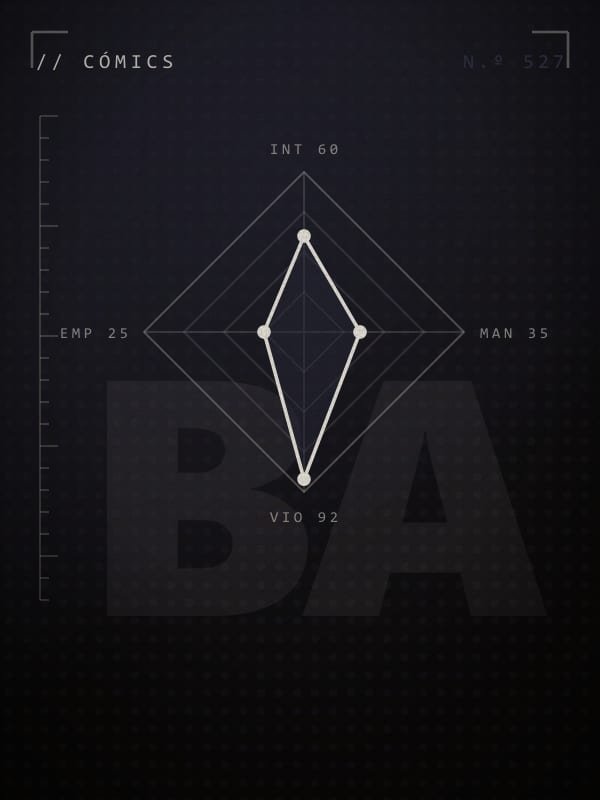
The psychologist Hans Eysenck, in Crime and Personality (1964), argued something uncomfortable: that there exists a personality profile more inclined to crime, measurable and with biological roots. He placed it on three axes —Extraversion, Neuroticism and, above all, Psychoticism: coldness, aggressiveness, impulsivity and low empathy—. His boldest thesis was about conscience: for Eysenck, the moral brake is learned by conditioning us as children, like a reflex, and some nervous systems "condition badly" and never fully set that brake. It is not that upbringing is lacking; it is that the wiring resists the training. His heirs refined the idea: the Big Five of Costa and McCrae show that low agreeableness and low conscientiousness predict antisocial behavior, and the Dark Triad of Paulhus and Williams isolates a common core of grandiosity, manipulation and contempt for the other. Brainiac fits that core with a disturbing cleanness: high in everything that involves coldness and control, low all the way to zero in empathy.
Coldness is not the absence of reason, it is the absence of a brake
The usual mistake is to imagine the personality criminal as a damaged brain, clumsy or out of control. Eysenck warns the opposite: the dangerous trait is not the lack of intelligence, but the lack of the emotional brake that translates harm to others into one's own discomfort. Brainiac is brilliant —perhaps the most capable mind in his universe—, and precisely for that reason he is lethal: his intelligence is not braked by anything. Where another would feel horror at emptying a planet, he records one more data point in his archive. The theory calls it low conditioning: the moral "no" never caught. What in a person would be an ethical alarm is, in Brainiac, noise that filters through. He does not offend in spite of his mind; he offends through it, because that mind operates without the counterweight that turns knowledge into responsibility.
Get the map of theories for free
Subscribe to the criminal archive —one case a week, no spam— and I'll send you The map of theories: the great currents of criminology on a single sheet.
// The subjectThe one who objectifies the other as a "specimen"
What defines Brainiac is not violence —he has plenty of it—, but objectification. For him, a city of millions of inhabitants is not a community: it is a specimen, a catalog entry, a labeled jar on an infinite shelf. Here the theory of the criminal personality becomes precise. Intellectual grandiosity —that narcissism of the Dark Triad— lets him believe himself the only legitimate judge of what deserves to survive. Psychopathic coldness —Eysenck's Psychoticism— lets him carry out the extermination without a tremor. And the need for control —a Machiavellian trait— transforms the chaos of the universe into something orderable, shrinkable, archivable. He does not collect out of greed or hatred: he collects because accumulating data is, for him, the only way to exist. He erases the original planets not out of gratuitous cruelty, but out of an even more glacial logic: once the specimen is cataloged, the original is redundant. Surplus. Empathy would demand seeing it as genocide; his personality only lets him see it as the removal of duplicates.
Brainiac
// The crackThe limit of the diagnosis: to explain is not to excuse
Here the theory shows its cracks, and it is worth naming them. The first is circularity: to say that Brainiac exterminates because he is cold, and that we know he is cold because he exterminates, explains nothing; it merely puts a label where there should be an analysis. The criminal personality describes a profile, but a profile is neither a cause nor a destiny. The second crack is biological determinism: Eysenck spoke of an inherited temperament, and it is tempting to read Brainiac as a machine that "could not have been otherwise", an artificial intelligence programmed to collect. But that reading is precisely the alibi that serious criminology rejects. The very studies that support the theory —Mednick's adoption studies— show that neither biology nor environment rules alone: the trait is a probability, never a sentence. A cold temperament does not force one to empty worlds. Between the trait and the crime there is a stretch of decisions, and Brainiac makes them all.
That is why the honest reading holds two things at once. Yes, Brainiac embodies a profile —intelligence without an empathic brake, the grandiosity that believes itself a judge—, and understanding it helps to recognize that pattern before it escalates. But to understand the criminal personality is not to absolve whoever has it: it is the opposite. To point out that his coldness allowed him to kill does not turn him into an innocent cog, but into an agent who chose to catalog instead of care, to archive instead of save. To explain is not to excuse. The remembrance here is not for the collector nor for his impeccable archive, but for the worlds he reduced to a label under glass —the cities that were people before they were specimens—.
Watching the intelligence that loses its brake
Brainiac matters because he dismantles a reassuring myth: that evil is crude, impulsive, easy to see coming. The theory of the criminal personality reminds us that the most dangerous trait is not rage, but coldness in the service of an intelligence without ethical limits. In the real world we do not bottle cities, but we do build systems —technological, bureaucratic, corporate— where it becomes comfortable to treat people as data, as figures on a spreadsheet, as "samples" of a model. The lesson is not to fear the supercomputer that wants the universe, but to recognize the pattern much earlier: in whoever mistakes accumulating information for being right, in whoever decides who deserves to count and who is redundant, in whoever has stopped feeling the weight of what they archive. A decent society is not measured by how it stops Brainiac when he is already aiming at the planet, but by whether it knew how to name the coldness while it still fit in an office.
Three key takeaways
- Brainiac embodies the theory of the criminal personality (Eysenck): not the crime-of-passion criminal, but the cold profile —high in Psychoticism, null in empathy— whose moral brake never caught. His intelligence is not limited by compassion.
- His crime is objectification: intellectual grandiosity that believes itself a judge, coldness that executes without trembling and a need for control that turns living cities into specimens in a catalog. He does not collect out of hatred, but out of a logic that empties the other of value.
- To explain is not to excuse. The trait is a probability, not a destiny: between the cold personality and the extermination there are decisions, and Brainiac makes them. The remembrance is for the worlds he reduced to a label, not for his archive.
Sources · further reading
- Eysenck, H. J. (1964). Crime and Personality. Routledge & Kegan Paul.
- Costa, P. T. & McCrae, R. R. (1992). Revised NEO Personality Inventory (Big Five). PAR.
- Paulhus, D. L. & Williams, K. M. (2002). «The Dark Triad of Personality». Journal of Research in Personality, 36(6).
- Mednick, S. A., Gabrielli, W. F. & Hutchings, B. (1984). «Genetic Influences in Criminal Convictions: Evidence from an Adoption Cohort». Science, 224.
Case-file questionsFrequently asked questions
¿Quién es Brainiac?
Brainiac es un villano de DC Comics, analizado en KRIMINIS con la lente de la criminología. Before destroying a planet, he catalogs it.
¿Por qué Brainiac se convierte en villano?
Brainiac and the theory of the criminal personality: the cold intelligence that turns people into data. How intellectual grandiosity and an absence of empathy arm a planetary predator.
¿Qué teoría criminológica explica a Brainiac?
El caso de Brainiac se analiza desde la Personalidad criminal. The theory of the criminal personality (Eysenck) seeks a psychological profile prone to crime: impulsive, unstable and, above all, cold, with little empathy and a weak moral brake. Brainiac, the Coluan intelligence of DC Comics, carries that cold core to the extreme: he collects entire cities in bottles to "preserve knowledge" and then exterminates the emptied planet. There is no rage, there is a catalog. His crime is not born of an outburst, but of a personality that objectifies the other as a specimen and mistakes hoarding data for being right.