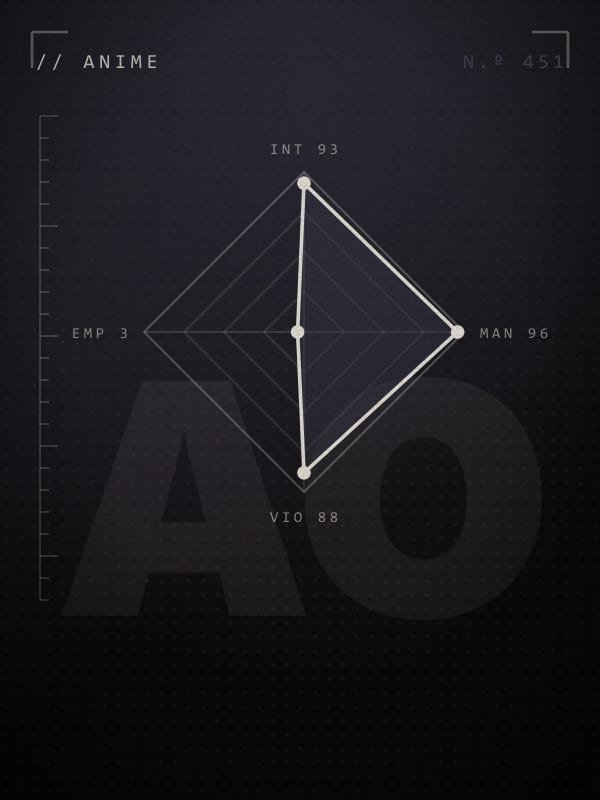
Mahito, in Jujutsu Kaisen, is not a human who became corrupted: he is a cursed spirit born of the hatred that humans feel for one another, made flesh in an almost human form. He manipulates souls, deforms bodies, kills out of curiosity and for what he calls «self-knowledge». What makes one shudder is not his cruelty, but the total absence of guilt: he does not stop before suffering because, for him, there is no one who suffers —only matter, toys, souls to experiment on—. For the moral disengagement of Albert Bandura, Mahito is the extreme case of one of its mechanisms: the dehumanization of the victim carried to the limit where the victim ceases entirely to exist as a person.
// The theoryMoral brakes and how they switch off
Bandura's moral disengagement begins from an uncomfortable idea: almost all of us have moral brakes —guilt, empathy, the self-censorship that keeps us from harming others— and yet normal people commit atrocities. How? Not by suppressing those brakes, but by deactivating them selectively through learned mechanisms. Bandura identified several: moral justification (I do it for a higher cause), euphemisms (not «killing» but «neutralizing», «collateral damage»), advantageous comparison (others do worse things), the displacement and diffusion of responsibility (I was only following orders; we all took part), the minimization of consequences, the attribution of blame to the victim and, the most radical, dehumanization: denying the victim their status as a person. When the other ceases to be a human being —and becomes vermin, a number, a thing— harming them no longer triggers any brake, because moral brakes only fire in the presence of people. Mahito dwells permanently in that last mechanism.
Dehumanizing: the switch that turns off guilt
Of all Bandura's mechanisms, dehumanization is the most powerful because it strikes at the very root of morality. It does not need to justify the act or spread the blame: it simply removes the victim from the category «person». A soldier who sees the enemy as «cockroaches», a torturer who sees «objects» instead of bodies, a perpetrator of genocide who speaks of «cleansing» —all have crossed the same line as Mahito, except that he was born already on the other side—. Mahito does not decide to see humans as matter: for him it is literal, it is his nature as a spirit born of human contempt. That is why he is so instructive as a monster: he shows, in pure form and without inner contradiction, the endpoint of a process that in real people is gradual. Real dehumanization does not begin with «they are not people»; it begins with a joke, a label, a «them» against an «us», and advances until harming the other costs nothing. Mahito is the final destination of that road, made flesh.
Get the map of theories for free
Subscribe to the criminal archive —one case a week, no spam— and I'll send you The map of theories: the great currents of criminology on a single sheet.
// The subjectThe spirit that plays with souls
Mahito kills without personal hatred and without conventional sadistic pleasure: he kills with curiosity. He deforms bodies to see what happens, he experiments with souls like a child taking apart a toy to understand its workings. His cruelty does not seek to make others suffer out of revenge —that would presuppose recognizing the victim as someone capable of suffering— but to know, to learn about himself through what he can do to human matter. It is dehumanization perfected: where there is no victim, there is no crime to repent of, only one more experiment. The series also presents him in full development: Mahito grows, learns, refines his technique and his idea of himself over the course of the story. That learning is the note that connects him to Bandura's learning theory: morality —and its disengagement— are not innate, they are molded. Mahito was born dehumanizing, but he also learns to do it better, to instrumentalize ever more cleanly those before him. It is not a fixed trait: it is a skill he perfects.
Mahito
// The crackUnderstanding the mechanism does not exculpate the one who uses it
Here is the most dangerous crack. Explaining that Mahito harms because he has dehumanized his victims can sound, if misread, like an alibi: «he is not guilty, it is his nature», «he does not see people, so he does not know what he is doing». It is the same trap that moral disengagement lays in real life: the mechanism that enables the harm is later presented as the one that excuses it. But understanding why a switch turns off guilt does not make innocent the one who flips it. Bandura's theory absolves no one: on the contrary, it describes moral disengagement precisely so that we can recognize and resist it. Knowing that dehumanization is the step before atrocity is a tool of defense, not of forgiveness. With Mahito —a fictional being who literally cannot see people— the temptation to exculpate is at its maximum, and that is why the case is so useful: it trains us to separate explanation from moral judgment.
That Mahito is a spirit and not a man does not change the lesson for us. Humans who dehumanize do see people —at least at first— and choose, mechanism by mechanism, to stop seeing them. Mahito is the extreme caricature that illuminates the real process: he teaches us to detect, in ourselves and in the discourses that surround us, the moment when a «them» begins to stop counting as people. That is the instant when the brakes must be switched back on, not off.
Recognizing dehumanization before it advances
Mahito matters because dehumanization is not a phenomenon of monsters: it is the everyday mechanism that makes bullying, institutional cruelty, contempt for the immigrant, mass violence and genocide possible. Bandura studied it in ordinary people —employees, soldiers, citizens— capable of doing harm once language and habit had switched off their brakes. The question Mahito leaves is a practical one: at what moment do I stop seeing someone as a person? When the euphemism that erases the harm appears, the label that reduces a group to a category, the joke that turns the other into a thing —there the same switch is being flipped—. A decent society does not defend itself from the real Mahitos by prohibiting evil, but by cultivating the opposite of dehumanization: the capacity to keep seeing the human face of the other, above all when something invites us not to see it. Understanding the mechanism is the first step to not flipping it.
Three key ideas
- Mahito, a cursed spirit born of human hatred, is the extreme case of a moral disengagement mechanism (Bandura): the total dehumanization of the victim. For him humans are not people, but matter to experiment with, and that is why he kills without guilt.
- Moral disengagement describes how ethical brakes are switched off —justification, euphemisms, diffusion of responsibility, dehumanization— without suppressing them: they are deactivated selectively. Dehumanization is the most powerful because it removes the victim from the category "person".
- Understanding the mechanism does not exculpate the one who uses it: the theory explains dehumanization in order to recognize and resist it, not to forgive it. The question Mahito leaves: at what moment do I stop seeing someone as a person?
Sources · further reading
- Bandura, A. (2016). Moral Disengagement: How People Do Harm and Live with Themselves. Worth Publishers.
- Bandura, A. (1999). "Moral Disengagement in the Perpetration of Inhumanities". Personality and Social Psychology Review, 3(3), 193-209.
- Haslam, N. (2006). "Dehumanization: An Integrative Review". Personality and Social Psychology Review, 10(3), 252-264.
Case-file questionsFrequently asked questions
¿Quién es Mahito?
Mahito («el espíritu maldito») es un villano de Jujutsu Kaisen, analizado en KRIMINIS con la lente de la criminología. He feels no guilt because, for him, there is no one to harm: humans are toys, matter, souls to experiment on.
¿Por qué Mahito (el espíritu maldito) se convierte en villano?
Mahito and moral disengagement: the mechanisms with which someone switches off their ethical brakes. The extreme case of dehumanization —for him, humans are not people, they are matter to play with—.
¿Qué teoría criminológica explica a Mahito?
El caso de Mahito se analiza desde la Desconexión moral. Moral disengagement (Bandura) describes the mechanisms by which a person deactivates their ethical brakes and does harm without feeling guilt: dehumanizing the victim, justifying the act, using euphemisms, blurring responsibility. Mahito, from Jujutsu Kaisen, is the extreme case of one of them —dehumanization—: a cursed spirit born of human hatred, he does not see people as people, but as matter to experiment with. Understanding that mechanism does not exculpate him; it makes him recognizable.