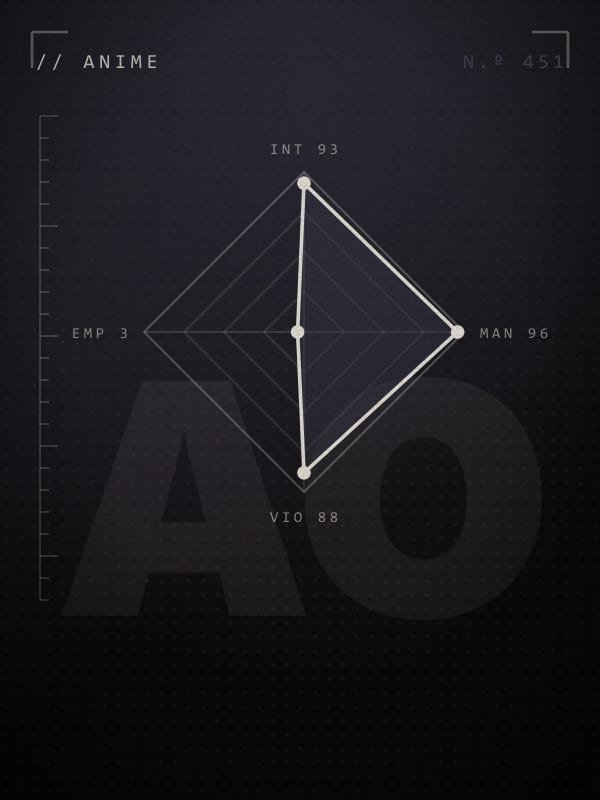
All For One, the «Symbol of Evil» of My Hero Academia, is the perfect fantasy of the criminal patriarch: a near-immortal being who has spent more than a century weaving an underworld empire, collecting other people's powers and —most disturbing of all— cultivating an heir. He chose a child, Tenko Shimura (the future Tomura Shigaraki), and molded him over years so he would inherit his hatred, his method and his throne. At first glance he seems the embodiment of an old criminological idea: the criminal bloodline, the cursed blood that passes crime down from generation to generation. But look closely and All For One proves the exact opposite of what he appears to be.
// The theoryThe blood that "inherits" crime
The theory of criminal heredity was born in the nineteenth century with Richard Dugdale's study of the «Jukes» family (1877): a supposed bloodline of criminals, beggars and the sick that, as the story was popularized, passed crime down through the blood. Soon after, Francis Galton —the father of eugenics— turned that intuition into a program: if talent and vice are hereditary, the species could be «improved» by controlling who gets to reproduce. From there the idea of the hereditary born criminal leapt into the culture: marked families, cursed surnames, a biology of crime handed from parent to child. All For One looks like the animated illustration of that myth: a criminal empire that is «inherited», a founder who anoints his spiritual offspring, a dynasty of evil that perpetuates itself. It is exactly the image the theory of criminal heredity tried to sell —and that modern criminology has dismantled piece by piece—.
Nurture disguised as nature
Here is the trick All For One lays bare. He does not father Shigaraki: he manufactures him. He locates a child already shattered by a family tragedy, takes him in when he is alone and desperate, and over years he isolates him, humiliates him, doles out measured doses of affection and cruelty until he has sculpted an heir to his own specifications. None of this is biology: it is grooming, indoctrination, psychological engineering. The villain himself admits it —he «raised» him the way one cultivates a plant—. And that is where the lesson lies: what looks like a bloodline (blood that transmits evil) is really upbringing (an environment designed to produce a criminal). All For One dresses his plan up as lineage —«my successor», «my heir»— to give it the sheen of inevitable destiny, when every trait of Shigaraki's was deliberately installed by an adult who chose him as raw material. It is nurture disguised as nature: the most calculated upbringing passing itself off as inheritance of blood.
Get the map of theories for free
Subscribe to the criminal archive —one case a week, no spam— and I'll send you The map of theories: the great currents of criminology on a single sheet.
// The subjectThe "godfather" who cultivates his replacement
All For One has no children of his own blood: he has a project. His relationship with Shigaraki is not that of a biological father but that of a manipulator who has studied his prey. He intercepted him at the worst moment of his life, when his quirk had erupted in tragedy and the boy was wandering with no one; he offered the only outstretched hand in his world and, from that absolute dependence, he kept installing in him resentment, ideology and a goal: to destroy the society that —he taught him— had abandoned him. Every gesture of «affection» was a tool of control; every deprivation, calculated. All For One is the classic criminal godfather taken to the extreme: he does not bequeath an empire to a relative, he builds himself an heir from childhood. And precisely because the process is visible —we watch him choose, isolate, mold— the series strips away the trick: there is no criminal blood that explains Shigaraki, there is a powerful adult who decided, step by step, what to turn him into. The «lineage» is the alibi; toxic upbringing is the mechanism.
All For One
// The crackNeither "crime runs in the blood", nor is Shigaraki innocent
The first crack is to believe the myth All For One is selling: that there exists a criminal bloodline, that evil is inherited, that Shigaraki was «destined» to be a monster. It is false —and dangerous—. Criminology abandoned criminal heredity because the old studies of cursed bloodlines confused poverty, exclusion and environment with biology: what families like the «Jukes» inherited were not genes for crime, but misery, marginalization and trauma. All For One confirms it within the fiction: Shigaraki was not born a criminal, he was raised to be one by someone who chose him on purpose. The determinism of blood is a lie that, in the real world, served to sterilize and persecute the «undesirable».
But the opposite crack also lurks: using grooming as an alibi to absolve Shigaraki entirely. That he was molded by a master manipulator explains how he became what he is —it does not turn him into an object with no will—. Understanding the origin does not erase the crimes nor the agency of the adult who chooses to keep killing. The honest reading walks the edge: to reject the myth of criminal heredity (no one is born condemned by their blood) and to reject the inverse fatalism (no one is excused for having been manipulated). Explaining is not excusing; and pointing to the maker does not absolve the tool that, now an adult, chooses to keep cutting.
The myth of cursed blood still kills
It matters because the theory of criminal heredity is not a nineteenth-century curiosity: it was the «scientific» basis of eugenics, of forced sterilization laws and, at its extreme, of the Nazi horror. Millions of people were branded as carriers of a «hereditary taint» —criminality, «feeble-mindedness», poverty— and persecuted for it. Today the myth reappears in disguise: every time people talk about «problem families», neighborhoods «with crime in their DNA», genes for violence, they are recycling the old idea of cursed blood. All For One teaches us to dismantle it: when something looks like a criminal dynasty, we have to ask what upbringing, what abandonment, what manipulation and what power lie behind it. Because what is passed between generations is not a gene for crime, but trauma, exclusion and —sometimes— a manipulator who decides to manufacture his heir. Mistaking that for biological inheritance is not only a scientific error: it is the door through which the worst policies in history have entered.
Three key ideas
- All For One seems to embody the "criminal bloodline" —an empire of evil inherited from generation to generation—, but it is an illusion: he does not father his successor, he hunts him as a child and molds him.
- It is nurture disguised as nature: Shigaraki does not carry crime in his blood, he was groomed, isolated and indoctrinated for years. The theory of criminal heredity (Dugdale, Galton) confused environment and trauma with biology.
- Neither does "crime run in the blood" (a dangerous myth that fed eugenics) nor is Shigaraki excused for having been molded. Explaining the origin does not erase the agency of the adult who keeps choosing to kill.
Sources · further reading
- Dugdale, R. L. (1877). The Jukes: A Study in Crime, Pauperism, Disease and Heredity. G. P. Putnam's Sons.
- Rafter, N. H. (1988). White Trash: The Eugenic Family Studies, 1877–1919. Northeastern University Press.
- Kevles, D. J. (1985). In the Name of Eugenics: Genetics and the Uses of Human Heredity. Alfred A. Knopf.
Case-file questionsFrequently asked questions
¿Quién es All For One?
All For One («el Simbolo del Mal») es un villano de My Hero Academia, analizado en KRIMINIS con la lente de la criminología. He has spent a century building a criminal empire and cultivating a successor.
¿Por qué All For One (el Simbolo del Mal) se convierte en villano?
All For One looks like living proof that crime is inherited through blood: an empire passed from one generation to the next. But look closely at how he chooses his heir and you will discover the opposite.
¿Qué teoría criminológica explica a All For One?
El caso de All For One se analiza desde la Teoría de la Herencia Criminal. The theory of criminal heredity (Dugdale, Galton) held that crime runs through the blood of certain bloodlines. All For One, of My Hero Academia, seems to embody that myth: a near-immortal crime lord who bequeaths his empire to a successor. But the series proves the opposite: he does not father Tomura Shigaraki, he recruits him as a child, isolates him and indoctrinates him for years. The "criminal lineage" is really upbringing, manipulation and the transfer of power. Nurture disguised as nature.