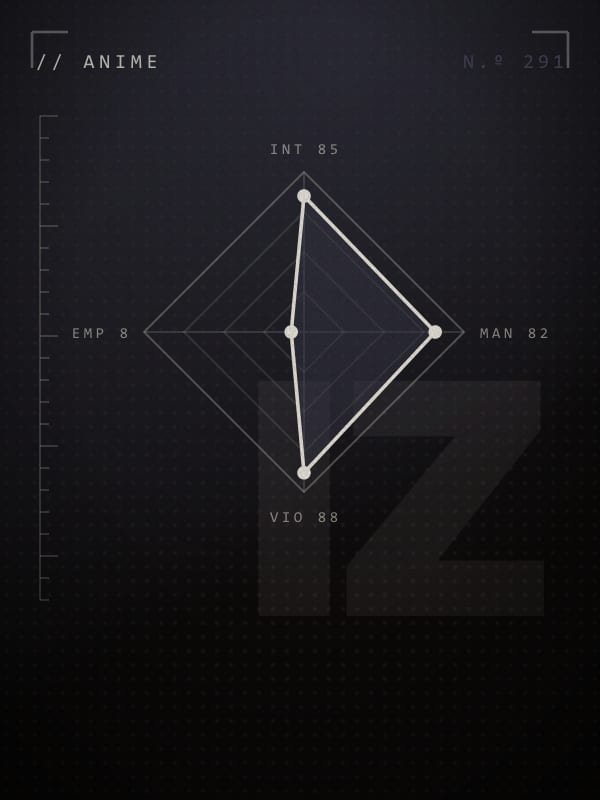
Lucius Zogratis wants to end suffering, and he has done the arithmetic. Suffering, he has concluded, comes from inequality—from the strong who dominate the weak, from hierarchies that grind people down, from the fear of death that makes cowards and tyrants of us all. Remove those structures and you remove the pain. So the final antagonist of Black Clover—the anime returns in October 2026—proposes a "world of equals": a humanity without conflict, without hierarchy, without fear. The method is where the horror lives. To build his world he intends to kill everyone who does not fit his design and to remake the survivors into Paladins, identical and obedient beings stripped of the will to resist. He does not present this as conquest. He presents it as medicine—the amputation a sick species needs to survive. And that is what makes him worth a file: not that his diagnosis is simply wrong, but that a real and serious diagnosis has been bent into a justification for mass murder.
// The theoryWhen crime is what the powerful decide it is
Conflict criminology—also called critical or radical criminology, with roots in the Marxist tradition— begins from an uncomfortable premise: that law and crime are products of social conflict over power and resources, not neutral reflections of a shared morality. In the account developed by Richard Quinney and William Chambliss, what a society defines as "crime" is not fixed by nature; it is shaped by who holds power. The behaviors of the powerless are policed and punished; the harms of the powerful—dangerous working conditions, environmental damage, the violence built into unjust institutions—are often not even named as crimes. Quinney went further: the criminal law itself, he argued, is an instrument by which a dominant class protects its interests and manages the tensions that inequality produces. The tradition's genuine contribution is to widen the lens beyond the individual offender to the structures—poverty, exploitation, hierarchy—that generate harm in the first place. This is not a fringe provocation; it is a serious strand of criminological thought, and its core observation is hard to dismiss: inequality does cause suffering, and the definition of crime is not innocent of power.
Lucius Zogratis has read the diagnosis and accepted it entirely—and then drawn from it a conclusion the theory never sanctions. He sees, correctly, that hierarchy and inequality produce misery: that the strong prey on the weak, that fear of death drives cruelty, that the world's suffering is not random but structured. Where the critical criminologist says "therefore we must change the structures that produce harm", Lucius says "therefore I must eliminate the structures —and the people who embody them— by force". He takes the true premise, inequality causes harm, and fuses it to a totalitarian solution: manufacture equality by killing the unequal and remaking the rest. The critique that was meant to expose domination becomes, in his hands, the blueprint for a new and total domination.
The utopia that requires a purge
The pattern Lucius follows has a long and grim pedigree, and it is worth naming plainly. It is the utopian-totalitarian structure: begin with a real injustice, propose a perfected society that would end it, and then discover that the perfected society requires the elimination of everyone who does not fit—the weak, the deviant, the unpersuadable. The diagnosis is often accurate; the historical regimes that promised to abolish inequality frequently began from genuine grievances against genuine oppression. What turns the critique lethal is the move from naming harm to engineering humanity by force—the conviction that a flawed species can be corrected the way a surgeon corrects a body, by cutting away the diseased part. Critical criminology itself contains no such move; Quinney's later work turned toward a peacemaking criminology explicitly opposed to the violence of the state. But the diagnosis it offers—inequality is a source of harm—is powerful, and powerful diagnoses are precisely what authoritarian projects borrow to dress coercion as cure. Lucius is the anime's distilled image of that borrowing: a man who took the truth that hierarchy wounds and concluded that he was entitled to remake every person alive into an identical, painless, unfree equal.
// The subjectThe physician who mistakes amputation for healing
What makes Lucius Zogratis genuinely unsettling is that he is not driven by hatred, appetite or wounded pride—the ordinary fuels of a villain. He is driven by a diagnosis he believes to be true and a compassion he believes to be total. He looks at humanity and sees a species deformed by inequality, chained by the fear of death, condemned to reproduce cruelty generation after generation, and he concludes that leaving it as it is would be the real cruelty. His "world of equals" is offered as mercy: an end to conflict, an end to fear, an end to the hierarchies that make some people wretched and others tyrants. The Paladins he creates are, in his mind, not slaves but liberated beings—freed from weakness, freed from the terror of dying, made equal at last. This is the terrible coherence of the utopian: every atrocity is a step toward the painless world, every victim a necessary subtraction. Against the heroes of Black Clover—Asta, who embodies the refusal to accept that the weak are worthless, and Yuno—Lucius sets not a lust for power but a program for salvation. And a salvation that must be imposed by killing the unsavable is the most dangerous kind, because the man who runs it sleeps soundly. He is not lying when he says he wants to save you. He simply believes that saving you may require erasing you first.
Get the map of theories for free
Subscribe to the criminal archive —one case a week, no spam— and I'll send you The map of theories: the great currents of criminology on a single sheet.
// The flawNaming inequality as harm does not license genocide to erase it
Lucius Zogratis
Here is the crack, and it is the whole point. That inequality and unjust hierarchy cause real suffering is true—critical criminology is right to insist on it, and dismissing the diagnosis would be its own kind of dishonesty. But from a true diagnosis Lucius extracts a conclusion the diagnosis does not contain and cannot support: that the cure for domination is a greater domination, that the way to abolish hierarchy is to place one man's design above every human will, that a world of equals can be built by force. It cannot. A world of forced equals is not the abolition of hierarchy; it is its perfection—a single hand at the top, and beneath it a mass of identical, unfree beings who were never asked. Equality imposed by killing the unequal is not equality; it is the most total inequality imaginable, the gap between the one who decides who lives and the many who do not get to choose. This is the sleight of hand the file exists to expose. Lucius smuggles a genuine critique—inequality harms— into service as an alibi for genocide, and the smuggling works precisely because the first half is true. Naming a real cause of harm does not license any means of erasing it. To explain the diagnosis, even to grant that it wounds where it points, is not to endorse the cure—and the cure, here, is mass murder wearing the language of justice.
The difference between changing structures and erasing people
Lucius Zogratis matters because he stages, in the clean lines of a battle shōnen, a confusion that outside fiction has killed by the million: the slide from a critique of unjust structures to a license to eliminate the people who embody them. The critique is legitimate and necessary—societies do encode the interests of the powerful into their laws, inequality does produce harm, and refusing to see this is not neutrality but complicity. What is illegitimate is the leap that follows in the totalitarian imagination: that because a structure is unjust, those who occupy it may be purged, and that a better world justifies remaking human beings against their will. The distinction is not a technicality; it is everything. To change unjust structures is to widen who counts, to redistribute power, to name harms that were hidden—work done with consent, argument and law. To erase the people is to concentrate all power in the one who decides which lives are surplus. Quinney, tellingly, ended not in revolutionary violence but in peacemaking. Lucius ends in the opposite place, and the anime is precise about the cost: his "equals" are Paladins, stripped of the will to say no. A decent politics can hold both halves at once—that inequality is a real wound, and that curing it by force is not a cure but the wound made total. Losing that distinction is how a physician becomes an executioner and never notices the change.
Three key takeaways
- Lucius Zogratis dramatizes conflict/critical criminology (Quinney, Chambliss): law and crime reflect who holds power, and structural inequality is itself a source of harm. He accepts this true diagnosis entirely—hierarchy and fear do produce suffering.
- From the true premise he draws a totalitarian conclusion: eliminate the unequal, the weak and the fearful by force, and remake the survivors into identical, obedient Paladins. He genuinely believes he is saving humanity—the utopia that requires a purge.
- The flaw: naming inequality as a cause of harm does not license genocide to erase it. A world of forced equals is not the abolition of hierarchy but its perfection—domination, not justice. Explaining the diagnosis is not endorsing the cure.
Sources · further reading
- Quinney, R. (1977). Class, State and Crime: On the Theory and Practice of Criminal Justice. Longman.
- Chambliss, W. J. & Seidman, R. B. (1971). Law, Order, and Power. Addison-Wesley.
- Quinney, R. (1970). The Social Reality of Crime. Little, Brown.
- DeKeseredy, W. S. (2011). Contemporary Critical Criminology. Routledge.
Fuentes · para seguir leyendo
- Quinney, R. (1977). Class, State and Crime: On the Theory and Practice of Criminal Justice. Longman.
- Chambliss, W. J. & Seidman, R. B. (1971). Law, Order, and Power. Addison-Wesley.
- Quinney, R. (1970). The Social Reality of Crime. Little, Brown.
- DeKeseredy, W. S. (2011). Contemporary Critical Criminology. Routledge.
Case-file questionsFrequently asked questions
Who is Lucius Zogratis?
Lucius Zogratis is a villain from Black Clover, analysed on KRIMINIS through the lens of criminology. He promises a world without conflict, fear or inequality—and to build it he means to kill everyone who does not fit and remake the survivors into obedient Paladins.
Why does Lucius Zogratis become a villain?
Lucius Zogratis and conflict (critical) criminology: how a true diagnosis—inequality and unjust hierarchy cause real harm—is perverted into an alibi for genocide. A world of forced equals is not justice; it is domination.
Which criminological theory explains Lucius Zogratis?
Lucius Zogratis's case is analysed through Class conflict. Conflict or critical criminology (Richard Quinney, William Chambliss) argues that law and crime are products of social conflict over power: what a society calls "crime" tends to reflect who holds power, and structural inequality is itself a source of harm. The diagnosis is real—unjust hierarchies do produce suffering. Lucius Zogratis, the final antagonist of Black Clover (returning October 2026), takes that true premise and draws a totalitarian conclusion: if inequality, weakness and fear cause suffering, then eliminate the unequal, the weak and the fearful by force and remake the rest into identical, obedient "equals". He genuinely believes he is saving humanity. And the flaw is decisive: naming inequality as a cause of harm does not license genocide to erase it—a world of forced equals is not justice but domination, and explaining the diagnosis is not endorsing the cure.