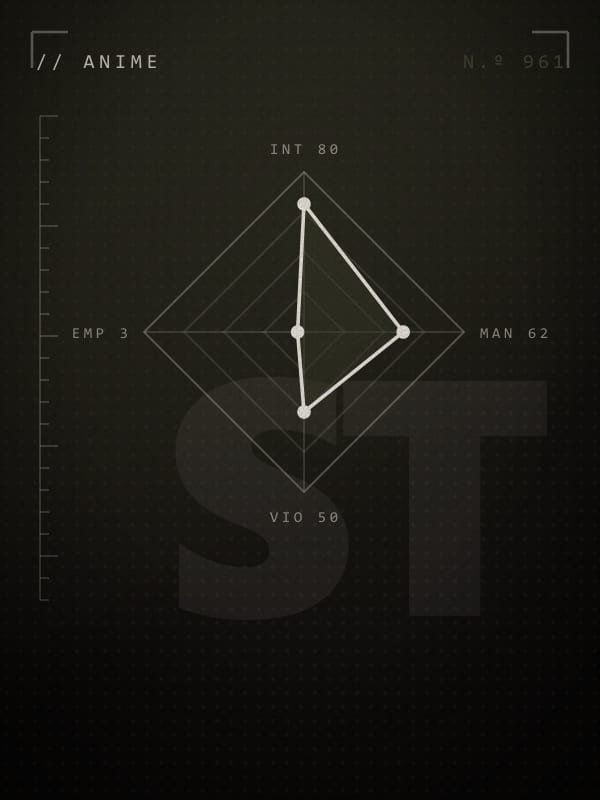
Hojo runs a laboratory inside a company that owns the planet's energy, its army and its press. He is not a rogue operator: he has a budget, a title, subordinates and a reporting line. Over the course of his career he injects an unknown organism into an unborn child who is his own son, keeps a colleague alive as a specimen for decades, and treats a population of human beings as a supply of tissue. None of it is done in secret from his employer, and none of it is done in anger. It is a research program, and the reason it belongs in this archive is that the real version of that program existed, was respectable, and was carried out by people with exactly his institutional profile.
// The theoryThe respectable science that sterilised tens of thousands
Francis Galton coined “eugenics” in 1883 and framed it as the applied science of improving human stock. Criminology adopted it immediately, because it slotted into the positivism of the era: if the criminal is born rather than made, then crime is a hereditary trait and the rational policy is to stop it reproducing. Henry Goddard's study of the “Kallikak” family (1912) supplied the popular evidence — a family tree purporting to show degeneracy descending through generations — and it was later shown to be methodologically worthless, with retouched photographs among its exhibits. What followed was not fringe. Sterilisation statutes passed in a majority of US states; similar laws operated in Sweden, Denmark, Norway, Switzerland and elsewhere; and in Buck v. Bell (1927) the United States Supreme Court upheld the compulsory sterilisation of Carrie Buck by eight votes to one, with Justice Holmes writing the sentence that has followed the case ever since: “three generations of imbeciles are enough”. Tens of thousands of operations were performed under those laws, and the German program that followed cited the American precedent explicitly.
The mad scientist is a comforting fiction
Here is the correction this file exists to make. Fiction stages eugenics as the project of an isolated obsessive in a basement, and that framing is a favor to the audience, because a monster is rare and identifiable. The historical record shows the opposite: the work was done by committees. Boards of respectable physicians reviewed cases. Judges signed orders. Social workers compiled the family histories. University professors supplied the theory and the journals published it. The horror of eugenics is not that a lunatic escaped supervision — it is that supervision is precisely what it had, and approved. Hojo is dangerous in the story for the same reason: not because he is unsupervised, but because his employer finds his results useful and his methods unremarkable. Every atrocity in this family of theories has an authorizing signature above it.
// The subjectFrom selecting to engineering
What makes Hojo the endpoint rather than another example is that he skips the step eugenics was stuck on. Historical eugenics could only subtract: it identified undesirable stock and prevented its reproduction, because nobody could build the desirable kind to order. Hojo builds. The project that produces Sephiroth is not a breeding program but a specification, and the subject is his own child, which removes the last constraint the historical movement still nominally respected — the eugenicist always sterilised someone else's family. Note too what he does with the results: he documents them. The archive, the reports, the continuity of the project across decades are not vanity. They are what converts a series of atrocities into a programme, and a program is the thing an institution can inherit and continue after the individual is gone.
Hojo
Get the map of theories for free
Subscribe to the criminal archive —one case a week, no spam— and I'll send you The map of theories: the great currents of criminology on a single sheet.
// The crackThe premise was false long before it was abandoned
It is worth being precise about why eugenics failed, because “it was immoral” is true and incomplete. It was also wrong on its own terms. The traits it proposed to eliminate were not the simple Mendelian characters it assumed; complex behavior is polygenic and heavily environment-dependent, so selection against it is ineffective even in principle. The family studies that supplied the evidence were riddled with confounding — poverty, nutrition, schooling and policing all traveling together and all attributed to blood. And the diagnoses that decided who was sterilised were themselves shaped by class, race and, in Carrie Buck's case, by the need to conceal a rape. The modern descendant of this territory, behavior genetics, reached the opposite conclusion from the same subject matter: heritability is real, it is distributed across thousands of variants of tiny effect, and it tells you nothing that licenses acting on an individual. The line between that finding and Galton's is the whole of this archive's argument about biology.
Watch the paperwork
Hojo is a fictional character with no capacity for remorse, and there is no risk of this file being read as sympathy for him. The risk runs the other way — that a monstrous scientist in a laboratory absorbs the whole of the reader's alarm and leaves nothing for the committee, the judge and the journal. Carrie Buck was sterilised by a state, with counsel, after appeal, with a written opinion from the highest court in the land. If the lesson taken from this file is that one should watch out for men like Hojo, the file has failed. The lesson is that one should watch out for the paperwork.
Three key ideas
- Galton (1883) framed eugenics as applied improvement of human stock, and criminology adopted it via positivism: if the criminal is born, stop the line. Goddard's Kallikak study (1912) supplied evidence later shown to be worthless.
- It was mainstream, not fringe: sterilisation statutes across most US states and several European countries, upheld in Buck v. Bell (1927) eight to one. The work was done by committees, judges and professors — not by isolated obsessives.
- It was also wrong on its own terms: complex behavior is polygenic and environment-dependent, the family studies were confounded, and the diagnoses tracked class and race. Modern behavior genetics reaches the opposite conclusion from the same material.
Sources · to keep reading
- Galton, F. (1883). Inquiries into Human Faculty and Its Development. Macmillan.
- Goddard, H. H. (1912). The Kallikak Family: A Study in the Heredity of Feeble-Mindedness. Macmillan.
- Supreme Court of the United States (1927). Buck v. Bell, 274 U.S. 200.
- Kevles, D. J. (1985). In the Name of Eugenics. Alfred A. Knopf.
- Lombardo, P. A. (2008). Three Generations, No Imbeciles: Eugenics, the Supreme Court, and Buck v. Bell. Johns Hopkins University Press.
- Gould, S. J. (1981). The Mismeasure of Man. W. W. Norton.
Case-file questionsFrequently asked questions
Who is Hojo?
Hojo is a villain from Final Fantasy VII, analysed on KRIMINIS through the lens of criminology. What he does to his partner's unborn child is not an outburst.
Why does Hojo become a villain?
Hojo and criminological eugenics: the corporate scientist who experiments on his own son before birth. The file on the idea that human quality can be administered — and on who actually administered it, which was never a madman in a basement.
Which criminological theory explains Hojo?
Hojo's case is analysed through Criminological eugenics. Eugenics was not a deviation from twentieth-century science: it was its mainstream for decades, with chairs, congresses, statutes and a United States Supreme Court ruling. Its criminological version held that the tendency to offend is inherited and can therefore be reduced by preventing certain people from reproducing. On that premise tens of thousands were sterilised in democratic countries, and from there to what others did the road is short and documented. Hojo, head of the science department of a corporation that effectively governs a planet, is eugenic logic in its final form: he no longer selects human material, he designs it. And he does it with resources, with permission and with paperwork.