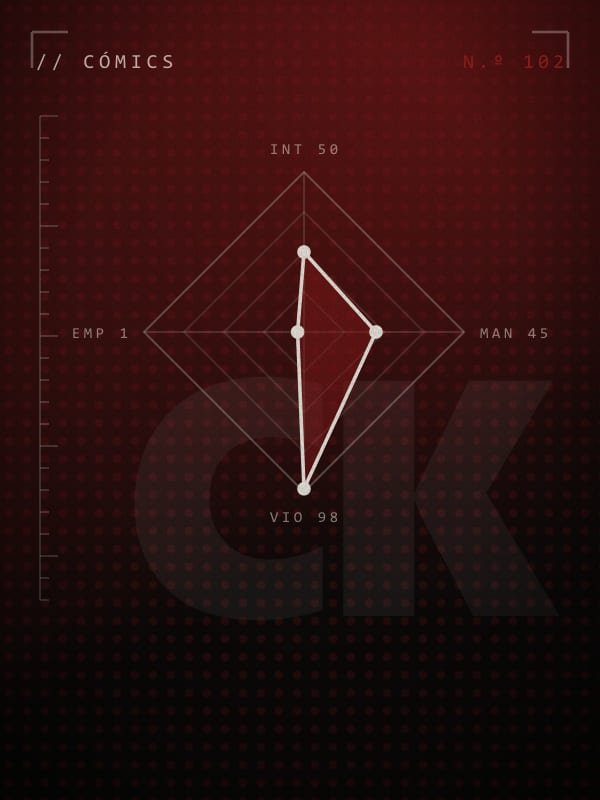
Kefka Palazzo begins as a sinister clown in the service of the empire and ends as a god who lays waste to the world and reigns over its rubble — the first great villain of his saga who truly wins. But what makes him unique is not his triumph, it is his motive: he wants neither power, nor revenge, nor order. He wants nothingness. If Frieza is a child who only understands force, Kefka is the rung below: the total absence of morality turned into a cackle.
// The theoryBelow the first stage
Kohlberg's theory of moral development describes how ethical judgment climbs through levels, from a child's self-interest to universal principles. Nearly every villain in this archive fits on some rung: they reason from force, from law, from a cause. Kefka poses a different and more unsettling problem: what lies below the first step? The answer is nihilism — not an immature morality, but the denial that morality, or any value, means anything at all. Kefka does not judge badly; he has stopped judging. For him there is no good and no evil, not even his own advantage: only the void, and the only coherent reaction to the void that he finds is laughter and destruction.
The contrast with Frieza is illuminating. Frieza destroys for something — power, dominion, the pleasure of command: his morality is low, but it exists, oriented toward self-interest. Kefka destroys for nothing: when he is at last an omnipotent god, he builds no empire and enjoys no luxury; he simply sits atop the ruins, bored, killing for killing's sake. It is the difference between an underdeveloped conscience and an absent one. Kefka is not a moral child: he is proof of what remains when every possibility of value is torn out by the root — a void that fills only for an instant, with the crash of whatever it breaks.
Moral immaturity is not the same as moral emptiness
Kefka forces a fine distinction that the theory of moral development sometimes blurs: it is one thing to have an immature morality (reasoning from fear or interest, like a child or like Frieza) and quite another to be a nihilist, denying that any reason exists to value anything. The first can, in principle, mature; the second has shut the door. Criminology rarely encounters pure nihilists — they belong more to philosophy and fiction than to statistics — but Kefka illuminates a theoretical extreme: the point where "moral development" no longer applies because the subject has renounced the very premise that anything matters. His horror is not the cruelty, but the coherence with which he inhabits the meaninglessness.
Get the map of theories for free
Subscribe to the criminal archive —one case a week, no spam— and I'll send you The map of theories: the great currents of criminology on a single sheet.
// The subjectLaughter as the last language
Kefka's hysterical laughter is his defining trait, and it is no accident: it is all that remains to someone who has emptied the world of meaning. Where others put ambition, ideology or pain, Kefka puts a cackle — the laugh of one who has looked into the abyss and decided the funniest thing is to push everyone into it. His origin hints at it: he was the first subject of a magical-infusion experiment that damaged his mind, a test animal broken by the power injected into him. But the saga resists explaining it fully, and there lies its strength: Kefka works precisely because he does not offer the reassuring alibi of a reason why. There is no trauma to redeem and no cause to fight; there is a void that laughs. He is the villain who frightens not because of what he wants, but because he wants nothing — and even so, or because of it, he destroys everything.
Kefka Palazzo
// The crackDoes the pure nihilist exist?
The serious objection is that the absolute nihilist barely exists outside fiction. In reality, even the most "senseless" violence usually has pain, trauma, mental illness or neurological damage behind it — and Kefka's own origin (an experiment that fries his mind) points to exactly that. Presenting him as "pure evil without cause" is narratively powerful but criminologically false: it is almost always a label we apply when we do not understand, not an explanation. The theory of moral development, moreover, insists on the opposite of nihilism — that morality can be cultivated. Kefka is valuable as a thought experiment (the logical extreme of the void), not as a portrait of a real criminal. In life, behind the "monster who laughs" there is almost always a story the laughter conceals.
Defending meaning
Kefka matters as a warning about what is at stake when a person — or a culture — loses every anchor in value. The theory of moral development does not only describe how one climbs the ethical ladder: it reminds us, by contrast, that the ladder must be held up, and that its base is the conviction that things and people matter. Against Kefka's nihilism, the answer is not an argument — you cannot convince with reasons someone who denies all reason — but the patient construction of meaning: bonds, purpose, belonging, everything that makes it worthwhile to someone that the world should exist. Kefka's cackle is the sound of that work having gone undone. And though the pure nihilist may be a rarity, the void from which he is born is not.
Three key takeaways
- Against the ladder of moral development (Kohlberg), Kefka represents what lies below the first rung: nihilism, the denial that anything is worth anything. He does not judge badly — he has stopped judging.
- Key: moral immaturity ≠ moral emptiness. Frieza destroys for something (interest); Kefka, for nothing (he sits, a god and bored, atop the ruins). His horror is the coherence with the meaninglessness.
- The crack: the pure nihilist barely exists outside fiction (behind "causeless" violence there is usually trauma or damage). Kefka is valuable as a thought experiment, not as a real criminal. The answer to the void is to build meaning.
Sources · further reading
- Kohlberg, L. (1981). The Philosophy of Moral Development. Harper & Row.
- Piaget, J. (1932). El criterio moral en el niño.
- Nietzsche, F. (1887). La genealogía de la moral.
- Baumeister, R. F. (1997). Evil: Inside Human Violence and Cruelty. W. H. Freeman.
Case-file questionsFrequently asked questions
¿Quién es Kefka Palazzo?
Kefka Palazzo («Kefka») es un villano de Final Fantasy VI, analizado en KRIMINIS con la lente de la criminología. Kefka Palazzo begins as a sinister clown in the service of the empire and ends as a god who lays waste to the world and reigns over its ruins — the first great villain of his saga who truly wins.
¿Por qué Kefka Palazzo se convierte en villano?
Final Fantasy VI and moral development: if Frieza is a child who only understands force, Kefka is the rung below — the total absence of morality turned into a cackle. The villain who really did destroy the world, not to rule it, but because he found no meaning in its existing at all.
¿Qué teoría criminológica explica a Kefka Palazzo?
El caso de Kefka Palazzo se analiza desde la Desarrollo moral. The theory of moral development describes the ascent of ethical judgment through stages. Kefka Palazzo, of Final Fantasy VI, represents its radical absence: while Frieza at least reasons from self-interest (a preconventional morality), Kefka reasons from nowhere — he is a nihilist who destroys the world not to dominate it, but because he denies that anything is worth anything. He embodies the moral void taken to its cosmic extreme, and serves as a contrast: not every villain is an immature moral judgment; some are the very denial that any moral judgment exists. Kefka's horror is his coherence with the void.