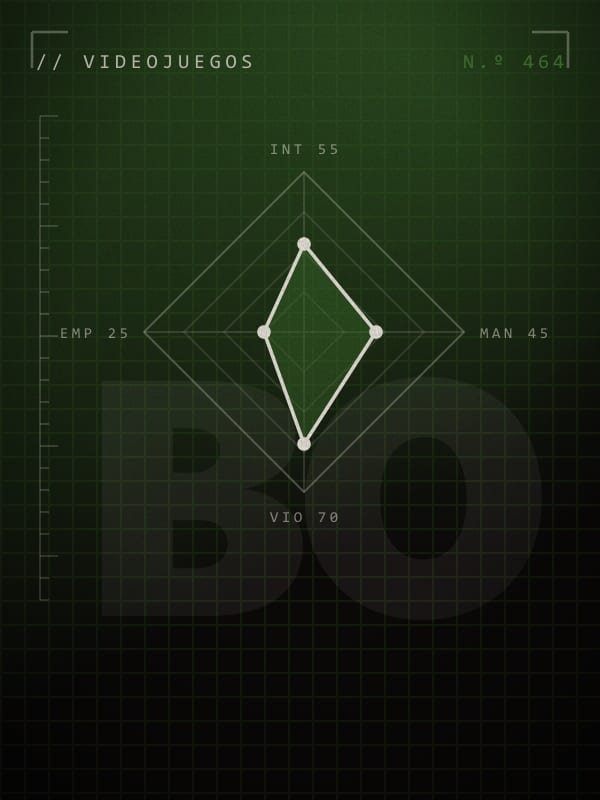
Fred C. Dobbs, the American drifter of The Treasure of the Sierra Madre (John Huston, 1948), starts out a poor but honest man who begs in Mexico and dreams of a better life. He partners with two other men to prospect for gold in the mountains, and they find it. But as the treasure grows, something rots in Dobbs: the distrust, the paranoia, the certainty that his partners want to rob him. He ends up betraying and shooting his companion over a few sacks of golden dust. For the moral cost-benefit theory, Dobbs is the theory filmed in real time: a conscience getting cheaper gram by gram as the gold warps his scale.
// The theoryGold as a moral solvent
The theory of Paternoster and Simpson holds that moral inhibition is the strongest barrier against crime, but also a barrier that can erode. Dobbs shows that erosion in real time. At first his moral cost is high: he is honest, he shares fairly, he is outraged by injustice. But each gram of gold he accumulates lowers that cost a little—because the more he has, the more he fears losing it, and the more he fears losing it, the more reasonable anything seems in order to keep it. The film underscores this mechanism with clinical precision: there is no single moment of falling, but a continuous descent in which distrust justifies surveillance, surveillance justifies the threat, and the threat justifies the gunshot. The gold does not change Dobbs all at once; it dissolves his conscience little by little, until betraying and killing seem, on his already warped ledger, reasonable decisions.
Erosion, not the leap
What Dobbs teaches, and what other cases hide, is that moral cost rarely collapses in a single leap: it erodes. Judah decides in one great deliberation; Moss, in an instant. Dobbs, by contrast, falls down a slope of a thousand small concessions—each one reasonable in the light of the previous one. First he distrusts “just a little”; then he insists on splitting the gold to guard his own; then he sleeps with the pistol; then he sees enemies where there are partners; and in the end he shoots. None of those steps, taken alone, would have seemed monstrous to the honest Dobbs of the beginning; but chained together, they lead him to murder. This is the theory's most useful warning: conscience is usually not sold in one great transaction, but spent as loose change—in small concessions that seem harmless and that, added up, completely empty the moral scale. By the time Dobbs pulls the trigger, there is no moral cost left to pay: he had spent it, gram by gram, long before.
// The subjectThe honest man greed devoured
Dobbs's tragic grandeur is that he did not start out evil. The character who shoots his partner is unrecognizable next to the one who begged at the start, and that distance is the film's thesis. Against him, Huston sets Howard, the old prospector who has already seen what gold does to men and therefore keeps his sanity; and Curtin, who resists corruption. The contrast proves that Dobbs's fall was not inevitable: it was a repeated choice, a moral cost that he, and he alone, decided to keep cheapening. Dobbs is responsible for his betrayal and his crime; his tragedy does not excuse him, but it does illuminate the process—how an honest man becomes, gram by gram, a murderer who believes he is in the right.
Fred C. Dobbs
Get the map of theories for free
Subscribe to the criminal archive —one case a week, no spam— and I'll send you The map of theories: the great currents of criminology on a single sheet.
// The crackNeither "the gold did it" nor a plain miser
The crack with Dobbs is to conclude that “the gold corrupted him”, as if the metal had a magic power that absolved him of guilt. The gold does nothing: it is Dobbs who, faced with each temptation, chooses to lower his moral cost instead of defending it. Greed explains his calculation; it does not commit it for him. The opposite crack is to reduce him to just any miser from the start, losing what his case teaches: that corruption is a process, not a trait, and that it began in an honest man.
The honest reading holds both things: Dobbs was the victim of a real slippery slope and the author of every step he took down it. His story does not absolve greed by appealing to the “spell of gold”; it lays it bare, showing how it works from the inside—how each small concession cheapens the next until the conscience empties out. The lesson is that greed does not corrupt the wicked all at once, but the ordinary little by little, and that the only defense is to refuse the first gram of concession.
Watch the first concession
Dobbs matters because his fall is the most recognizable of all: that of the honest man who corrupts slowly. Almost no fraud, no betrayal, no corruption begins with one great evil decision; it begins with a small concession that lowers the moral cost only a little, and continues with another, and another. The executive who first “dresses up” a figure, then hides a loss, then falsifies the accounts; the partner who first distrusts, then watches, then betrays: all of them walk Dobbs's slope. His practical lesson is to watch the first concession, not the last—because by the time the gunshot arrives, the moral cost was spent long ago. Decency is not lost all at once: it is spent as loose change. And whoever wants to keep it must refuse the first gram, when it still seems not to matter.
Three key takeaways
- Fred C. Dobbs, the gold prospector of The Treasure of the Sierra Madre, starts out honest and ends up shooting his partner over the treasure: the moral cost-benefit filmed in real time, the conscience cheapening gram by gram.
- It teaches that moral cost rarely collapses in a single leap: it erodes across a thousand small concessions, each reasonable in the light of the previous one. By the time he shoots, he had already spent his conscience as loose change.
- Neither "the gold did it" (it was he who chose each step) nor a plain miser (he started out honest). Corruption is a process, not a trait. The defense is to refuse the first concession, when it still seems not to matter.
Sources · further reading
- Paternoster, R. & Simpson, S. (1996). “Sanction Threats and Appeals to Morality”. Law & Society Review, 30(3).
- Traven, B. (1927). El tesoro de Sierra Madre.
- Katz, J. (1988). Seductions of Crime. Basic Books.
Case-file questionsFrequently asked questions
Who is Fred C. Dobbs?
Fred C. Dobbs (“—”) is a villain from The Treasure of the Sierra Madre, analysed on KRIMINIS through the lens of criminology. He starts out a poor but honest man.
Why does Fred C. Dobbs become a villain?
Fred C. Dobbs and the moral cost-benefit: a gold prospector whose conscience cheapens gram by gram. The treasure lowers his moral cost until distrust, betrayal, and murder start to seem reasonable to him. Greed as the solvent of the scale.
Which criminological theory explains Fred C. Dobbs?
Fred C. Dobbs's case is analysed through Moral cost-benefit. The moral cost-benefit theory studies how conscience gets cheaper. Fred C. Dobbs, from The Treasure of the Sierra Madre, shows it in real time: a gold prospector whose moral cost collapses as the treasure grows. The gold lowers his scruple gram by gram until paranoia, betrayal, and murder seem reasonable to him. Greed as the solvent of the moral scale, filmed as a step-by-step degradation.