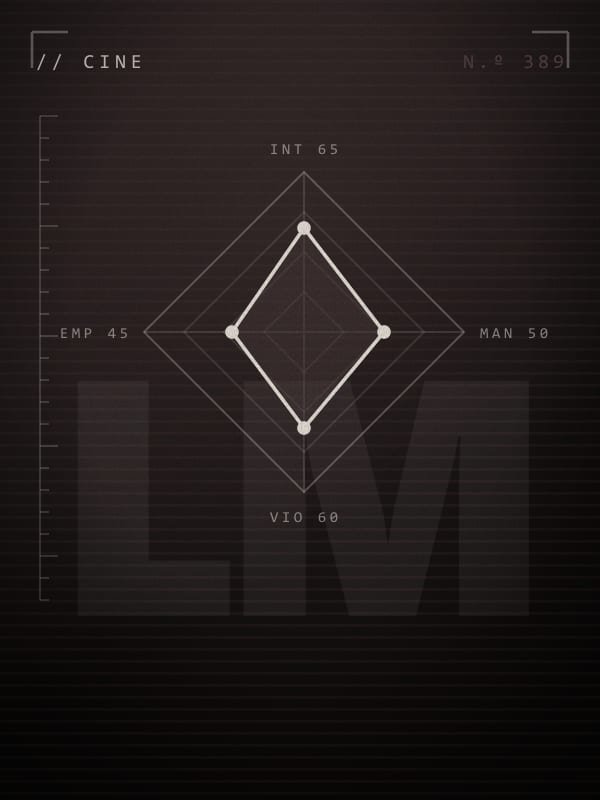
Llewelyn Moss, the welder and Vietnam veteran of No Country for Old Men (the Coen brothers, 2007), goes out hunting in the Texas desert and finds the remains of a drug-deal reckoning: bullet-riddled trucks, corpses, drugs and, a little farther off, a case holding two million dollars. In that instant he does the sum that will decide his fate: he takes the money. He is neither a criminal nor a man greedy by vocation; he is an ordinary guy facing a colossal temptation. For moral cost-benefit, Moss illustrates how a haul large enough can, in a single second, cloud the risk and silence the conscience of anyone.
// The theoryWhen the prize warps the scales
The theory of Paternoster and Simpson holds that three things weigh on the decision to offend: the benefit, the risk and the moral cost. Moss shows what happens when the benefit grows so enormous that it crushes the other two. Two million dollars is not just a lot of money: it is enough to cloud the risk calculation (Moss knows that money has dangerous owners, but the prize makes him minimize it) and to silence the moral voice telling him that returning the case was the right thing. The theory stresses this mechanism because it is real: the size of the haul does not change just one side of the scales, it warps the whole balance, making the risk look cheap and the scruple insignificant. Moss is neither stupid nor evil; he is a man whose sum was distorted by the magnitude of the prize, to the point of making in one second the decision that will hunt him to his death.
The reckoning of an instant
What sets Moss apart from Judah or Dobbs is the speed of his calculation. There is no deliberation of months, no gradual corruption: there is a case, a second, and a decision. Moral cost-benefit is usually imagined as a cold deliberation, but Moss reveals its instant version —the sum made in a heartbeat, when the temptation is so great that the reflective part does not arrive in time—. This connects with what psychology calls "fast thinking": faced with a colossal prize, the brain leaps to the benefit before weighing the cost. Moss did not ignore the risk out of stupidity; he ignored it because the haul captured his attention completely. And there lies the warning of his case: the most dangerous sums are not the ones we make slowly, but the ones we make the instant the prize dazzles us —when we grab the case before we have finished thinking—.
Get the map of theories for free
Subscribe to the criminal archive —one case a week, no spam— and I'll send you The map of theories: the great currents of criminology on a single sheet.
// The subjectThe ordinary man who could not let go
Moss is not a villain; he is almost the opposite, a man with a code —he goes back to the scene of the massacre to bring water to a dying man, a gesture of decency that, ironically, gives him away—. But his tragedy is that of the man who could not undo the sum. There is a moment, well into the story, when returning the money could still save him; and he does not. Once the case is taken, the conscience that should tell him "this is not worth your life" is already silenced by the benefit, and Moss clings to the prize to the end. The film kills him almost in passing, without epic, to underline the lesson: the ordinary man who does the fatal sum receives neither a hero's fate nor a villain's, only the consequences of a decision he made in a second and could not revoke.
Llewelyn Moss
// The crackNeither judge him with arrogance, nor excuse his greed
The crack with Moss is judging him from the sofa with arrogance —"I would have returned the money"— without acknowledging the real force of the temptation that warped his sum. The theory exists precisely to explain why ordinary people cross lines faced with hauls large enough; to despise Moss is to miss the mechanism. The opposite crack is to excuse him entirely: "anyone would have taken it". But not anyone; and the fact that the temptation explains his decision does not make it inevitable or good. Moss had, more than once, the chance to let go of the case, and his greed —understandable, but his own— led him not to.
The honest reading acknowledges both things: that the temptation was colossal and that Moss was free to resist it. His case neither absolves nor condemns too much; it describes. It sits us before the case so we feel the pull of the prize, and then leaves us the uncomfortable question —not "what did Moss do wrong?", but "at what point would I have let go of the money, if I had let go at all?"—.
The sums we make while dazzled
Moss matters because his crime is not the criminal's, but the occasional opportunist's —the ordinary person facing an extraordinary temptation—, which is a form of wrongdoing far more common than the career criminal's. The money that appears, the bank error in our favor, the inside information that falls into our hands, the extra change we do not return: all are lesser versions of Moss's sum, the one we make when an unexpected benefit dazzles us and the conscience arrives late. His lesson is to learn to recognize that instant —the moment when the prize captures all our attention— and to distrust the sums we make while dazzled. Because, as his fate teaches, a one-second decision can cost everything else, and the most tempting case is usually the one we should never have picked up.
Three key takeaways
- Llewelyn Moss, an ordinary man from No Country for Old Men, finds two million beside a drug massacre and, in a single second, does the fatal sum: the haul clouds the risk and silences the voice that said "give it back".
- He illustrates how a colossal prize warps the whole balance: it changes not just the benefit, but makes the risk look cheap and the scruple insignificant. It is the reckoning of an instant, made before reflection arrives in time.
- Neither judge him with arrogance (the temptation was real) nor excuse him (he had chances to let go of the case and did not). His case teaches us to distrust the sums we make dazzled by an unexpected benefit.
Sources · further reading
- Paternoster, R. & Simpson, S. (1996). «Sanction Threats and Appeals to Morality». Law & Society Review, 30(3).
- Kahneman, D. (2011). Pensar rápido, pensar despacio. Debate.
- Cornish, D. & Clarke, R. (1986). The Reasoning Criminal. Springer.
Case-file questionsFrequently asked questions
¿Quién es Llewelyn Moss?
Llewelyn Moss («—») es un villano de No es país para viejos, analizado en KRIMINIS con la lente de la criminología. He is not a criminal: he is an ordinary man who finds a case.
¿Por qué Llewelyn Moss (—) se convierte en villano?
Llewelyn Moss and moral cost-benefit: a welder finds two million dollars beside the corpses of a drug deal gone wrong and, in a single second, does the fatal sum —the haul clouds the risk and silences the voice that said "give it back"—.
¿Qué teoría criminológica explica a Llewelyn Moss?
El caso de Llewelyn Moss se analiza desde la Coste-Beneficio Moral. Moral cost-benefit adds conscience and risk to the equation of crime. Llewelyn Moss, of No Country for Old Men, is the ordinary man who finds two million dollars beside a drug massacre and, in a single second, does the fatal sum: the haul clouds the risk and silences the voice telling him to return the money. Greed warps the scales, and a decision made in an instant drags him to his death.