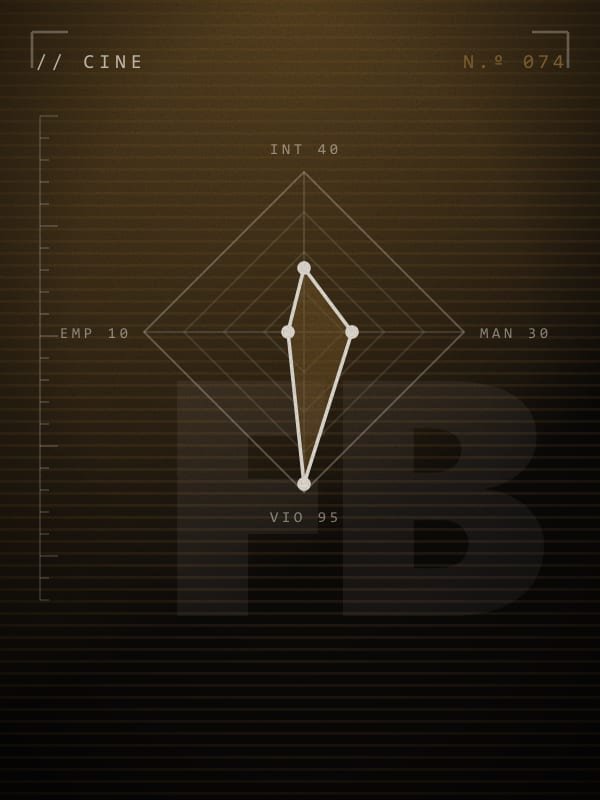
A heavyweight boxer is banned from the sport for killing a man in the ring, and takes work as muscle for a criminal organization that pays in cash and asks nothing of him but what he already is. He has no strategy, no ideology and no ambition beyond the fee. In a roster of characters defined by philosophies, nations and disciplines, he is defined by a body — and the game is not being careless. It is reproducing, with unusual fidelity, a theory of criminality that a Harvard psychologist spent thirty years trying to prove.
// The theoryThree components, and one of them is supposed to offend
William Sheldon's constitutional psychology, set out in The Varieties of Human Physique (1940) and applied in Varieties of Delinquent Youth (1949), was not a typology of three boxes but a scoring system on three axes. Endomorphy is softness and roundness, digestive bulk, associated by Sheldon with a viscerotonic temperament — sociable, comfort-seeking, relaxed. Ectomorphy is linearity and fragility, high surface area to mass, paired with cerebrotonia — restraint, inhibition, oversensitivity, a preference for solitude. Mesomorphy is bone and muscle, and its temperament, somatotonia, is the one that matters here: assertive, physically energetic, indifferent to pain, drawn to risk and direct action. Everyone receives three numbers. And Sheldon's claim was not that muscle causes crime but something more ambitious and less falsifiable — that build and disposition are two expressions of the same underlying constitution, so the body is a legible index of the person.
The Gluecks found it. That is the problem
The reason this theory cannot simply be laughed off is Physique and Delinquency (1956). Sheldon and Eleanor Glueck, whose Unraveling Juvenile Delinquency is one of the most careful longitudinal studies of the era, matched 500 persistent delinquents against 500 non-delinquents on age, ethnicity, intelligence and neighborhood, and somatotyped both groups. Roughly 60 per cent of the delinquents were predominantly mesomorphic against about 31 per cent of the controls. That is a large difference, it was not produced by sloppy work, and versions of it have turned up since. So the finding is real. The question is what produces it, and there are at least four non-constitutional answers, each of which fits the data as well as Sheldon's. Selection: physical offending rewards physical capacity, so boys who can fight are the ones for whom fighting works. Perception: a large, muscular adolescent is read as threatening, is more likely to be stopped, charged and convicted, and so appears in delinquent samples at a higher rate for the same conduct. Reverse causation: manual labor, street life and an absence of schooling build muscle. Confounding: nutrition, class and physical work track both build and official delinquency. Sheldon considered none of them seriously, because his framework did not require him to.
// The subjectA roster that is a somatotype chart
What makes Balrog worth a file is not that he illustrates the theory but that he was built by it. Consider the design logic of the cast around him: a bulky sumo whose whole character is appetite and good humor, an emaciated ascetic whose character is restraint and mysticism, and a set of bone-and-muscle bruisers whose characters are aggression and directness. That is Sheldon's three axes with the temperaments attached exactly as he attached them — endomorph as viscerotonic, ectomorph as cerebrotonic, mesomorph as somatotonic — reproduced not because anyone consulted the 1940 monograph but because the association is a cultural reflex. Balrog's backstory is the reflex made explicit: the sport valued him only for the body, and when the body killed someone the organization that hired him valued him for the same thing. Nobody in his story has ever asked him a question that his build could not answer.
This is worth stating precisely, because it is where the theory does real damage. Somatotype thinking is not dangerous as science; it died as science. It is dangerous as a perceptual habit, and the habit runs through charging decisions, bail hearings, school discipline and jury inference. A defendant who looks the part has to disprove something a slighter defendant is never accused of, and the evidence on perceived threat is consistent enough to take seriously. The modern echo is the literature on facial width-to-height ratio and inferred aggression, which reproduces the structure of the original error with better statistics — a real correlation between an appearance and an outcome, and an untested leap to constitution.
Balrog
Get the map of theories for free
Subscribe to the criminal archive —one case a week, no spam— and I'll send you The map of theories: the great currents of criminology on a single sheet.
// The crackThe method could not have produced any other answer
Sheldon's work collapses on its procedure, and the details matter. Somatotypes were assigned from standardized nude photographs, rated by eye — by Sheldon, who in his delinquency study also knew which subjects were delinquent and who scored the delinquency himself on a scale of his own devising. There was no blinding, no independent coding and no operational definition that a second researcher could apply and reach the same numbers. His sample in Varieties of Delinquent Youth was 200 young men at a single Boston rehabilitation home, a population selected by the very processes the theory was supposed to explain. The photograph archive itself became a scandal decades later when it emerged that Ivy League universities had photographed incoming students for the project without meaningful consent. Beyond method, the framework fails three tests a theory has to pass: it cannot predict which mesomorph offends, since most do not; it cannot account for offenses that require no physical capacity at all, which is most of them by value; and it treats constitution as fixed when build responds to nutrition, labor and training across a lifetime. What survives is thin and worth keeping: physical size and strength have weak associations with some kinds of aggression, mediated heavily by how others respond to them. The better-supported biological correlates of antisocial conduct — low resting heart rate, prefrontal function, early neurodevelopmental insult — have nothing to do with silhouette, which is the clearest sign that Sheldon was reading the wrong surface.
Handled as a body
Balrog has beaten people for money and killed a man in a ring, and none of that is mitigated by anything in this file. The point runs the other way. His story is what it looks like when a person is treated as a somatotype by every institution he meets: a sport that monetised the body, a governing authority that expelled it, and a criminal organization that hired it, none of which required him to have a mind. Sheldon's error was to believe that a build predicts a character. The lasting harm is that a build predicts how a person will be handled, and that part is not a discredited theory. It is an operating procedure.
Three key ideas
- Sheldon scored physique on three axes — endomorphy, mesomorphy, ectomorphy — and paired each with a temperament, claiming body and disposition are two aspects of one constitution. The mesomorph was the predicted offender.
- The Gluecks (1956) confirmed the correlation on matched samples: 60 per cent of delinquents mesomorphic against 31 per cent of controls. But selection into physical offending, perceived threat, reverse causation and class confounding each explain it without constitution.
- The method could not have produced another answer: unblinded somatotyping from nude photographs, scored by the man who also scored the delinquency. What survives is that build predicts how a person is handled, which is a procedure rather than a theory.
Sources · to keep reading
- Sheldon, W. H. (1940). The Varieties of Human Physique. Harper.
- Sheldon, W. H. (1949). Varieties of Delinquent Youth. Harper.
- Glueck, S. y Glueck, E. (1956). Physique and Delinquency. Harper.
- Glueck, S. y Glueck, E. (1950). Unraveling Juvenile Delinquency. Harvard University Press.
- Rafter, N. H. (2007). “Somatotyping, Antimodernism and the Production of Criminological Knowledge”, Criminology, 45(4).
- Gould, S. J. (1981). The Mismeasure of Man. Norton.
Case-file questionsFrequently asked questions
Who is Balrog?
Balrog is a villain from Street Fighter, analysed on KRIMINIS through the lens of criminology. The uncomfortable fact is not that the theory was absurd.
Why does Balrog become a villain?
Balrog and somatotype theory: the boxer whose entire biography fits inside his build. The file on the correlation that does exist and the explanation that never worked.
Which criminological theory explains Balrog?
Balrog's case is analysed through Somatotypes. William Sheldon argued in the 1940s that body and temperament are two aspects of the same thing, and classified people along three components: endomorphy, mesomorphy and ectomorphy. His criminological prediction was that delinquents would be disproportionately mesomorphic — muscular, big-boned, energetic, risk-tolerant — and in 1956 Sheldon and Eleanor Glueck tested it on 500 delinquents and 500 controls and confirmed it: 60 per cent against 31. The correlation is there and it has replicated. What does not hold is what Sheldon inferred from it. Balrog is the perfect case because in him the theory is not described but applied. He is a character whose design is his biography.