Amy Dunne vanishes on her fifth wedding anniversary, leaving a trail of clues that point to her husband as the killer. The twist: she is alive, and she engineered every bit of it herself. Gone Girl is, among other things, a clinical study of psychopathy dressed in the most disarming disguise imaginable: the perfect wife.
// The theoryThe affective factor, in the feminine
Robert Hare's PCL-R splits psychopathy into two faces. The interpersonal-affective factor gathers superficial charm, grandiosity, manipulation, and the absence of empathy and remorse. Amy scores off the charts on it, with minimal impulsivity: this isn't a shouting match, she is a planner. And here is the crux: psychopathy in women was studied late and shows up differently—less physical violence, more relational aggression and manipulation. Amy is the textbook for the very profile the clinic side-eyed for decades.
The "Cool Girl" monologue is her thesis: Amy describes performing a self for others, a mask with nothing stable beneath it. That is exactly the affective core of psychopathy—Cleckley's "mask of sanity": a flawless social performance staged over an emotional void. The "Amazing Amy" of her parents' books is grandiosity turned into biography: a self built to be admired.
Developmental psychology gives that difference a name. Crick and Grotpeter showed that aggression in girls tends to be relational—excluding, slandering, wrecking reputations—rather than physical, and Amy raises it to a fine art: she doesn't throw punches, she destroys lives in writing. On top of that expression bias sits a bias of detection. As far back as 1950, Otto Pollak argued—on grounds now heavily contested, though with a kernel of truth—that female crime is underestimated because it's hard to suspect a woman: the system's chivalry and gender roles act as camouflage. Amy doesn't just have the profile; she has the social disguise that keeps anyone from looking for it in her.
The invisible psychopath
The PCL-R was built largely on samples of incarcerated men. Female psychopathy—more manipulative, less overtly violent—slips past the stereotype. Amy weaponizes precisely the traits society doesn't suspect in a woman: the victim narrative, the model wife. The most dangerous mask is the one no one questions.
Get the map of theories for free
Subscribe to the criminal archive —one case a week, no spam— and I'll send you The map of theories: the great currents of criminology on a single sheet.
// The subjectThe engineering of the story
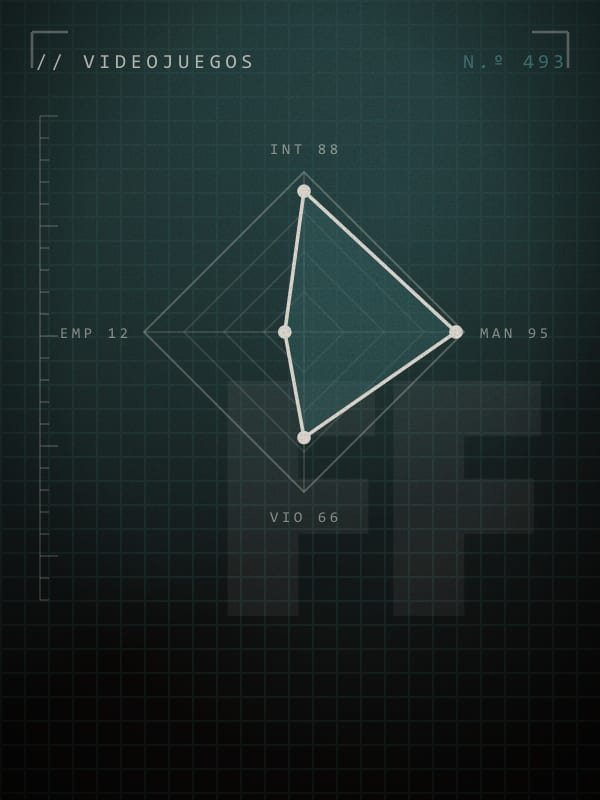
Amy's violence is instrumental and planned down to the millimeter—the fake diary, the clues, the framing—: controlled, never reactive. She doesn't lose her cool; she writes reality. Where the movie psychopath explodes, Amy drafts, edits, and publishes the version that suits her.
There is a term for what Amy represents: the successful psychopath. In Snakes in Suits, Robert Hare and Paul Babiak described those who carry the affective core of the profile but channel their manipulation within the rules—in marriage, business, social life—without ever setting foot in a police station. Amy is their textbook specimen: she doesn't offend out of clumsiness, she offends with an alibi. Her greatest achievement isn't a crime, it's not looking like a criminal—which makes her more unsettling than any killer who ends up behind bars.
Amy Dunne
// The crackDiagnosis or character?
The usual caution applies: Amy is a work of fiction, amplified for the thriller; real psychopathy is clumsier and rarely this omnipotent. And "psychopath" is neither an insult nor a verdict. But Gone Girl does something valuable: it forces us to see that the profile isn't always a male serial killer—sometimes it's the person everyone calls "amazing."
The film also plays with how society reads women—victim, ideal wife, woman scorned—boxes Amy exploits deliberately. Label and gender bias intersect with the clinical profile: sometimes we don't see the psychopath because we're looking at the label we expected.
That collision of profile and prejudice has measurable consequences. Forensic tools were calibrated on incarcerated men, so a woman with Amy's pattern is more easily read as "victim" or "unstable" than as what she is. The result is twofold: risk assessments that fail, and a culture that still imagines the predator with a male mugshot for a face. Gone Girl doesn't invent the female psychopath; it merely shines a light on the blind spot where she had been sitting for decades.
The contrast with Bateman seals it: where Patrick needs the bloody ritual to feel real, Amy doesn't spill a drop she hasn't planned. Both share the affective void; only the wrapping changes—his, spectacular and masculine; hers, domestic and invisible. Psychopathy, the file insists, has no single script, and the most dangerous one is the script we don't even recognize as such.
// Why it mattersLooking past the stereotype
Assessing risk rigorously means letting go of the cinematic image of the psychopath. Many people with high scores are well integrated, come across as charming, and are not who you'd suspect. A clinical tool, used with care, sees the pattern that prejudice overlooks—including the prejudice of assuming "that" is only done by men, and only with a knife.
Three key ideas
- Amy embodies the affective factor of psychopathy (charm, manipulation, zero remorse) without impulsivity: pure planning.
- Female psychopathy, more relational than physical, slipped past the stereotype (and past the research, done on men).
- The most dangerous mask is the one no one questions: Amy weaponizes the image of victim and perfect wife.
Sources · further reading
- Cleckley, H. (1941). The Mask of Sanity. Mosby.
- Hare, R. D. (2003). Hare Psychopathy Checklist-Revised (PCL-R), 2nd ed. Multi-Health Systems.
- Pollak, O. (1950). The Criminality of Women. University of Pennsylvania Press.
- Crick, N. R. & Grotpeter, J. K. (1995). "Relational Aggression, Gender, and Social-Psychological Adjustment." Child Development, 66(3).
- Forouzan, E. & Cooke, D. J. (2005). "Figuring out la femme fatale: psychopathy in females." Behavioral Sciences & the Law, 23.
- Babiak, P. & Hare, R. D. (2006). Snakes in Suits: When Psychopaths Go to Work. Harper.
Case-file questionsFrequently asked questions
¿Por qué Amy Dunne (Amazing Amy) se convierte en villano?
Gone Girl and psychopathy behind the most disarming mask of all: the perfect wife. A profile science was slow to recognize because it didn't fit the stereotype.
¿Qué teoría criminológica explica a Amy Dunne?
El caso de Amy Dunne se analiza desde la Psicopatía. Amy Dunne embodies the affective factor of psychopathy—charm, manipulation, zero remorse—without an ounce of impulsivity. And she spotlights something research long overlooked: female psychopathy, more relational than physical.