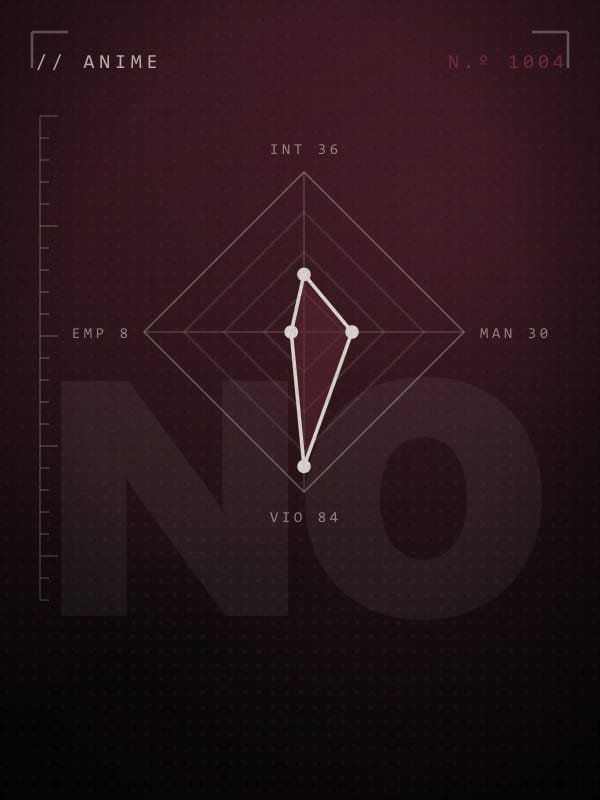
In episode 5 of the Tokyo Revengers anime (chapter 12 of Ken Wakui’s manga), Draken carries Mikey, asleep after lunch, to a hospital. In the bed lies a girl who has not regained consciousness in five days, her face and body covered in wounds. She is the girlfriend of a friend of Pah-chin, captain of the Tokyo Manji Gang’s (Toman’s) 3rd Division. Her father shouts at them that his daughter is in this state because of people like them. Mikey replies that they have done nothing wrong; Draken forces him to bow and says it is all their responsibility. The series never gives the girl a name. It does say whom Toman blames: Nobutaka Osanai, the eighth leader of Moebius, the biker gang that runs Shinjuku, a generation of delinquents two years older than Mikey’s. Osanai, a 17-year-old boxer, is the villain who opens the Moebius arc (summer 2005, chapters 13-16 of the manga and episodes 6-7 of the anime), and his defeat sets off the August 3 battle in which Draken was supposed to die.
// The theoryA woman’s body as a message to another man
Patriarchy theory has no single author: it is the collective work of feminist criminology since the 1970s. In 1975, Susan Brownmiller argued in Against Our Will that rape is not an act of uncontrolled desire but an instrument of intimidation and power. R. Emerson and Russell Dobash (1979) studied violence against wives as a way of maintaining male authority, and Sylvia Walby (1990) defined patriarchy as a system of social structures and practices in which men dominate women. R. W. Connell (1995) developed the concept of hegemonic masculinity, the model of manhood a culture rewards, defined by the subordination of women and of other men, and James Messerschmidt (1993) showed that, for many boys with no other resources, street violence is a way of proving they are men. The anthropologist Rita Segato (2003), drawing on interviews with men convicted of rape in a prison in Brasília, supplied the piece that matters most here: rape has two addressees. One is the victim. The other is the rest of the men, before whom the attacker displays his power.
Striking a man through what is “his”
In chapter 11 (episode 5), Mitsuya explains how it all began: Pah-chin’s friend had a run-in with Osanai over something trivial. Moebius’s response does not stop at the boy. They beat him, they assault his girlfriend in front of him, they take all the money he has on him, and afterward they go after his parents and siblings too. This is the pattern Segato describes: the punishment is aimed at a man, and it is delivered through what the gang regards as his, his family, his money and his partner. For the gang, the girl is not the target of the conflict but the means of humiliating her boyfriend. And Toman reads it in the same terms: Mikey calls the war in the name of Pah-chin’s friend, not in hers.
// The subjectThe man who could not stand being looked at
Osanai appears in three moments. The first is his arrival (chapters 14-16; episodes 6-7). Moebius shows up by surprise, and in force, where Toman’s leadership is gathered. Osanai mocks Mikey’s gang as a bunch of middle school kids, demands that Pah-chin address him with respect because he is two years older, and hits Takemichi just for looking at him: he says that look of contempt is the one he hates most. Then he knocks Pah-chin down with his boxing and breaks his nose. Mikey drops him with a single kick, and when Osanai gets up with a broken bottle, Draken stops him and tells him why he lost: he strayed from the delinquent’s path, because gang rape and attacking someone’s parents is garbage. As the police close in, Pah-chin stabs Osanai and stays behind to turn himself in. The second moment takes place in 2017, in the present in which Draken is dead (chapter 13; episode 6). Osanai is 29, works on a construction site, and his boss yells at him for being late. He speaks timidly, trembles, denies that Moebius killed Draken and says it was all the plan of someone he will not name. He leaves on a half-finished sentence: if Draken had not died, he too…
Nobutaka Osanai
Get the map of theories for free
Subscribe to the criminal archive —one case a week, no spam— and I'll send you The map of theories: the great currents of criminology on a single sheet.
// The crackWho did what?
The third moment changes everything. (Spoiler warning.) Later, in the Valhalla arc (chapter 47; episode 17), Takemichi and Chifuyu look for Osanai, who at 17 is already working. He tells them that he used to beat up anyone he did not like, until there was no one left around him, and that this was when Kisaki approached him. By following Kisaki’s advice, in one year he went from a brute who only knew how to fight to running Shinjuku. And the 8/3 conflict showed him he was only a stepping stone: the war with Toman had been set up by Kisaki, who pushed Pah-chin into a corner until he had a reason to fight and put all the blame on Osanai. The story never makes clear what Osanai did with his own hands. Mitsuya speaks of Moebius’s members, Draken throws it in Osanai’s face, and Osanai later says he took the fall for someone else’s plan. What no one questions is that the assault happened, and that it was carried out in the name of Moebius, the gang he led and whose style he embodied.
For patriarchy theory, that doubt saves no one: it confirms the argument. If Kisaki could use a sexual assault as a lever to split Toman, it was because he knew how everyone would read it, as an insult between men that can only be washed away with more violence between men. And so it went: a stabbing, an arrest and nearly a civil war. Even Draken’s code, which condemns what happened, places the girl outside the boys’ world, as someone who must not be dragged into their business, and not as someone with a voice. The series does the same. She has no name and not a single line, and it is her father who speaks for her. Explaining Osanai is not excusing him. Being Kisaki’s pawn does not make his gang’s violence any less real, and the fact that violence follows a cultural script does not lessen the responsibility of whoever commits it.
The victim the story leaves out
Using sexual violence to strike the other side is not a manga invention. In 2008, UN Security Council Resolution 1820 recognized that sexual violence is used as a tactic of war. In the accounts of those conflicts, the same thing often happens as in the Moebius arc: the victim fades into the background, turned into the reason for a fight between men. The theory asks us to look at the scene the other way around, from the hospital bed: the girl is nobody’s casus belli, but the person who was harmed.
Three key ideas
- Patriarchy theory (Brownmiller, 1975; Dobash and Dobash, 1979; Walby, 1990; Connell, 1995; Messerschmidt, 1993) reads sexual violence as an instrument of domination, and Segato (2003) adds that it is also aimed at other men.
- Nobutaka Osanai, the eighth leader of Moebius, opens the 8/3 arc of Tokyo Revengers: his gang beats up a friend of Pah-chin, assaults his girlfriend in front of him and attacks his family, and Toman answers with a war in which the girl, the victim, is reduced to a pretext.
- The crack: Osanai later says Kisaki planned it all and the blame was put on him; but the fact that the assault worked as a lever confirms the theory, and explaining Osanai does not excuse him.
Sources · further reading
- Brownmiller, S. (1975). Against Our Will: Men, Women and Rape. Simon & Schuster.
- Dobash, R. E. and Dobash, R. P. (1979). Violence Against Wives: A Case Against the Patriarchy. Free Press.
- Walby, S. (1990). Theorizing Patriarchy. Basil Blackwell.
- Messerschmidt, J. W. (1993). Masculinities and Crime: Critique and Reconceptualization of Theory. Rowman & Littlefield.
- Connell, R. W. (1995). Masculinities. Polity Press.
- Segato, R. L. (2003). Las estructuras elementales de la violencia [The Elementary Structures of Violence]. Universidad Nacional de Quilmes.
- Wakui, K. (2017-2022). Tokyo Revengers. Kodansha, chapters 11-16 and 46-47.
- Tokyo Revengers (2021). Anime series, LIDENFILMS, episodes 5-7 and 17.
Case-file questionsFrequently asked questions
Who is Nobutaka Osanai?
Nobutaka Osanai is a villain from Tokyo Revengers, analysed on KRIMINIS through the lens of criminology. The girl has been in a coma for five days, and the series never tells us her name.
Why does Nobutaka Osanai become a villain?
Nobutaka Osanai, leader of Moebius in Tokyo Revengers, and patriarchy theory: the assault on a boy, his family and his girlfriend that starts the war with Toman, and what it says about who speaks through whose body.
Which criminological theory explains Nobutaka Osanai?
Nobutaka Osanai's case is analysed through Patriarchy and crime. Patriarchy theory, the collective work of feminist criminology (Brownmiller, 1975; Dobash and Dobash, 1979; Walby, 1990; Connell, 1995), holds that sexual violence is not the outburst of rare individuals but an instrument of domination, and that it often works as a message aimed at other men as well. Nobutaka Osanai, the eighth leader of the Moebius gang in Tokyo Revengers, is the villain of the first major arc: his gang beats up a friend of Pah-chin, sexually assaults his girlfriend in front of him and attacks his family, and Toman answers with a war. Later, Osanai will say that Kisaki planned it all.


