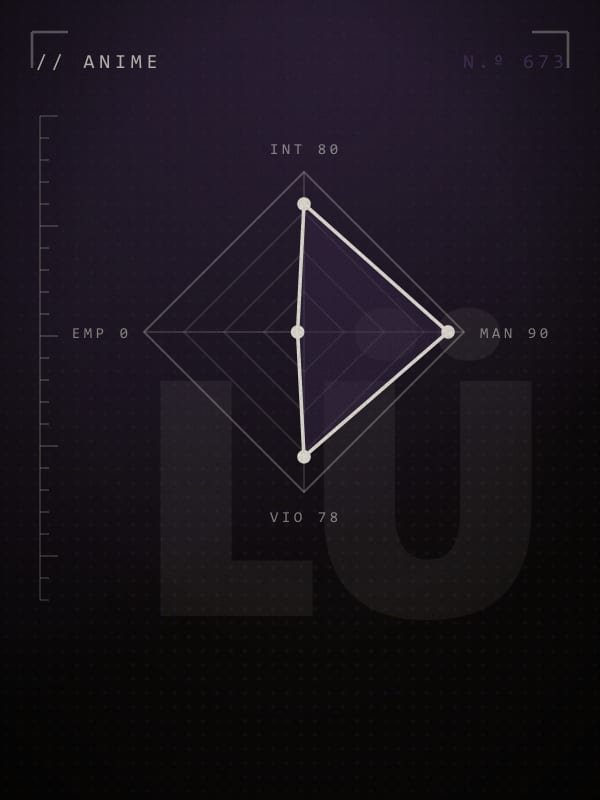
A demon stands outside a human settlement and asks to negotiate. He speaks courteously, invokes peace, and uses family words with perfect fluency. Everything about the performance is calibrated, and none of it corresponds to anything inside him: in this world demons acquired human language as a hunting tool, the way some predators acquire a color or a sound, and the word that opens a door is simply the word that opens a door. The story treats this as a fact about a species. That makes it an unusually clean laboratory for a family of explanations that criminology has never been comfortable with and has never been able to dismiss either.
// The theoryWhat advantage could deception have had?
Evolutionary approaches to crime start from a premise that sounds provocative and is nearly trivial: behavior is produced by brains, brains have an evolutionary history, and dispositions that persist across populations usually did something for somebody. The serious work is narrow and empirical. Martin Daly and Margo Wilson's Homicide (1988) examined who kills whom and found patterns that sociological accounts alone predicted badly — the age and sex distribution of killers, the risk gradients within households. And Linda Mealey (1995) proposed that a persistent, low-frequency strategy of exploitation could be maintained by frequency-dependent selection: cheating pays only while cheaters are rare, so the strategy stabilizes at a low proportion rather than spreading or disappearing. That is a real mechanism with real mathematics, and it is what the demons of this story literalise — a lineage whose payoff comes entirely from exploiting a signal system it did not build.
Aggressive mimicry exists, and it does not require a liar
Biology has a precise name for what Lügner does. Aggressive mimicry is when a predator imitates a signal that its prey is adapted to respond to, so the prey approaches the thing that will eat it. Anglerfish grow a lure shaped like food. Females of the firefly genus Photuris flash the mating code of a different genus and eat the males that answer. In none of these cases is there deception in the human sense — no intention, no theory of the victim's mind, no understanding of the message. The signal simply works, and the lineage that emitted it left more descendants. That is the concept the demons instantiate, and it matters for this file because it separates two things criminology constantly merges: behaviour that exploits trust and a person who chooses to betray. They look identical from outside and they are not the same object at all.
// The subjectA predator with a vocabulary
Watch what Lügner actually does with language and the structure is exact. He uses the words that produce hesitation in humans — appeals to mercy, to kinship, to negotiation — and he deploys them at the moments when hesitation is tactically useful. What he never does is use them when nobody is listening, or apply them to himself, or show any sign that they organize his own behavior. The story makes this legible through a detail worth stealing for real analysis: the demons ask for things using kinship terms they cannot define. That gap between fluent use and absent comprehension is the whole diagnosis. And it produces the strategic consequence that drives the plot — a negotiator who cannot be negotiated with, because negotiation assumes both parties are running the same program and one of them is running a lure.
Lügner
Get the map of theories for free
Subscribe to the criminal archive —one case a week, no spam— and I'll send you The map of theories: the great currents of criminology on a single sheet.
// The crackWhere this becomes the most dangerous lens on the map
Three problems, escalating. The first is methodological: evolutionary explanations are notoriously easy to generate and hard to test, and Gould and Lewontin's 1979 critique of “just-so stories” remains the standard warning — any observed trait can be narrated as an adaptation after the fact, and a story that cannot fail is not a finding. The second is the naturalistic fallacy: even a perfectly established evolutionary account of a behavior says nothing whatever about whether it is acceptable, and the slide from this is ancient to this is excusable is made constantly in popular writing and never by the researchers.
The third is the reason this file needed a fictional non-human subject. Evolutionary reasoning about crime is at its most dangerous the moment it is applied to a group rather than to the species. The claim “that kind of person is innately predatory” has a history, and the history is the worst material in this entire archive: it licensed slavery, colonial administration, sterilisation and extermination, and it was always dressed in the best available science of its day. Frieren's demons can be a species with an innate predatory strategy because they are an invention. No human population is, the evidence for within-species differences of this kind is nonexistent, and the moment a real argument starts to sound like this one, the correct response is not curiosity — it is the fire alarm.
A reason to stop them, not to forgive them
This is the file in the archive where the rule has to work hardest, because the subject is designed to make it fail. If a creature genuinely cannot understand what it is doing to others, is it responsible? The story answers by declining to grant the question: the demons are treated as lethal regardless, and their inability to comprehend harm is a reason to stop them, not to spare them. That is also, roughly, what every legal system does with dangerousness that is not accompanied by capacity — it protects the potential victims first and argues about blame afterwards. The useful transfer to the real world is the inverse of what a careless reader takes. Humans are not demons. Anyone who tells you a category of person is one is not doing biology.
Three key ideas
- Evolutionary criminology asks what advantage a behavior had. Its serious work is narrow: Daly and Wilson on the distribution of homicide, Mealey (1995) on exploitation strategies stabilized at low frequency by frequency-dependent selection.
- Aggressive mimicry is the precise concept: a predator emitting a signal its prey is adapted to answer, with no intention or comprehension. It separates behavior that exploits trust from a person who chooses to betray — identical from outside, not the same object.
- Three dangers, escalating: just-so stories that cannot fail (Gould and Lewontin, 1979), the naturalistic fallacy, and above all the application of innate predation to a human group, which is the historical engine of the worst material in this archive.
Sources · to keep reading
- Daly, M. y Wilson, M. (1988). Homicide. Aldine de Gruyter.
- Mealey, L. (1995). “The sociobiology of sociopathy: An integrated evolutionary model”, Behavioral and Brain Sciences, 18(3).
- Gould, S. J. y Lewontin, R. C. (1979). “The Spandrels of San Marco and the Panglossian Paradigm”, Proceedings of the Royal Society B, 205.
- Buss, D. M. (2005). The Murderer Next Door. Penguin.
- Lloyd, J. E. (1975). “Aggressive mimicry in Photuris fireflies”, Science, 187(4175).
- Walsh, A. y Beaver, K. M. (eds.) (2009). Biosocial Criminology. Routledge.
Case-file questionsFrequently asked questions
Who is Lügner?
Lügner is a villain from Frieren, analysed on KRIMINIS through the lens of criminology. He says “please” with the exact intonation.
Why does Lügner become a villain?
Lügner and evolutionary criminology: a predator who mimics his prey's language without understanding a single word of it. The file on the evolutionary account of deception — and on why applying it to human groups has always been a catastrophe.
Which criminological theory explains Lügner?
Lügner's case is analysed through Evolutionary criminology. Evolutionary criminology asks what reproductive advantage a behavior we now call crime might once have had. Its serious version has produced uncomfortable and solid findings — Daly and Wilson on homicide, models of cheating strategies sustained by frequency-dependent selection — and its lazy version has produced moral fables in laboratory vocabulary. The demons of Frieren are the ideal case study because in their world the premise is literally true: they mimic human speech the way an anglerfish mimics a lure, without comprehension and without intention in our sense. That allows the theory's logic to be examined in pure form — and shows with total clarity where it stops being biology and becomes something far more dangerous.


