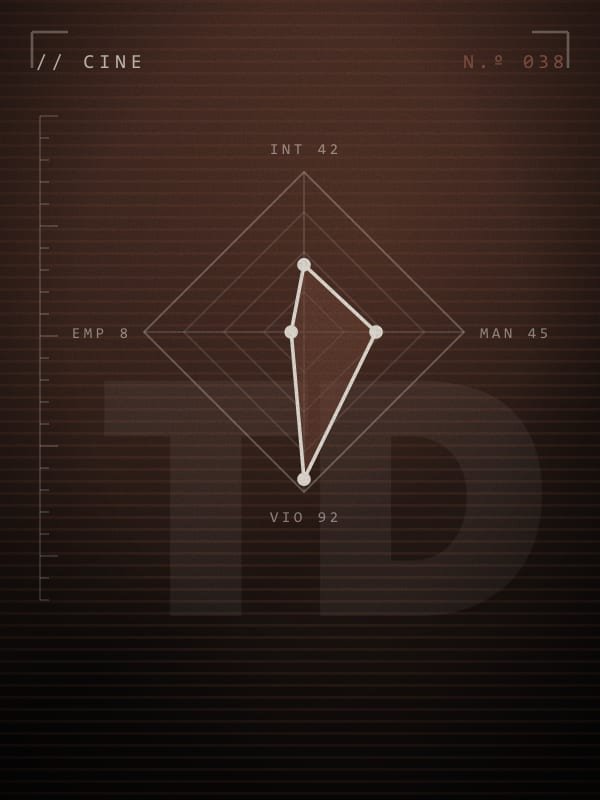
Gyp Rosetti is a Prohibition-era gangster whose defining trait is a monstrous touchiness: he reads any gesture —a kind remark, a stock phrase, a glance— as a sign of disrespect that demands blood. He kills a man for explaining an expression he took as an insult. He is unpredictable, explosive, lethal over trifles. For the subculture of violence theory, Gyp is the code of honor taken to its pathological extreme: the exact point where the norm of answering affronts turns into a disease.
// The theoryHonor as a wound that never closes
The subculture of violence described by Wolfgang and Ferracuti depicts worlds where an affront to one's honor demands a violent response. Gyp lives in that world —the Italian-American underworld of the 1920s, with its iron cult of rispetto— but he pushes it to a point where the mechanism runs out of control. For him, the threshold of what counts as an «affront» is so low that almost everything crosses it: a kindness can be condescension, a joke can be mockery, a favor can be a veiled insult. The cultural norm of honor, which in others regulates violence, in Gyp triggers it constantly, because his mind turns every interaction into a test of respect that must be won with blood.
When the norm becomes a disease
Gyp illustrates a crucial nuance of the theory: the subculture of violence sets a threshold of affront —what counts as disrespect demanding a response—. In most members that threshold is high, and violence is therefore relatively rare and ritualized. In Gyp, the threshold has sunk to the floor, and the result is a machine that kills over trifles. He is the crossing point between the cultural norm (honor demands a response) and individual pathology (an extreme touchiness and impulsivity). The theory needs both layers: the culture gives him the script —«affronts are washed away with blood»—; his psychology decides how many affronts he sees. Gyp is what happens when a code of honor lands on the person least fit to carry it.
Get the map of theories for free
Subscribe to the criminal archive —one case a week, no spam— and I'll send you The map of theories: the great currents of criminology on a single sheet.
// The subjectThe man who never feels respected
Beneath Gyp's fury lies a devouring insecurity: a man who never feels respected enough and who seeks in violence the confirmation his own interior denies him. The theory reads his case as the interaction between an environment that sacralizes honor and a personality incapable of feeling honored. His history of slights and humiliations explains where his hypersensitivity comes from; it does not excuse the bodies he leaves along the way. Gyp is responsible for every absurd death he causes —but his absurdity has a grammar: that of an honor that is never satisfied—.
Gyp Rosetti
// The fault lineNeither "just crazy" nor "it's the underworld's culture"
The fault line with Gyp is to write him off as a simple, unpredictable psychopath: that loses sight of the fact that his violence follows a logic —that of offended honor—, only with the threshold broken. He does not kill at random; he kills over affronts, even if the affronts exist only in his head. The opposite fault line is to blame it all on the culture: «that's just how the Italian underworld was». No: most of his peers, in the same subculture, did not kill over a misunderstanding; Gyp combines the code with a personal pathology that overwhelms him. The theory explains the script; his psychology, the frequency. Neither the culture nor his character forces him to shoot: he is responsible for mistaking every brush for a war.
That Gyp ends up killed by his own people —worn out by his unpredictability— confirms the lesson: even within the subculture of violence, the one who breaks the threshold and kills over trifles becomes a danger to his own. Honor without measure does not consolidate power: it blows it apart.
The threshold that decides how much blood
Gyp matters because he points to where the lever of violence sits in these subcultures: in the threshold of affront. Two environments can share the same code of honor and have very different levels of violence depending on how high or low that threshold sits —what is considered an offense that «must» be answered—. Lowering the violence of an honor subculture does not always require erasing honor; sometimes it is enough to raise the threshold: to teach that not every brush is an affront, that it can be let go without losing respect. Gyp is the extreme reminder of what happens when that threshold sinks: an entire life —and several others— spent washing away offenses no one meant to give.
Three key takeaways
- Gyp Rosetti takes the code of honor of the subculture of violence to its pathological extreme: he kills over misunderstandings, so hypersensitive that he reads any gesture as an affront demanding blood.
- He illustrates the role of the "threshold of affront": the culture gives the script (honor demands a response), but his psychology —impulsivity, insecurity— decides how many affronts he sees. Cultural norm + individual pathology.
- Neither "just crazy" (his violence follows the logic of offended honor) nor "it's the underworld's culture" (his peers did not kill over trifles). Lowering violence sometimes does not require erasing honor, but raising the threshold of what counts as an affront.
Sources · further reading
- Wolfgang, M. E. & Ferracuti, F. (1967). The Subculture of Violence. Tavistock.
- Nisbett, R. E. & Cohen, D. (1996). Culture of Honor. Westview Press.
- Johnson, N. (2002). Boardwalk Empire. Plexus.
Case-file questionsFrequently asked questions
¿Quién es Gyp Rosetti?
Gyp Rosetti («Gyp») es un villano de Boardwalk Empire, analizado en KRIMINIS con la lente de la criminología. An innocent remark, a misread glance, and there's already a corpse.
¿Por qué Gyp Rosetti se convierte en villano?
Gyp Rosetti and the subculture of violence: the code of honor taken to its pathological extreme. A man so hypersensitive to disrespect that he kills over a misunderstanding.
¿Qué teoría criminológica explica a Gyp Rosetti?
El caso de Gyp Rosetti se analiza desde la Teoría de la Subcultura de la Violencia. The subculture of violence (Wolfgang and Ferracuti) describes environments where honor demands a violent response. Gyp Rosetti, from Boardwalk Empire, takes that code to its pathological extreme: so obsessed with respect that he reads any gesture as an affront and kills over a misunderstanding. It is the subculture of honor turned into gunpowder: the point where the norm becomes a disease.