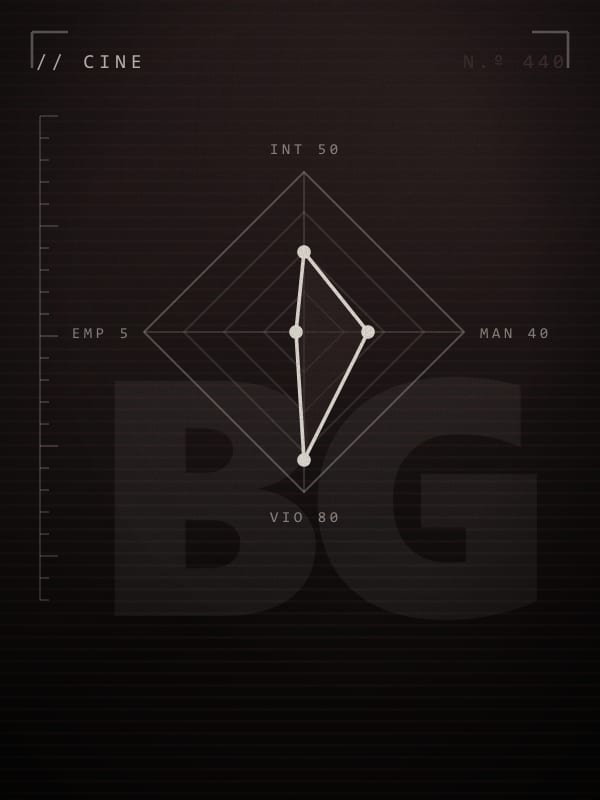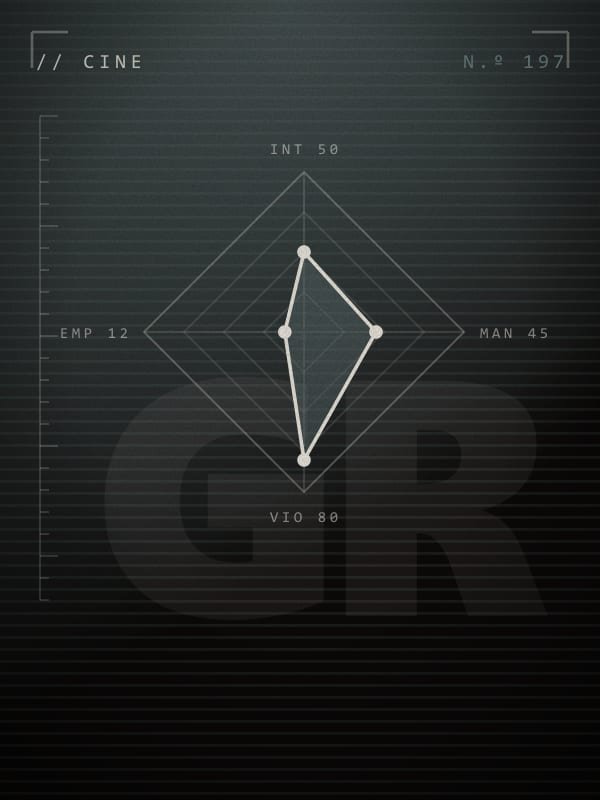
Gil Renard is a failed salesman whose only source of meaning is a baseball team and, above all, its star player, Bobby Rayburn. For Gil, Rayburn is not a distant celebrity: he is his friend, his hero, almost an extension of himself. He follows every game as if his own life were being played out in it. When the idol enters a slump and «disappoints» him, Gil decides to fix it… his way, with violence. For Glaser's differential identification, Renard illustrates one of its most modern forms: parasocial obsession.
// The theoryIdentifying with someone who will never know you
Glaser noted that we can identify with figures we have never met. Psychology called that bond a parasocial relationship: an intense, one-sided emotional connection with a media figure who doesn't even know we exist. For most people it is harmless —fans, followers, admirers—. But when the parasocial bond becomes the only support of an empty identity, the identification can turn total and dangerous. Gil doesn't admire Rayburn: he has fused with him, made the player's glory his own reason for existing. The star is his borrowed self.
That is where it turns. Because the identification is total, Gil feels he has rights over his idol: if he gives him everything (devotion, meaning, life), Rayburn «owes» it to him to perform, to be grateful, to reciprocate. When the player fails to honor that imaginary contract, Gil doesn't experience a fan's disappointment: he experiences a personal betrayal. And the violence that follows is that of a broken possessive bond, closer to the stalker's than the fan's.
From parasocial love to possession
Gil's line —«without us you'd be nothing»— reveals the toxic heart of his identification: he has turned admiration into a debt. In healthy parasocial relationships, the fan knows the bond is one-sided and demands nothing in return. In the pathological version, the subject erases that asymmetry: he believes his devotion creates an obligation, that the idol belongs to him. It is the same mechanism behind many real cases of stalking celebrities —an identification so total that the admirer feels entitled over the admired, and punishes their «ingratitude»—. Glaser would frame it as identification taken to the point where the borrowed self demands to be returned with interest.
Get the map of theories for free
Subscribe to the criminal archive —one case a week, no spam— and I'll send you The map of theories: the great currents of criminology on a single sheet.
// The subjectThe void an idol cannot fill
Beneath Gil's obsession lies, once again, a collapsed self: a failed job, a broken family, no source of worth of his own. Baseball and Rayburn are the only place where he feels part of something great. Glaser would point to the rule that runs through all these files: the emptier the self, the more total —and more fragile— the identification with an external model. The problem is that an idol can never fill that void, because he doesn't know Gil exists. The fantasy is doomed to shatter, and when it does, it drags down the only identity Gil had.
Gil Renard
// The flawNeither "harmless fan" nor guilty idol
Gil's flaw is confusing degree with kind. The vast majority of intense fans are not dangerous —parasocial passion is normal and healthy—; to pathologize it would be absurd. But we shouldn't romanticize Gil as «a fan who loved too much» either: he stalks, threatens and assaults, and explaining his identification does not excuse his violence. And beware of the opposite flaw: blaming the idol —«for letting himself be idolized»— is absurd; Rayburn did not create Gil's obsession nor did he owe him anything. The fair reading: Gil is responsible for his acts, and his case illuminates how a total parasocial identification, over an empty self, can slide toward stalking and possession.
The film gets it right by showing that the line between the devoted fan and the stalker is not drawn by the intensity of love, but by the moment the fan starts to believe the idol belongs to him. That leap —from admiring to possessing— is the one that turns an identification into a crime.
Support the self, don't hunt the fan
Gil Renard has a very current reading, in the age of stans and hyperconnected fan communities: parasocial identification has become massive, and with it the cases where it bends toward harassment or threat. Prevention does not mean policing admirers —they would number in the millions—, but the usual thing: reducing the void that makes an idol, for some, the only identity available. A Gil with real bonds, achievements of his own and a sense of belonging would not have needed to turn a baseball player into the meaning of his life —nor into the target of his revenge when that meaning collapsed—.
«Without us you'd be nothing», Gil shouts at his idol. It is the voice of someone who has poured his whole being into another and now demands it back. That is the tragedy of parasocial identification: handing a stranger the identity one failed to build, and collecting on it when the stranger, who never signed anything, goes on with his life without looking back.
Three key takeaways
- Gil Renard is Glaser's parasocial identification: an imaginary, one-sided and total relationship with a sports idol that becomes his borrowed self.
- The turn is from love to possession: because it is total, Gil believes the idol «owes» him and belongs to him; when the idol fails that imaginary contract, devotion turns to violence —the mechanism of celebrity stalking—.
- Neither harmless fan nor guilty idol: responsible for his acts. Parasocial passion is normal; it bends when the fan believes he possesses the idol. Prevention is supporting the self, not policing admirers.
Sources · further reading
- Glaser, D. (1956). «Criminality Theories and Behavioral Images». American Journal of Sociology, 61(5).
- Horton, D. & Wohl, R. R. (1956). «Mass Communication and Para-Social Interaction». Psychiatry, 19(3).
- Meloy, J. R. (1998). The Psychology of Stalking. Academic Press.
Case-file questionsFrequently asked questions
¿Quién es Gil Renard?
Gil Renard («el fan») es un villano de The Fan, analizado en KRIMINIS con la lente de la criminología. For Gil, the star player is no stranger: he is his best friend, his reason to live.
¿Por qué Gil Renard (el fan) se convierte en villano?
Gil Renard and Glaser's differential identification: parasocial obsession. An imaginary, one-sided and total relationship with a sports idol that, when it breaks, turns into possessive violence.
¿Qué teoría criminológica explica a Gil Renard?
El caso de Gil Renard se analiza desde la Teoría de la identificación diferencial. Glaser's differential identification includes identifying with figures we never meet. Gil Renard, of The Fan, takes it to the parasocial extreme: he builds an imaginary, total relationship with a baseball idol, identifies with the star's glory as his own and, when that fantasy shatters, unleashes possessive violence on the man he idolized.