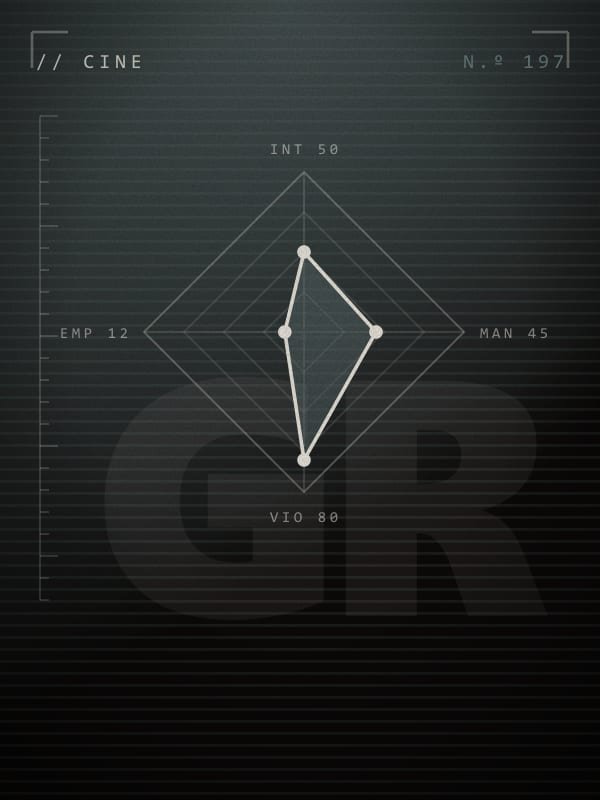
Boss Godfrey, nicknamed "the Man with No Eyes", is the guard who dominates the chain gang in Cool Hand Luke (1967). He barely speaks and his eyes are never seen: he hides them behind mirrored glasses in which only the prisoner he aims his rifle at is reflected. His job is simple and brutal: to watch over a crew of convicts who, in chains, open and repair roads under the scorching sun of the American South. Godfrey does not run a complex business like Warden Norton, nor manage a camp like Amon Göth; he embodies something more elemental and therefore more revealing: bare forced labor, the prisoner's body reduced to pure extractable force. For the political economy of punishment, he is the cleanest image of its central thesis.
// The theoryThe chain gang as an open-air factory
Rusche and Kirchheimer argued that the prison is, at its economic core, a mechanism for extracting labor from the convict's body. The chain gang is that thesis in its most literal and historical form. After the American Civil War, many Southern states discovered they could replace the newly abolished slave labor with leased convicts (the convict leasing system) and with chained crews that built public infrastructure at no wage cost. The convicts —disproportionately poor and Black— became the labor force that raised roads, railways and quarries. Godfrey is the overseer of that open-air factory. The crew's sweat is turned into public works; the punishment is paid in miles of asphalt. There is no reform or redemption at stake: there is a productive task the state needs and captive bodies compelled to perform it. Melossi and Pavarini summed it up in the title of their book: The Prison and the Factory. Godfrey watches over the exact point where the two become the same thing.
The impersonal surveillance Foucault described
Godfrey's mirrored glasses are one of cinema's most precise symbols of the power of punishment. Because his eyes are never seen, Godfrey ceases to be an individual with a name and motives and becomes the gaze of the system itself: impersonal, constant, unappealable. The prisoners never know exactly who he is looking at, and so they must behave as if he were watching them all, always. It is, almost to the letter, the panopticon that Foucault described in Discipline and Punish: a mechanism in which the watched person internalizes the surveillance because they can never verify when they are observed, and end up disciplining themselves. Godfrey hardly needs to shoot; his mere presence —that gaze which cannot be held or deciphered— is enough to keep the crew working. The theory teaches that the power of modern punishment is not primarily the whip, but the gaze: an eye that is not seen but is felt, and that turns each prisoner into his own guard. When Godfrey finally uses the rifle —at the climax, against Luke— it is not an excess: it is the reminder that behind the silent surveillance the lethal force that backs it always waits.
Get the map of theories for free
Subscribe to the criminal archive —one case a week, no spam— and I'll send you The map of theories: the great currents of criminology on a single sheet.
// The subjectThe faceless guard against the untamable man
Godfrey functions in the film as Luke's opposite pole, the protagonist prisoner. Luke is all face, wit, rebellion and stubborn humanity; Godfrey is the absence of all that: no eyes, no words, no cracks. Their confrontation is that of the irreducible individual against the impersonal system that wants to break him —not necessarily kill him, but bend him, turn him into one more docile prisoner in the crew—. Every time Luke escapes and is captured, the system punishes him to "get his mind right": it exhausts him, humiliates him, forces him to dig and refill the same ditch until he collapses. It is Foucauldian discipline in action: the aim is not to destroy the body, but to domesticate it, to extract obedience from it. Godfrey is the final instrument of that domestication. That he is a character almost without psychology is not a flaw in the script: it is his meaning. He represents that which, in forced labor, has neither face nor reasons —the machinery of productive punishment—, against which Luke sets the one thing that machinery can neither manufacture nor extract: a free will.
Boss Godfrey
// The fault lineNeither psychological villain, nor "necessary" discipline
The fault line in reading Godfrey is to search in him for a psychological villain —a sadist with traumas, a cruel man with motives—, when his dramatic force lies precisely in the fact that he has no visible psychology: he is a function, not a person. To look for his motives is to lose what he represents. The opposite, more dangerous, fault line is to accept the frame the system itself proposes: that the discipline of the chain gang is regrettable but "necessary" to keep order, that Luke "had it coming" for being a rebel. The political economy of punishment dismantles that frame: the chained crew does not exist to reform anyone, but to extract free labor and, along the way, to stage the state's power over the bodies of the poor. To call it "necessary discipline" is to accept the alibi. The honest reading sees Godfrey for what he is: not an evil man nor a regrettable necessity, but the faceless face of a system that turns punishment into public works and surveillance into submission, on the backs of those least able to defend themselves.
That Luke dies at the end —gunned down by Godfrey's rifle after his last escape— and yet survives as a legend among the prisoners who tell his story and smile, is the answer that Cool Hand Luke sets against the Man with No Eyes: the machinery could extract his labor and even his life, but it could not extract his example. The system breaks the body; the will that body embodied slips through its fingers. The eyeless gaze watches over bodies, but it cannot watch over what a free man leaves in the memory of others.
Seeing the labor behind the punishment
Godfrey matters because he makes visible what almost always stays hidden: that much of punishment has been, and still is, labor. The chain gang is not a relic of the past; its logic lives on in contemporary prison labor —convicts who fight fires, make furniture or staff call centers for cents an hour—, captive labor whose low cost sustains whole services and industries. The political economy of punishment teaches us to look at any penal system and ask not only "who is being punished?", but "what are they being made to produce, and who benefits from it?". Godfrey, with his mirrored glasses, gives us back our own reflection: that of a society that has learned to extract value from the bodies it locks up while looking the other way. To recognize that gaze —impersonal, comfortable, willing to call "justice" what is, at bottom, forced labor— is the first step toward ceasing to be complicit in it.
Three key takeaways
- Boss Godfrey, "the Man with No Eyes", is the overseer of the chain gang in Cool Hand Luke: he watches over the convicts opening roads under the sun. He embodies the bare forced labor Rusche and Kirchheimer describe, the historical heir of the convict leasing of the American South after the abolition of slavery.
- His mirrored glasses, which erase his gaze, turn him into the impersonal power of the system: Foucault's panopticon made image. The prisoners discipline themselves because they never know when he is watching. He hardly needs to shoot; the gaze that is not seen but is felt is enough to keep them working.
- Neither psychological villain (his force is that he has NO psychology: he is a function) nor "necessary discipline" (that is the system's alibi): the crew exists to extract free labor, not to reform. He matters because penal labor lives on today. Luke dies but survives as a legend: the system extracts the body, not the will.
Sources · further reading
- Melossi, D. y Pavarini, M. (1977). Cárcel y fábrica. Il Mulino.
- Foucault, M. (1975). Vigilar y castigar. Gallimard.
- Blackmon, D. A. (2008). Esclavitud por otro nombre. Doubleday.
Case-file questionsFrequently asked questions
¿Quién es Boss Godfrey?
Boss Godfrey («El Hombre sin Ojos») es un villano de La leyenda del indomable, analizado en KRIMINIS con la lente de la criminología. His eyes are never seen, only the reflection of the prisoner he aims at.
¿Por qué Boss Godfrey (El Hombre sin Ojos) se convierte en villano?
Boss Godfrey, "the Man with No Eyes", watches over the chain gang from behind his mirrored glasses. Forced labor in its barest form: the convict's body reduced to a tool under the rifle.
¿Qué teoría criminológica explica a Boss Godfrey?
El caso de Boss Godfrey se analiza desde la Economía Política del Castigo. The political economy of punishment shows the prison as an institution of forced labor. Boss Godfrey, the overseer in Cool Hand Luke, embodies that bare logic: the chain gang of the American South, where convicts open roads under a scorching sun, watched by a guard whose mirrored glasses erase his gaze. It is penal labor as pure extraction of physical force, and power as impersonal, unappealable surveillance.